Business Expansion vs. Immigration: What Gulf Founders Should Understand First About Canada

For many founders in the Gulf, Canada often looks like a two-in-one opportunity: expand your business and secure long-term residency at the same time. On paper, it sounds efficient. In reality, these are two completely different tracks, and confusing them is where many costly mistakes begin.
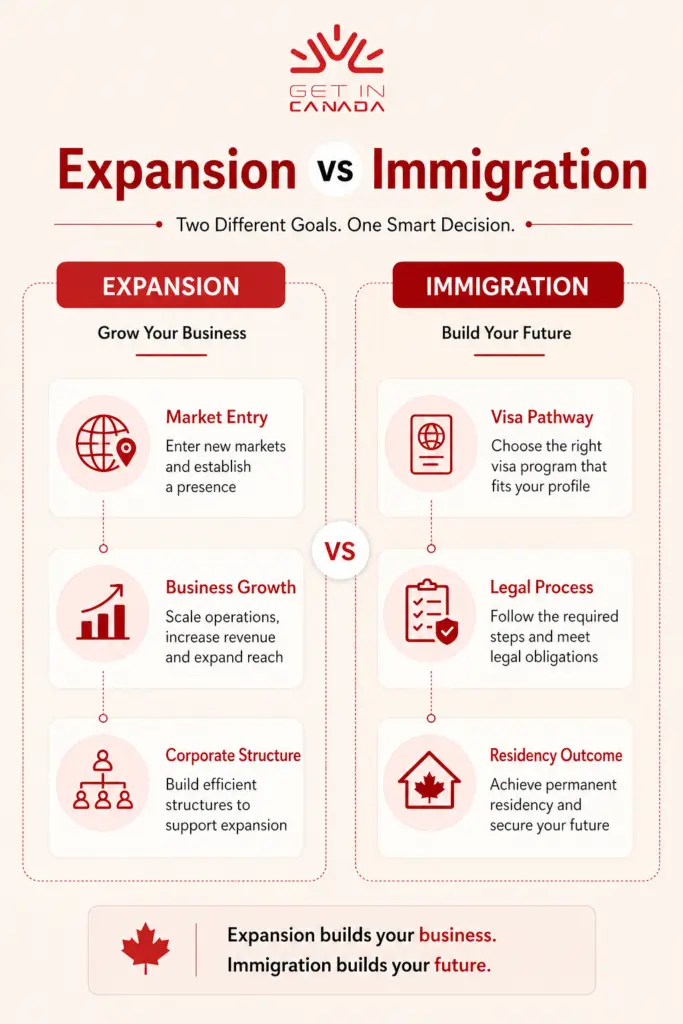
Business expansion is about profitability, market fit, and operations. Immigration is about eligibility, documentation, and long-term commitment to Canada’s economy. Yes, they can overlap—but they don’t automatically guarantee each other.
If you understand this distinction early, you’ll approach Canada with a much clearer, more strategic mindset.
If you’re unsure which path fits your situation, getting a professional assessment early can save you time and costly mistakes.
Why is Canada a popular destination for immigrants?
Canada has built its reputation as one of the most welcoming countries for immigrants, and that’s not just marketing—it’s policy.
Some of the main reasons include:
- A structured and transparent immigration system
- High quality of life and public services
- Access to free healthcare and strong education
- A diverse, multicultural society where newcomers can integrate more easily
Cities like Toronto and Vancouver are known for their diversity, making them especially attractive for international founders and families.
What is the entrepreneur route in Canada?
Canada offers several business immigration pathways, but the most recognized one is the Start-Up Visa Program.
This program is designed for entrepreneurs who can:
- Build an innovative business
- Create jobs for Canadians
- Compete globally
To qualify, you typically need:
- A qualifying business idea
- Support from a designated Canadian investor or incubator
- Proof of funds to settle in Canada
- Language proficiency
It’s important to understand that this is not a “buy your way in” program. Your business must be viable and scalable.
This is where many founders struggle—understanding whether their business actually qualifies. Getting expert guidance early can prevent costly rejections.
Who are the top 3 immigrants in Canada?
Canada is home to millions of successful immigrants, and many have become globally recognized figures. A few well-known examples include:
- Elon Musk (lived in Canada before moving to the U.S.)
- Michaëlle Jean (born in Haiti)
- Jim Pattison (one of Canada’s most prominent entrepreneurs, though Canadian-born, represents the scale immigrants often aim for)
The broader point: Canada has a strong track record of enabling immigrants to succeed at high levels.
What is the new immigration plan in Canada?
Canada updates its immigration targets regularly through multi-year plans. The current direction focuses on:
- Increasing the number of skilled workers
- Supporting economic growth through targeted immigration
- Addressing labor shortages in key sectors
Programs like Express Entry continue to play a central role, with category-based selections becoming more common.
How much money do I need for a Canada startup visa?
There’s no fixed “investment fee” for the Start-Up Visa, but realistically, founders should be prepared for:
- Settlement funds (starting from around CAD $13,000+ for a single applicant, higher for families)
- Legal and application costs
- Business development and operational expenses
In practice, many entrepreneurs budget CAD $50,000 to $150,000+ depending on the nature of the business and support requirements.
Can I get PR if I open a business in Canada?
Opening a business alone does not guarantee permanent residency.
Canada separates business ownership from immigration eligibility. To obtain PR, you must qualify under an official immigration program such as:
- Start-Up Visa Program
- Express Entry
- Provincial Nominee Programs (PNPs)
Without meeting program criteria, simply owning a company will not lead to PR.
This is one of the most common and costly mistakes. Many founders invest without a clear immigration strategy—something a proper consultation can clarify from day one.
Who owns 90% of Canada?
This is a common misconception. Roughly 90% of land in Canada is publicly owned, often referred to as “Crown land.”
This land is managed by federal or provincial governments, not private individuals. For business owners, this mainly matters in industries like natural resources, energy, and large-scale development.
What are some important things to know about Canada as a country?
Before expanding or relocating, it’s worth understanding a few key realities:
- Canada is geographically massive but relatively low in population
- Weather conditions can impact operations and logistics
- Regulations are strict but transparent
- The economy is stable, but growth can be moderate
It’s a country that rewards patience, compliance, and long-term planning.
What is the UAE investing in in Canada?
The United Arab Emirates has shown growing interest in Canada across several sectors, including:
- Renewable energy
- Real estate and infrastructure
- Technology and innovation
- Logistics and supply chains
These investments reflect confidence in Canada’s long-term economic stability.
Which country invests the most in Canada?
The United States remains Canada’s largest foreign investor by a significant margin.
This is due to:
- Geographic proximity
- Strong trade agreements
- Deep economic integration
For Gulf founders, this also means competing in a market heavily influenced by U.S. businesses.
At this stage, what matters most is clarity—knowing whether you’re entering Canada for business, immigration, or both.
If you’re a Gulf-based entrepreneur, the key takeaway is simple but often overlooked:
Canada is not just an immigration destination—it’s a highly regulated, competitive business environment.
Clarity is the Key to Your Canadian Success
Ultimately, your success in Canada depends on defining your primary “North Star.” If your main objective is residency, your priority must be a rock-solid immigration strategy. However, if your goal is business expansion, your focus should remain on market entry and sustainable profitability.
Trying to pursue both without a clear, professional plan is where most founders lose their time, capital, and momentum. At Get In Canada, we have successfully guided thousands of Gulf-based business owners through their expansion and transition into the Canadian market.
Don’t leave your ambitions to chance. Book a professional consultation today to identify the most effective path forward for your future.