Canada Express Entry Sees 30% Drop in Top CRS Scores
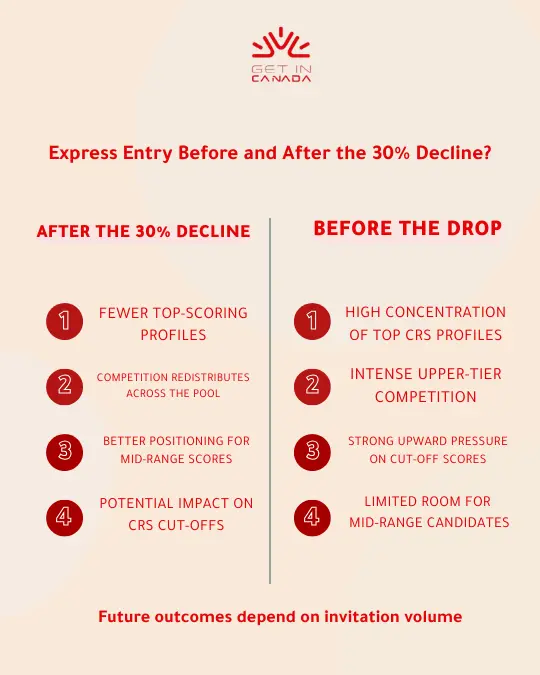
Canada’s Express Entry pool has recorded a 30% decline in the number of top-scoring profiles, a development that could significantly influence future CRS cut-off trends. Because Express Entry functions as a ranking-based immigration system rather than a fixed-threshold model, shifts in score distribution can directly affect how competitive the system feels for candidates applying for an Express Entry visa. In practical terms, fewer profiles in the highest score brackets may reduce upward pressure on cut-offs; however, the real impact depends on how quickly new high-scoring candidates enter the pool and whether IRCC maintains large invitation rounds.
1. How the CRS Score Distribution Shift Changes Canada Express Entry?
When the number of elite CRS profiles decreases, the competitive curve flattens at the top, which can indirectly benefit candidates sitting just below historical cut-off levels. Since selection depends on relative ranking, not absolute eligibility, even a moderate reduction in high-tier scores alters the dynamics inside the pool. That said, this does not automatically translate into lower CRS thresholds in every draw, because invitation volume and draw type still play a decisive role.
Key structural implications include:
- Reduced concentration of 500+ CRS profiles
- Stronger positioning for mid-to-high range candidates
- Increased sensitivity to draw size and frequency
In other words, the pool becomes less top-heavy, and competition redistributes rather than disappears.
2. What Likely Caused the 30% Decline
The drop in top-scoring profiles is most likely cyclical rather than structural weakness. Large invitation rounds remove high-ranking candidates from the pool, while profile expirations and slower inflow of new elite applicants can temporarily thin the upper tier. At the same time, shifts in labour demand and evolving Express Entry Canada requirements may influence the profile strength of incoming candidates. Therefore, the decline reflects rebalancing within Canada’s electronic immigration system rather than a policy overhaul.
Contributing factors may include:
- Recent high-volume ITA rounds
- Exit of invited candidates
- Expiration of older profiles
- Slower entry of new high-CRS candidates
This suggests the change could be temporary unless reinforced by continued large draws.
Book Your Consultation Session →
3. What This Means for Candidates in the Pool
For applicants currently inside the system, the 30% decline presents a potential strategic window. While eligibility rules remain unchanged, ranking dynamics are shifting, meaning candidates in competitive mid-range brackets may find themselves closer to selection. Because the system remains comparative, small improvements can now have amplified impact, especially when fewer profiles dominate the top tier. Reassessing competitiveness using an Express Entry Calculator becomes particularly important in this phase.
Strategic actions candidates should consider:
- Improving language test scores
- Adding additional skilled work experience
- Updating their Express Entry profile promptly
- Monitoring draw types (CEC, PNP, category-based)
In a ranking-based system, timing can matter as much as score strength.
4. Will CRS Cut-Off Scores Drop Next?
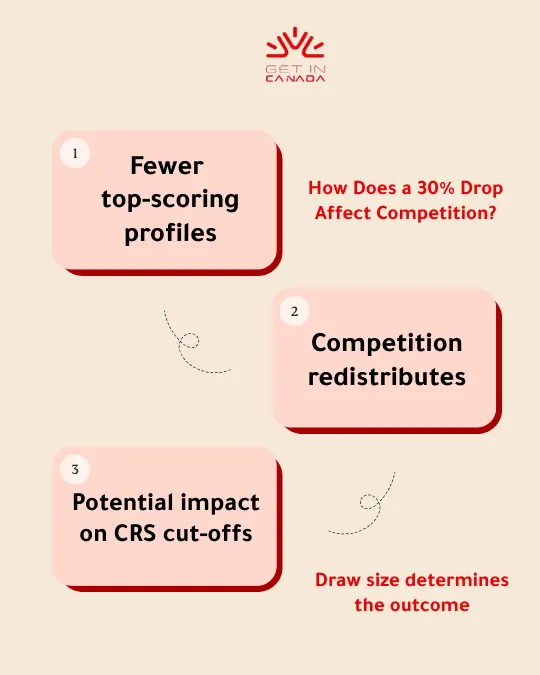
Although a 30% reduction increases the probability of lower CRS thresholds, outcomes ultimately depend on invitation volume and draw strategy. If IRCC continues issuing large rounds of invitations, downward pressure on scores is likely; however, targeted or category-based draws could offset the effect by narrowing the selection pool. Therefore, the next few draws will reveal whether this decline signals a short-term correction or a broader competitive shift.
Score Distribution Snapshot
| Factor | Before Decline | After 30% Decline | Potential Impact |
|---|---|---|---|
| High CRS Profiles (500+) | High concentration | Reduced concentration | Less upward pressure |
| Mid-Range Profiles (470–495) | Strong competition | Improved positioning | Higher competitiveness |
| Draw Size Sensitivity | Moderate | Higher | More volatility in cut-offs |
This evolving distribution reinforces that Express Entry outcomes are shaped by relative positioning rather than static eligibility.
Book Your Consultation Session →
5. Express Entry Structure and Requirements Remain Stable
Despite changes in score concentration, the foundation of the Express Entry visa system remains intact. Candidates must still meet baseline eligibility under federal programs before entering the pool, and Express Entry Canada requirements continue to include skilled work experience, language proficiency, and recognized education credentials. What has shifted is not eligibility, but competition intensity inside the electronic ranking system.
Conclusion
The 30% drop in top-scoring Express Entry profiles highlights how quickly Canada’s immigration landscape can shift. While this change may influence future CRS trends, outcomes will still depend on draw size and pool dynamics. For candidates, staying informed and strategically improving their profile is more important than ever. At Get in Canada, we continue to monitor Express Entry developments closely to provide clear guidance and timely updates. Understanding the system today can make a meaningful difference in tomorrow’s results.