Canada Resumes Low-Wage LMIA Processing in 8 Additional Regions Starting January 9, 2026
Starting January 9, 2026, the federal government will resume processing low-wage Labour Market Impact Assessments (LMIAs) in eight additional regions across Canada after unemployment rates in those areas dropped below 6%.
This is significant under the Temporary Foreign Worker Program (TFWP) because foreign nationals generally cannot apply for or renew a work permit in the low-wage stream unless the employer has a positive or neutral LMIA.
1. Key policy snapshot (as provided)
| Data point | Value |
|---|---|
| Regions reopened | 8 |
| Processing resumes | January 9, 2026 |
| Core threshold | 6% or lower unemployment |
| Valid period | Jan 9 to Apr 9, 2026 |
| Next update expected | April 10, 2026 |
Book Your Consultation Session →
2. The 6% rule: how eligibility is determined
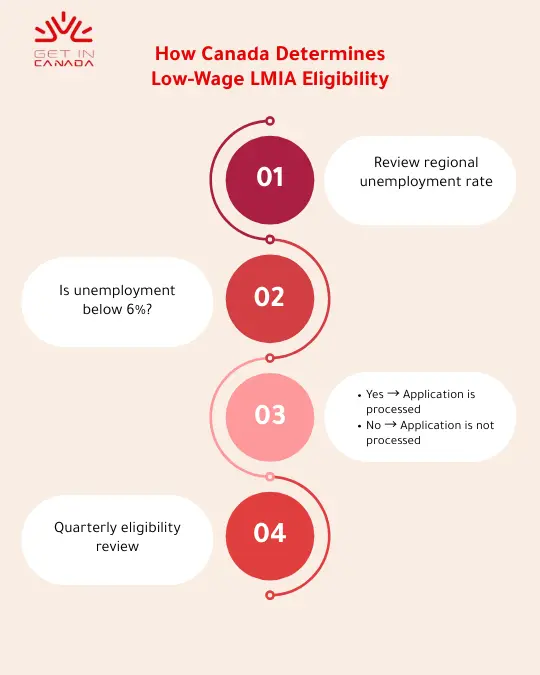
Canada processes low-wage LMIAs only in CMAs where unemployment is 6% or lower.
| CMA unemployment rate | Low-wage LMIA processing |
|---|---|
| Above 6% | Not processed |
| 6% or lower | Processed |
3. What counts as “low-wage” under the TFWP?
A job is considered low-wage if the pay does not:
- meet or exceed 120% of the regional median wage, or
- fall within what the employer pays current employees at that location with the same role and experience,
whichever is higher.
4. Occupation exemptions
Certain occupations are exempt from the freeze, including:
- primary agriculture
- construction
- select front-line healthcare occupations
5. What changed as of January 8, 2026?
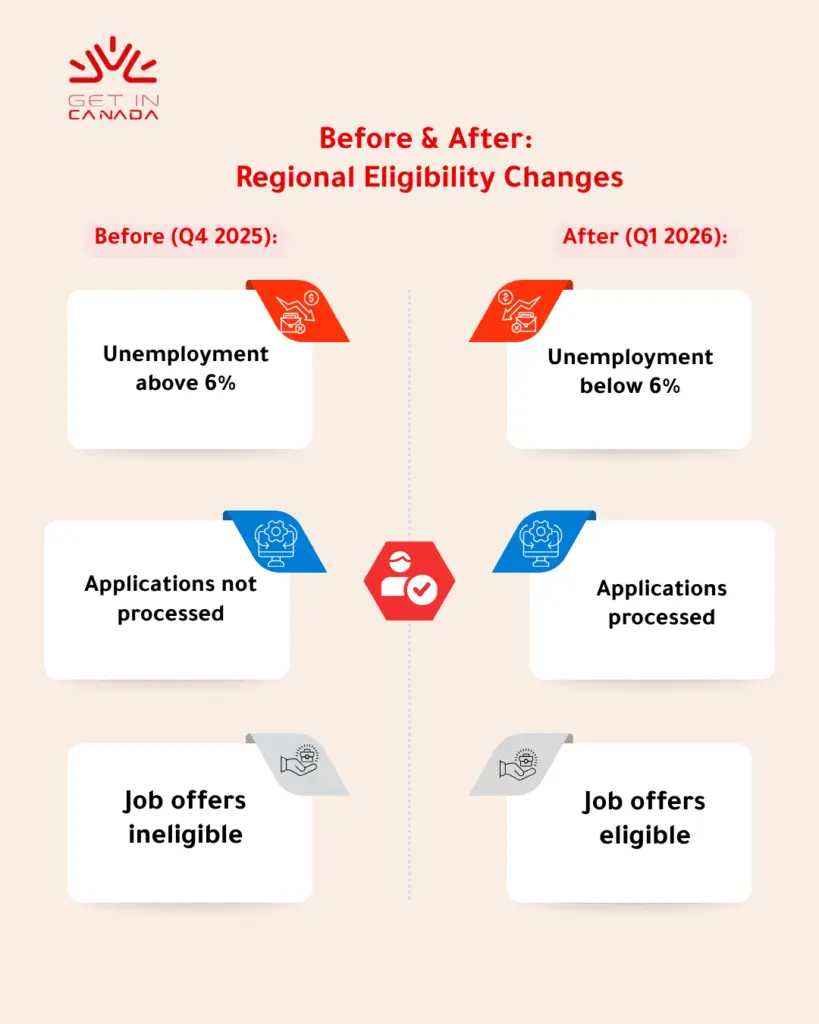
As of January 8, 2026, no new regions were added to the list of areas ineligible for low-wage LMIA processing. However, several regions were removed from the ineligible list after their unemployment rates fell below the 6% threshold, making them eligible again for processing in the first quarter of 2026.
| Region | Unemployment (Before → After) |
|---|---|
| Halifax, NS | 6.1 → 5.2 |
| Moncton, NB | 7.3 → 5.5 |
| Saint John, NB | 7.3 → 5.8 |
| Fredericton, NB | 6.7 → 5.2 |
| Montréal, QC | 6.7 → 5.5 |
| Kingston, ON | 6.6 → 5.6 |
| Winnipeg, MB | 7.3 → 5.7 |
| Vancouver, BC | 6.8 → 5.9 |
Job offers from these regions were ineligible for low-wage LMIA processing in Q4 2025 but are eligible again in Q1 2026.
6. Full ineligible CMA list (as of January 8, 2026)
Low-wage LMIAs will not be processed for applications submitted Jan 9 to Apr 9, 2026 in these CMAs:
| # | CMA | Unemployment (%) |
|---|---|---|
| 1 | St. John’s, NL | 7.1 |
| 2 | Ottawa–Gatineau, ON/QC | 6.8 |
| 3 | Belleville–Quinte West, ON | 10.6 |
| 4 | Oshawa, ON | 8.0 |
| 5 | Toronto, ON | 7.5 |
| 6 | Hamilton, ON | 6.4 |
| 7 | St. Catharines–Niagara, ON | 6.5 |
| 8 | Kitchener–Cambridge–Waterloo, ON | 8.1 |
| 9 | Brantford, ON | 8.5 |
| 10 | Guelph, ON | 7.4 |
| 11 | London, ON | 7.3 |
| 12 | Windsor, ON | 7.1 |
| 13 | Barrie, ON | 8.7 |
| 14 | Greater Sudbury, ON | 6.0 |
| 15 | Regina, SK | 6.3 |
| 16 | Lethbridge, AB | 7.2 |
| 17 | Calgary, AB | 6.3 |
| 18 | Red Deer, AB | 8.9 |
| 19 | Edmonton, AB | 6.9 |
| 20 | Kelowna, BC | 8.5 |
| 21 | Kamloops, BC | 6.6 |
| 22 | Chilliwack, BC | 7.3 |
| 23 | Abbotsford–Mission, BC | 6.4 |
| 24 | Nanaimo, BC | 6.3 |
7. Why the policy exists (August 2024 background)
In August 2024, the government announced it would stop processing low-wage LMIA applications in CMAs with unemployment 6% or higher to encourage employers to hire eligible local workers.
Since then, Canada has published a quarterly CMA unemployment list to clarify where low-wage LMIA processing will not be available.
Book Your Consultation Session →
8. Options if your job offer is in an impacted CMA
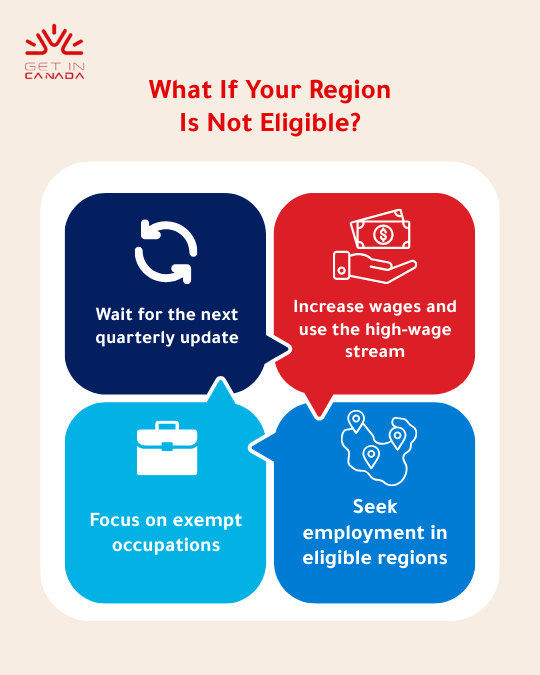
If a job offer is located in a census metropolitan area with an unemployment rate of 6% or higher, both employers and foreign workers should reassess their options before applying. These may include adjusting wages to qualify under the high-wage stream, focusing on exempt occupations, or waiting for the next quarterly update when regional eligibility may change.
8.1 For employers
If unemployment is 6% or higher, employers may:
- increase wages so the position falls under the high-wage stream, or
- wait three months for the next quarterly update.
8.1.1 New wage thresholds (CAD)
If wages meet or exceed the threshold below (in the province/territory of employment), the employer must apply under the high-wage stream:
| Province/Territory | New wage threshold (CAD) |
|---|---|
| Alberta | 36.00 |
| British Columbia | 36.60 |
| Manitoba | 30.16 |
| New Brunswick | 30.00 |
| Newfoundland and Labrador | 32.40 |
| Northwest Territories | 48.00 |
| Nova Scotia | 30.00 |
| Nunavut | 42.00 |
| Ontario | 36.00 |
| Prince Edward Island | 30.00 |
| Quebec | 34.62 |
| Saskatchewan | 33.60 |
| Yukon | 44.40 |
8.2 For foreign nationals
Foreign nationals can:
- focus on exempt occupations (primary agriculture; construction; food manufacturing; hospitals; nursing/residential care; certain in-home caregiver roles; PR-support only roles; short-duration roles ≤120 days if criteria are met), or
- target CMAs where low-wage LMIAs are still processed.
8.3 Status and work continuity notes
- Workers who lose status because work permits cannot be extended must stop working; they may apply for a visitor record.
- Some may be able to start working for a new employer while an application is being processed if they meet certain criteria.
9. How to confirm whether your job location is in an impacted CMA
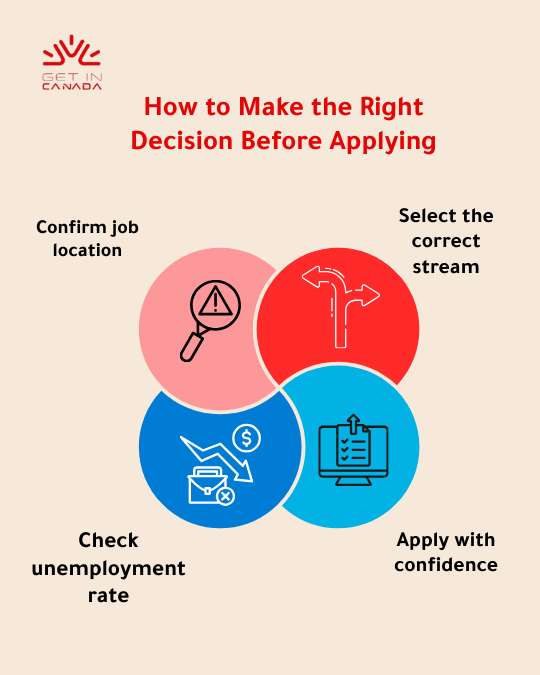
To confirm whether a job location is in an impacted region, the full worksite postal code should be verified against the official list of Census Metropolitan Areas. This step is essential before submitting an application to avoid processing delays or refusals.
- Visit the Census of Population website
- Enter the full postal code of the work location
- Check “Census metropolitan area / Census agglomeration”
- If it shows a CMA, compare it with the ineligible list above
- If no CMA is listed, the job location remains eligible under this mechanism
10. Conclusion
This update reflects Canada’s data-driven approach to managing the labour market, where regional eligibility is adjusted based on real economic indicators. For both employers and foreign workers, closely monitoring these changes and verifying regional eligibility before applying is essential to avoid delays and to make well-informed decisions that align with current policies.
Key takeaways:
- Low-wage LMIA processing has resumed in 8 regions starting January 9, 2026, as unemployment rates fell below 6%.
- 24 census metropolitan areas remain ineligible for low-wage LMIA processing between January 9 and April 9, 2026.
- The next official update is scheduled for April 10, 2026, and may alter regional eligibility.
- Transitioning to the high-wage stream remains a direct option for employers who meet the updated wage thresholds by province or territory.