Canada’s Job Market Outlook for 2026: Where Are the Opportunities
Canada’s 2026 Job Market: A Quick Snapshot
Labour market forecasts suggest that Canada will continue to face strong demand for talent in 2026, driven by digitalization, demographic change, and infrastructure projects. This environment creates real opportunities for newcomers and international graduates, but it also raises the bar in terms of what employers expect from candidates. Understanding these expectations now can help you choose the right study path, training, or immigration program before you arrive; or before you change your status in Canada.
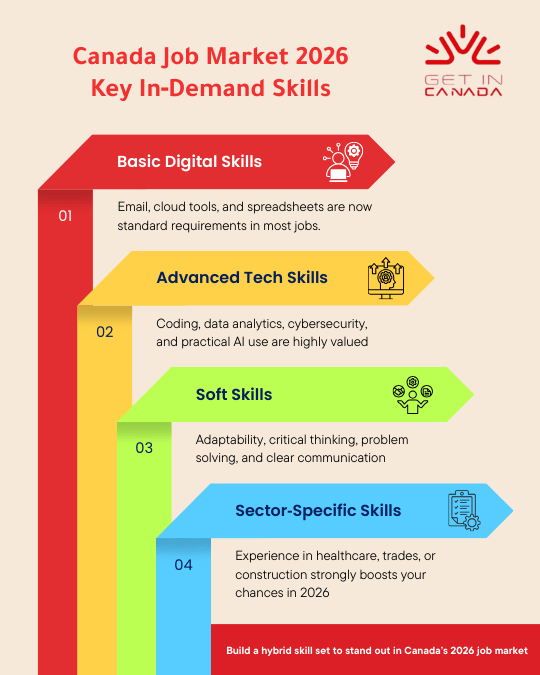
| Category | Examples of in‑demand skills | Why they matter in 2026 Canada |
|---|---|---|
| Basic digital skills | Email, cloud tools, Excel, dashboards | Most jobs now require comfort with everyday tech. |
| Advanced tech skills | Coding, data analytics, cybersecurity, AI tools | Ongoing shortages in digital and tech roles. |
| Soft skills | Adaptability, critical thinking, communication, teamwork | Employers want problem‑solvers, not task followers. |
| Sector‑specific | Healthcare, trades, construction, elder care | Demographics and housing projects drive demand. |
Book Your Consultation Session →
1. Why a Skills‑Focused Strategy Matters in 2026
Instead of hiring purely on degrees or job titles, many Canadian employers are shifting toward skills‑based hiring, asking: “What can this person actually do for our organization?”. This shift highlights the gap between formal credentials and real‑world capabilities, often referred to as the “skills gap”. For newcomers, being able to translate past experience into clear skills (e.g., customer service, data analysis, project coordination) is critical to standing out in applications and interviews.
2. Key Technical Skills in Demand in Canada 2026
Canada’s growing reliance on digital tools means that technical skills are no longer optional add‑ons but core components of employability in many roles. Even jobs that used to be more manual or paper‑based now rely on software systems, online platforms, and remote collaboration tools.
Core Digital Literacy and Everyday Tech Skills
Core digital literacy refers to the practical ability to work effectively in a modern, tech‑enabled environment. It typically includes:
- Managing professional email, calendars, and online meetings.
- Working with shared cloud folders and collaboration platforms.
- Using spreadsheets to track tasks, budgets, or customer data.
These capabilities are expected in office administration, customer support, sales, logistics, and many entry‑level positions across sectors.
Advanced Tech Skills and AI Awareness
Advanced tech skills tend to be associated with higher earning potential and strong job security. In 2026, hot areas include:
- Software and application development.
- Data analytics and business intelligence.
- Cybersecurity and network protection.
- Practical use of AI tools to automate tasks, generate insights, or support decision‑making.
You don’t need to be a deep technical expert to benefit; even a basic understanding of how these technologies affect your industry can help you position yourself as forward‑thinking and adaptable.
3. Soft Skills Canadian Employers Value Most
While technical skills get your profile noticed, soft skills often determine whether you are hired, promoted, or trusted with more responsibility. Employers in Canada consistently report that they struggle to find candidates who combine technical ability with strong interpersonal and problem‑solving skills.
Adaptability and Lifelong Learning
Workplaces in Canada are becoming more dynamic, with hybrid models, shifting tools, and changing customer expectations. Adaptable employees—those who can adjust quickly, learn new tools, and contribute in different roles are seen as long‑term assets.
Examples of adaptability and learning mindset:
- Volunteering to learn a new software system instead of resisting change.
- Regularly taking short courses or internal trainings to keep skills current.
- Responding constructively to feedback and using it to improve your performance.
Critical Thinking, Problem Solving, and Communication
These three skills appear at the top of almost every “future of work” skills report.
- Critical thinking: evaluating information rather than accepting it at face value.
- Problem solving: taking initiative to propose solutions when issues arise.
- Communication: expressing ideas clearly and listening actively to others.
In multicultural Canadian workplaces, being able to explain your reasoning and understand different perspectives is particularly valuable.
Book Your Consultation Session →
4. Sectors Expected to Keep Hiring in 2026
The Canadian job market is not uniform; some sectors face intense competition, while others struggle to find enough qualified workers. Knowing where demand is strongest helps you prioritize your training and immigration strategy.
Healthcare and Social Services
Healthcare remains one of the most critical areas of labour shortage due to aging demographics and rising service needs.
In‑demand roles include:
- Registered and practical nurses.
- Personal support workers and caregivers.
- Allied health professionals and mental health practitioners.
These jobs require technical competence, but also emotional resilience, empathy, and clear communication with patients and families—qualities many newcomers naturally possess.
Skilled Trades and Technical Occupations
Canada’s plans for housing, infrastructure, and green transitions rely heavily on skilled trades.
High‑demand trades include:
- Electricians, HVAC technicians, and plumbers.
- Automotive service technicians and mechanics.
- Carpenters, equipment operators, and construction labourers.
For those who prefer hands‑on work, these careers can provide strong wages, stable employment, and pathways to self‑employment or small business ownership.
5. How Immigrants and Students Can Prepare for Canada’s 2026 Job Market
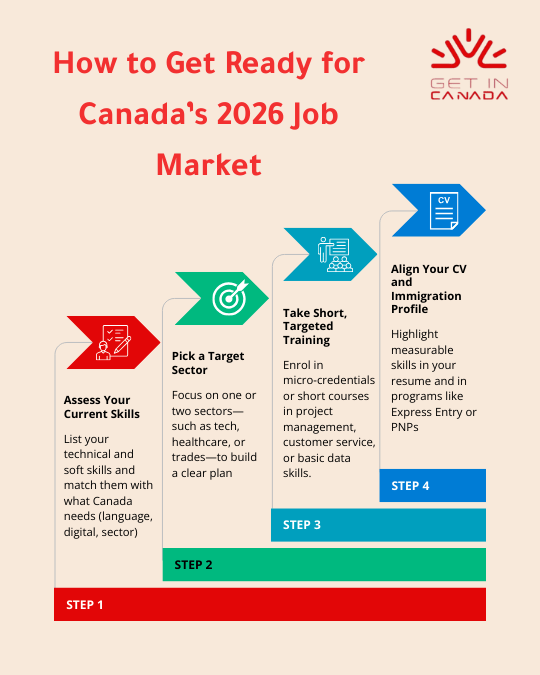
The key is to convert labour market insights into a concrete, time‑bound plan for developing your profile over the next 1–2 years.
Building a Hybrid Skill Profile
A hybrid skill profile combines:
- One or two technical or digital skills tied to your target field (e.g., accounting software, CRM tools, basic SQL, or Excel).
- One or two standout soft skills that you can clearly demonstrate (e.g., client communication, team leadership, or conflict resolution).
This combination makes you more flexible and attractive to employers and may align better with skills‑based immigration assessments.
Investing in Short, Practical Training and Micro‑Credentials
Short programs are a powerful way to quickly close specific skills gaps without committing to a multi‑year degree.
Examples of strategic training for 2026:
- Introductory project management or Agile fundamentals.
- Customer experience and service excellence courses.
- Foundations of data analysis or AI tools for non‑technical professionals.
- Sector‑specific certificates in healthcare support, trades safety, or specialized software.
Employers often view these micro‑credentials as proof of initiative and up‑to‑date knowledge.
6. Conclusion: Turning 2026 Labour Trends into a Personal Advantage
Canada’s 2026 job market outlook is not just abstract data—it is a roadmap you can use to shape your next steps. By identifying the skills that will matter most in your target sector and actively developing them now, you can arrive in Canada—or move forward within Canada—better prepared and more competitive.
Get In Canada can support you by:
- Connecting your skills and goals with in‑demand occupations in current immigration streams.
- Helping you choose study paths or short programs that strengthen both your immigration profile and employability.
- Guiding you in reading and using labour‑market information to make smarter career decisions in 2026 and beyond.