Express Entry Canada 2026 Draw Updates and CRS Score Guide
Last updated: January 20, 2026
Express Entry remains Canada’s primary selection system for skilled immigration. In 2026, the most important metrics for candidates are the draw type, the number of Invitations to Apply (ITAs) issued, and the minimum CRS cut-off score required to receive an ITA. This article summarizes the latest 2026 draw results and explains how CRS works plus practical steps to improve your score.
1. Latest Express Entry Canada 2026 Draw : January 20
IRCC conducted the third Express Entry draw of 2026 on January 20, 2026, targeting Provincial Nominee Program (PNP) candidates. The draw issued 681 ITAs, with a minimum CRS score of 746.
Tie-breaking detail (important): To be considered, candidates needed to have created their Express Entry profile before 4:09 a.m. UTC on November 19, 2025.
Book Your Consultation Session →
2. Express Entry 2026 Draws So Far (Year-to-Date)
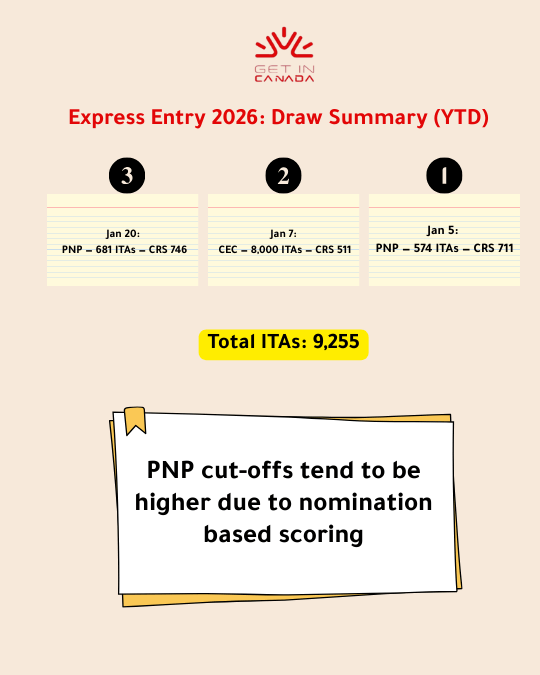
Based on the published draw summary, IRCC has held three draws in 2026 up to January 20:
| Draw Date (2026) | Draw Type | ITAs Issued | CRS Cut-off |
|---|---|---|---|
| January 20 | PNP | 681 | 746 |
| January 7 | Canadian Experience Class (CEC) | 8,000 | 511 |
| January 5 | PNP | 574 | 711 |
Total ITAs issued in 2026 (as of Jan 20): 9,255 across CEC and PNP draws.
3. What the 2026 Draw Pattern Suggests
Early 2026 activity indicates ongoing prioritization of:
- Candidates nominated by provinces (PNP).
- Candidates with Canadian work experience (CEC).
It is normal for PNP draws to show higher CRS cut-offs because PNP candidates typically benefit from substantial additional points compared to non-nominated candidates, making the PNP cut-off look significantly higher than CEC cut-offs.
4. What Is the CRS Score?
The Comprehensive Ranking System (CRS) is the points-based method used to score and rank candidates in the Express Entry pool. It assesses factors such as:
- skills.
- education.
- language ability.
- work experience.
- other selection factors.
CRS scores are calculated out of 1,200 points, and cut-off scores can vary from one round to the next depending on IRCC’s draw strategy and pool composition.
5. What Is the Tie-Breaking Rule?
When multiple candidates have the same CRS score at the cut-off, IRCC applies a tie-breaking rule based on the date and time candidates submitted their Express Entry profiles.
This is why draw results often include a precise “profiles created before” timestamp (as seen in the January 20, 2026 draw).
6. Important 2026 CRS Update: Job Offer Points Removed (Still Matters for Eligibility)
As of March 25, 2025, IRCC removed CRS points for job offers for current and future Express Entry pool candidates (previously 50 or 200 points depending on occupation group).
However, a valid job offer can still matter for program eligibility in certain situations (for example, parts of FSW/FST criteria and some provincial streams), so candidates should still include job-offer details in their profiles when applicable.
Book Your Consultation Session →
7. Why CRS Cut-Off Scores Rise or Fall
CRS cut-offs in 2026 can shift based on:
- Draw type (PNP vs CEC vs other rounds)
- Number of ITAs issued (larger draws may reduce the cut-off over time)
- How many high-scoring profiles are in the pool
- Timing between draws (longer gaps can allow the pool to “refill” at the top)
A single draw is not a reliable predictor; trends across multiple draws are more meaningful.
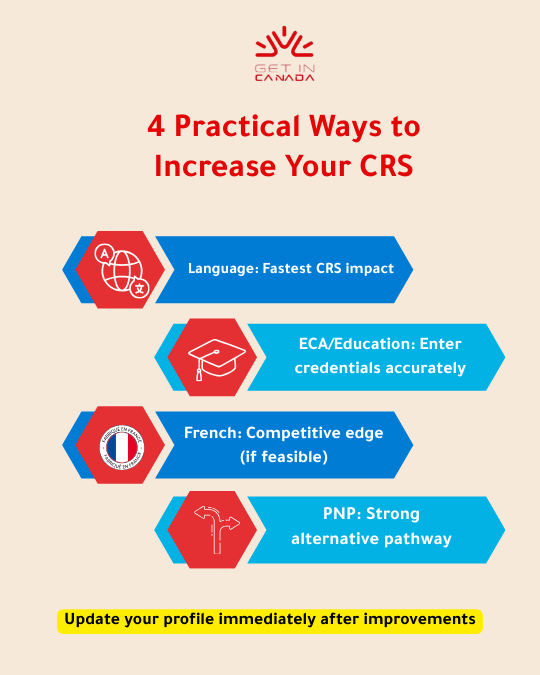
8. How to Improve Your CRS Score in 2026
If your score is below the cut-offs you see in the news, these are practical steps that often make a real difference—either by increasing your CRS or by opening stronger pathways such as PNP.
1) Improve your language score
Why language is the fastest lever
Language is often the most flexible factor because you can improve it faster than education or work experience. Even a small increase can raise CRS and, for some candidates, improve skill-transferability points.
What to focus on
- Identify your weakest skill (often listening or writing).
- Plan a structured retake rather than relying on a single attempt.
- Consider French only if it fits your time and capacity.
Common mistakes
- Taking the test without a study plan.
- Ignoring one skill that blocks you from reaching a key benchmark.
- Delaying a retake when a small increase could change your ranking.
2) Confirm and enter your ECA accurately
Why candidates lose points on education
Many candidates lose CRS due to profile-entry errors or because their ECA does not clearly reflect their highest completed credential in the way they entered it.
What to double-check
- Your profile education details match the ECA wording and outcome.
- You claim your highest completed credential (not incomplete studies).
- Dates and credential types are consistent across the profile.
Common mistakes
- Selecting the wrong credential level in the drop-down list.
- Forgetting to include an additional completed credential.
- Entering inconsistent study dates.
Book Your Consultation Session →
3) Consider French (if feasible)
When French is a smart move
French can be helpful if:
- You are close to typical cut-offs and need an extra boost.
- You have the time and background to learn consistently.
- You want to broaden options beyond a single pathway.
How to start realistically
- Set a clear target level for TEF/TCF within a defined timeframe.
- Study on a consistent weekly schedule.
- If French isn’t realistic, keep your priority on English and PNP strategy.
4) Explore Provincial Nominee Programs (PNP)
Why PNP may be a practical route
If your CRS is far from expected cut-offs, PNP streams may offer a realistic alternative by targeting provincial labour needs—not only general CRS competition.
How to choose the right province
- Match your occupation and experience with provincial criteria.
- Filter streams by your situation (inside/outside Canada, language, education).
- Prepare early—some streams open briefly or run on a first-come basis.
What to prepare in advance
- A Canada-style resume.
- Strong proof of work experience (proper reference letters).
- Valid language results.
- ECA if required for your pathway.
Common mistakes
- Applying randomly without meeting key criteria.
- Weak or non-compliant reference letters.
- Waiting for a program to open before preparing documents.
5) Additional quick actions that help
Update your profile immediately
New language results, added experience, completed education, or marital status changes should be updated as soon as possible.
Review for technical errors
Sometimes the issue is not your real score—but a profile entry mistake that reduces your CRS.
Use a timeline instead of “waiting”
Set a plan like:
- 1 month for language improvement/retake
- 2 weeks to review ECA and education entries
- 1 month for PNP research and document prep
9. Practical Next Steps After Each New Draw
After each draw announcement:
- Compare draw type first, then evaluate CRS cut-off
- Check ITAs issued and draw frequency to understand competitiveness
- Note the tie-breaking timestamp if your CRS matches the cut-off
- Update your profile promptly if you improve language, education, or experience
Conclusion
Express Entry in 2026 is moving quickly, with early draws already spanning CEC and PNP and showing distinct CRS cut-offs by round type. The most effective strategy is to stay draw-aware while actively improving the factors you control; especially language performance, education recognition, and provincial nomination opportunities.