How to Get Canadian PR with a Two-Year College Degree
For many international students, studying in Canada is not the final goal securing Canadian PR is. While longer academic programs are often seen as stronger immigration pathways, a two-year college diploma can be equally effective when integrated into a structured immigration strategy.
Canada’s immigration system rewards preparation, skilled work experience, language strength, and timing. A two-year diploma becomes powerful when aligned with those elements.
1. Understanding How Canadian PR Is Assessed
Before you apply for Canadian PR, it is important to understand how the selection system works. Most graduates transition through Express Entry, which ranks candidates using the Comprehensive Ranking System (CRS).
Your Canada PR points are calculated based on:
- Age
- Education
- Language proficiency
- Canadian skilled work experience
- Additional factors such as provincial nomination
Permanent residence is competitive. Applicants are ranked against one another, and Invitations to Apply (ITA) are issued to the highest-ranking profiles.
The long-term Canada PR benefits include:
- Freedom to live and work anywhere in Canada
- Access to public healthcare
- Free education for children
- A pathway to Canadian citizenship
- Family sponsorship eligibility
Understanding this structure allows you to plan your academic and professional decisions around your PR objective.
Book Your Consultation Session →
2. How a Two-Year Diploma Becomes a Structured PR Pathway
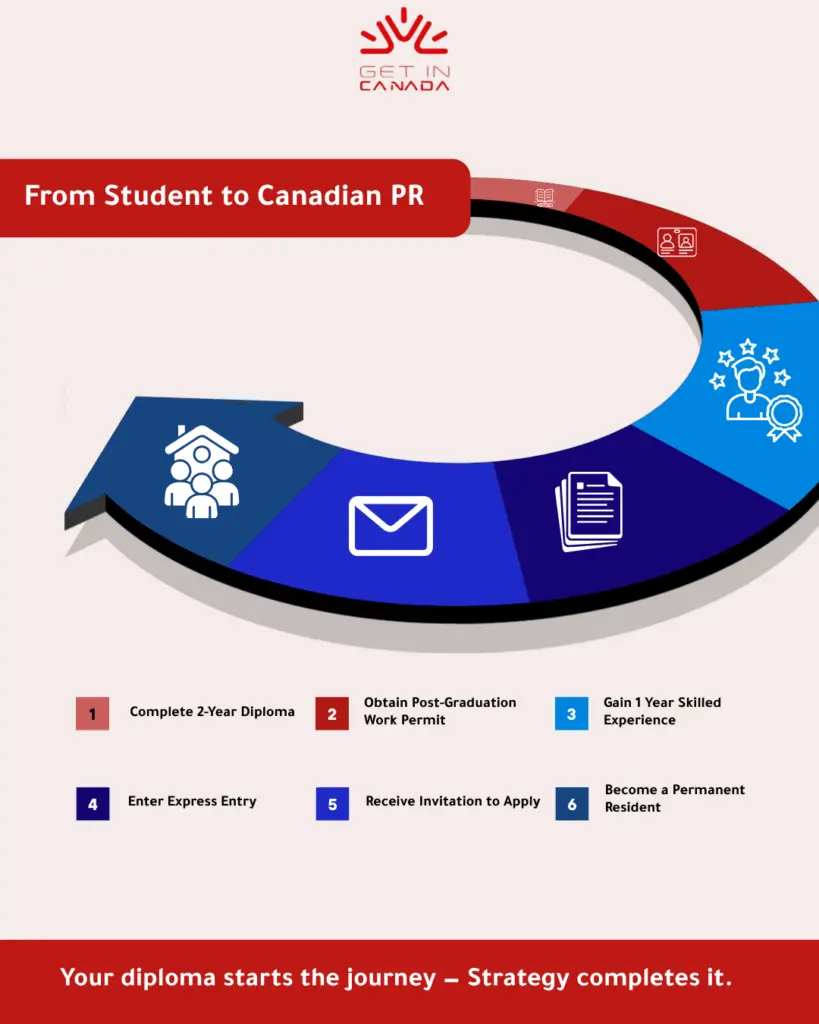
A two-year diploma completed at a Designated Learning Institution (DLI) can qualify you for a Post-Graduation Work Permit (PGWP). This is where the transition from student to immigration candidate begins.
The pathway unfolds through clearly connected stages:
- Step 1: Graduate from a PGWP-Eligible Program
The program must meet eligibility criteria. Without this, your pathway toward Canadian PR becomes limited. - Step 2: Obtain a Post-Graduation Work Permit (Up to 3 Years)
A two-year diploma typically leads to a three-year open work permit, giving you sufficient time to gain qualifying experience. - Step 3: Gain Skilled Canadian Work Experience
At least one year of full-time paid work in a TEER 0, 1, 2, or 3 occupation is required for the Canadian Experience Class. - Step 4: Create an Express Entry Profile
Once eligible, your profile is ranked based on your Canada PR points. - Step 5: Receive an Invitation to Apply and Submit Your Application
Upon meeting the cutoff, you formally submit your PR application for processing.
Each stage strengthens your immigration position. The diploma creates eligibility, but skilled employment creates competitiveness.
Book Your Consultation Session →
3. Canada PR Points and How to Strengthen Your Profile Strategically
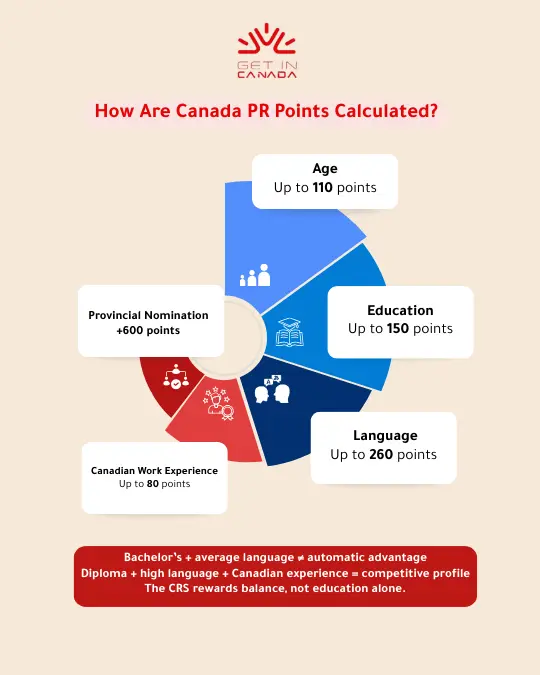
When applying through Express Entry, your Canada PR points determine your ranking among candidates. While education contributes to your score, it is not the only deciding factor. The system evaluates your overall profile, not just your academic level.
Your competitiveness for Canadian PR depends on the balance between age, education, language ability, and Canadian work experience.
3.1 How Canada PR Points Are Calculated
| CRS Factor | Maximum Points |
|---|---|
| Age | 110 |
| Education | 150 |
| Language | 260 |
| Canadian Work Experience | 80 |
| Provincial Nomination | +600 |
A two-year diploma provides fewer education points than a bachelor’s degree, but this gap can be offset by stronger language scores and Canadian experience.
3.2 Why a Two-Year Diploma Can Still Be Competitive
Many applicants assume that a bachelor’s degree automatically guarantees a stronger profile. In practice, candidates with:
- Higher language scores
- Strong Canadian skilled experience
- A provincial nomination
often rank above those with higher academic credentials but weaker supporting factors.
The CRS rewards balance and strategy, not just education level.
3.3 A Practical Example Comparing Two Candidates
Consider two applicants:
Applicant A:
- Bachelor’s degree
- Moderate language scores
- No Canadian work experience
- No provincial nomination
Applicant B:
- Two-year college diploma
- High language scores
- One year of skilled Canadian work experience
- No provincial nomination
In many cases, Applicant B may achieve a higher CRS score despite holding a lower academic credential. This is because language proficiency and Canadian work experience significantly influence overall Canada PR points.
The CRS rewards balance and strategic profile building, not education alone.
3.4 Practical Ways to Increase Your Canada PR Points
Your score is dynamic and can be improved through deliberate action, including:
- Retaking language exams to achieve higher results
- Gaining an additional year of skilled Canadian work experience
- Applying through a Provincial Nominee Program
- Adding French language proficiency
- Securing a qualifying job offer
When a two-year diploma is supported by strong language results and real Canadian experience, it becomes a competitive foundation for obtaining Canadian PR.
4. Canada PR Processing Time and What Influences It
After receiving an Invitation to Apply and submitting a complete file, the Canada PR processing time begins.
| Immigration Stream | Average Processing Time |
|---|---|
| Express Entry | Around 6 months |
| Express-linked PNP | 6–8 months |
| Non-Express PNP | 12+ months |
Processing time is influenced by several practical factors:
- Accuracy and completeness of documentation
- Employment verification clarity
- Security and background checks
- Medical examination timelines
- Overall IRCC workload
A well-prepared application does not accelerate government procedures, but it significantly reduces avoidable delays.
5. Provincial Nominee Programs as a Strategic Reinforcement
When CRS cutoffs are high, Provincial Nominee Programs (PNPs) provide strategic reinforcement.
A provincial nomination adds 600 CRS points to your profile, making an Invitation to Apply highly likely.
Many provinces target graduates in sectors such as:
- Healthcare
- Information technology
- Skilled trades
- Transportation and logistics
- Business and finance
Monitoring PNP criteria while building your Express Entry profile increases flexibility and reduces reliance on fluctuating federal draw scores.
Book Your Consultation Session →
6. Realistically Connecting Study to Permanent Residence
One of the most common mistakes students make is separating study from immigration planning. In reality, the connection between education and Canadian PR must begin before enrollment.
A realistic integration strategy includes:
- Selecting a PGWP-eligible program
- Choosing a field aligned with labor market demand
- Planning language preparation early
- Targeting skilled employment immediately after graduation
- Tracking Express Entry trends during your studies
When education is treated as part of a broader immigration framework, the transition to permanent residence becomes predictable rather than uncertain.
A two-year diploma does not guarantee PR, but when aligned with skilled work, competitive Canada PR points, and strategic timing, it becomes a practical gateway to permanent residence.
Conclusion
Securing Canadian PR with a two-year college diploma is not about finding a shortcut, it is about following a well-planned pathway. While the diploma opens the door through a post-graduation work permit, real progress comes from gaining skilled Canadian work experience, strengthening language results, and understanding how Canada PR points influence your ranking in the Express Entry system. When these elements are aligned, even a shorter academic program can support a strong and competitive immigration profile. Awareness of Canada PR processing time and opportunities such as Provincial Nominee Programs further strengthens this strategy and provides additional pathways toward permanent residence. When education is approached as part of a long-term immigration plan, the transition from international student to permanent resident becomes both structured and achievable. Ultimately, success in obtaining Canadian PR depends less on the length of your studies and more on the clarity of your planning and the strength of each step along the way.