International Students in Canada Must Know These 2 New IRCC Updates (2025–2026)
Canada’s Immigration, Refugees and Citizenship Canada (IRCC) has issued two major updates that every current and future international student must understand. These changes released in December 2025 affect study permit validity and Post-Graduation Work Permit (PGWP) eligibility, with real consequences for planning your education and future in Canada.
1. What the IRCC Updates Are
These updates clarify how IRCC applies rules to international students across different situations. Understanding them is critical to maintaining legal status and future work eligibility.
The updates focus mainly on study permit validity and PGWP eligibility standards.
1.1 Study Permit Validity for Prerequisite & Pathway Programs
IRCC clarified how long your study permit remains valid if you are enrolled in a prerequisite or pathway program such as language training or foundational courses before your main academic program.
Key change:
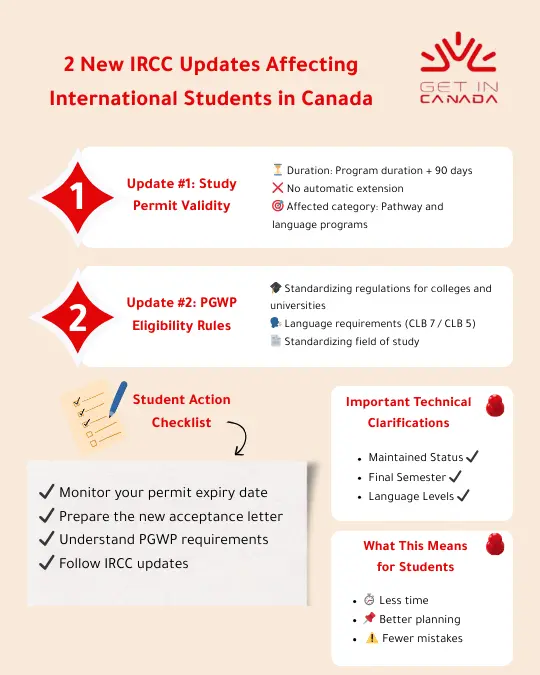
Study permits for prerequisite/pathway programs are now valid only for the duration of the program plus 90 days, not a full extra year as before.
Why this matters:
- You now have less time after completing these programs to secure a new study permit for your main program or to leave Canada.
- This affects students in ESL, FSL, conditional admission, and academic upgrading programs prior to degree or diploma programs.
If you finish your pathway course, you must apply quickly for a new study permit — waiting could lead to loss of legal status in Canada.
Book Your Consultation Session →
2. Major Clarifications to PGWP Eligibility Rules
The Post-Graduation Work Permit (PGWP) is one of the most valued pathways for students to stay and work in Canada after completing studies. IRCC updated how it assesses eligibility and standardized key rules.
2.1 Harmonized Rules for College & University Graduates
Previously, graduates from colleges and universities faced slightly different language and field-of-study checks. IRCC now treats both groups the same in eligibility assessments.
What’s new:
- Language requirements are now uniform for college and university grads.
- Field-of-study eligibility is applied consistently across credentials.
This reduces confusion and unfair differences in PGWP decisions.
3. Important Technical Changes That Matter to Students
In addition to major policy updates, IRCC also clarified several technical rules. These details can directly affect PGWP eligibility and permit renewals.
Students should not ignore these changes, as they impact real-world applications.
3.1 Maintained Status & the 180-Day Rule
If your study permit expires but you applied for a renewal before expiry, you may have maintained status in Canada. IRCC now clearly states that this counts toward PGWP eligibility — including in some tricky scenarios.
3.2 Final Academic Session Definition
IRCC also clarified what counts as your “final academic session” for PGWP purposes — including part-time studies near the end of your program — reducing past confusion in applications.
3.3 Language Requirement Levels
Minimum language levels now formally apply to many PGWP applicants — usually CLB 7 for degrees and CLB 5 for college credentials — unless exempted (e.g., you applied before Nov. 2024).
Book Your Consultation Session →
4. How These Updates Affect Students in Real Life
These IRCC changes have immediate practical consequences for international students. Timelines are tighter, and compliance is more important than ever.
Planning mistakes can now lead to loss of status or missed opportunities.
4.1 Shorter Permit Buffers for Pathway Students
If you are studying in a preparatory or pathway program, you now have only 90 days after completion to:
- Submit a new permit application
- Get a letter of acceptance for your next program
- Apply for an extension
- If you miss this window, you could lose status.
4.2 Clearer PGWP Rules = Better Planning
The new harmonized standards help students from different institutions understand exactly what’s needed to qualify for a PGWP — including language and field requirements.
5. Additional IRCC Trends
These updates come at a time when Canada is tightening international student policies for wider economic and social planning:
- Canada has reduced the number of study permits overall to manage housing and services pressure.
- International student arrivals dropped significantly in 2025.
- Provincial allocation caps now influence how many permits each region can issue.
6. Key Takeaways for Students
International students must now be more proactive and organized. Missing deadlines or misunderstanding rules can have serious consequences.
- Plan ahead. Don’t wait until your permit is about to expire.
- Understand program differences. Prerequisite permits are no longer as long.
- Know your PGWP rules. Language and credential standards now apply across the board.
- Stay informed. IRCC continues to refine its guidance; always check official updates.
7. Action Checklist Before You Apply
This checklist helps students stay compliant and avoid unnecessary risks. Completing these steps early can protect your future plans.
- Confirm your program type (pathway vs main credential)
- Track your study permit expiry and start renewal early
- CheckPGWP eligibility before graduation
- Save communication from your institution and IRCC for proof
Conclusion
IRCC’s December 2025 updates bring both stricter timelines and clearer eligibility rules for international students. While tighter schedules mean less room for delay, the clarifications; especially around the PGWP can benefit careful planners. Staying informed and proactive is key to successfully studying and building your future in Canada.