IRCC Changes How Canada’s Immigration Processing Times Are Calculated
About the Update
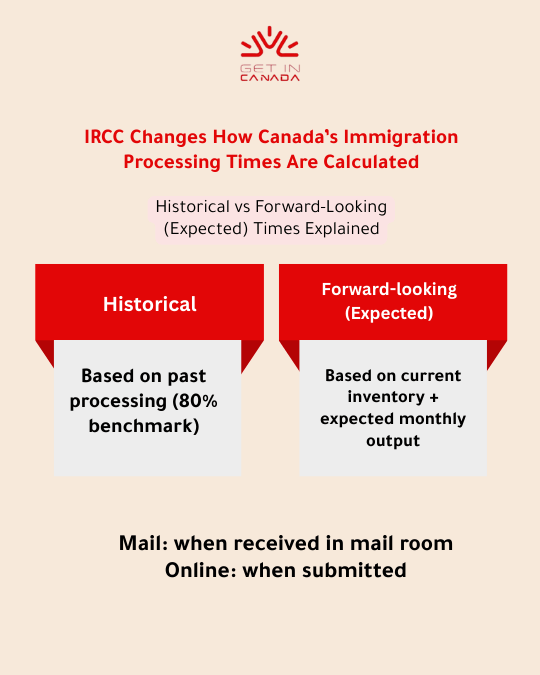
IRCC has clarified that processing times are not all calculated the same way. Most remain historical, but certain immigration and citizenship application types now display forward-looking (expected) processing times.
This update matters because it changes how applicants should interpret the number they see online and how they build realistic timelines around submission, travel, work, and supporting documents.
1. What IRCC Counts as “ Immigration Processing Time ”
IRCC defines processing time as the period that starts when IRCC receives your complete application and ends when IRCC makes a decision.
This is a definition issue as much as it is a timeline issue: applicants often count from the day they begin preparing their file or send documents, but IRCC’s “clock” starts only at receipt/submission of a complete application.
- Starts: the day IRCC receives your complete application
- Ends: the day IRCC makes a decision
Book Your Consultation Session →
2. Historical Processing Times (The 80% Benchmark)
IRCC states that most processing times are historical, meaning they are based on how long it took IRCC to process 80% of applications in the past. 2
This method is best understood as a backward-looking benchmark: it reflects past performance for that application type and can change as past processing outcomes change.
3. Forward-Looking (Expected) Immigration Processing Times
IRCC introduced forward-looking (expected) processing times for certain categories on May 1, 2024.
Instead of relying primarily on historical completion times, IRCC calculates forward-looking estimates using two operational inputs:
- the total number of that application type IRCC has to process.
- the amount IRCC expects to process every month.
4. Application Types That Use Forward-Looking Processing Times
IRCC specifies which categories display forward-looking (expected) processing times. If your application falls under one of these, the posted time is intended to reflect current inventory and expected monthly throughput rather than only historical performance.
The application types showing forward-looking Immigration processing times are:
- Canadian Experience Class (Express Entry)
- Provincial Nominees Program (Express Entry and non-Express Entry)
- Federal Skilled Workers (Express Entry)
- Quebec skilled workers
- Spouse or common law partner (living inside or outside Canada)
- Parents or grandparents
- Citizenship grants
- Citizenship certificate (proof of citizenship)
5. When IRCC Starts Counting Your Processing Time (Submission Method Matters)
IRCC uses different start points depending on how you submit. This is a practical detail that can materially change how applicants interpret “time already waited,” especially when comparing personal timelines to the posted processing time.
5.1Principle to remember
IRCC measures processing time from the point it receives (or you submit) a complete application until it makes a decision.
Accordingly, applicants should anchor their “start date” to IRCC’s stated start point for their submission method, rather than to earlier preparation or shipping milestones.
5.2 If you apply by mail
IRCC states that, for mailed applications, processing time starts when your complete application arrives in IRCC’s mail room.
Operationally, this means:
- The relevant start point is arrival in the mail room, not the date you sent the package.
- Delivery/transit time is outside the official processing-time clock as defined by IRCC.
- When you track your timeline, use the mail-room arrival date (for a complete application) as the baseline for comparing against posted processing times.
5.3 If you apply online or in person
IRCC states that, for online or in-person submissions, processing time starts when you submit your application.
Practically:
- The baseline is your confirmed submission moment (not the date you began completing forms).
- Use the submission date as the anchor when comparing your personal timeline to the processing time shown online.
- Since IRCC ties processing time to receipt/submission of a complete application, accuracy and completeness at submission remain critical for effective planning.
Book Your Consultation Session →
6. What the Update Means for Applicants
The main takeaway is that you should interpret the processing time number through the lens of the calculation method and the submission method. This helps reduce misaligned expectations and supports more accurate planning for follow-on steps and life decisions.
- Do not assume every posted time is calculated the same way. Most are historical, but several major categories are now forward-looking.
- Expect movement over time in forward-looking categories. Because the estimate uses inventory and expected monthly output, it can change as volumes and capacity change.
- Plan around IRCC’s start point. Processing time starts at mail-room receipt for paper applications and at submission for online/in-person applications.
- Prioritize completeness. IRCC’s definition explicitly starts the clock when the complete application is received/submitted and ends at decision.
Conclusion
The key takeaway is that IRCC’s posted processing times are no longer calculated in a single way. Most remain historical (based on how long it took to process 80% of past applications), while certain categories now use forward-looking estimates based on current inventory and expected monthly processing.
To plan accurately, confirm which calculation applies to your pathway, measure your timeline from IRCC’s official start point (mail-room arrival or online submission), and treat the posted figure as a planning benchmark rather than a guaranteed deadline.