Why Do You Need an Immigration Plan B in 2026?
1. Introduction
In a rapidly changing world, immigration to Canada is no longer based on a single clear and stable pathway as it once was. With constant updates in policies, increasing competition, and global political and economic uncertainty, immigration planning has become more complex than ever.
As global tensions rise and stability becomes less predictable in many regions, more people are actively seeking secure alternatives for their future. This is where the concept of an Immigration Plan B becomes essential, giving you the flexibility to adapt and continue your journey without losing opportunities.
2. What Is Plan B and Why Is It Now Essential?
A Plan B is a strategic alternative pathway you can rely on if your primary immigration plan does not work out. However, it is no longer just a backup option, it has become a core part of any successful Canada immigration strategy in 2026.
With frequent changes in immigration rules, stricter eligibility criteria, and evolving program requirements, relying on a single pathway can be risky. For example, combining options like studying in Canada and transitioning into work can significantly increase your chances of success.

Book Your Consultation Session →
3. Why Is Relying on One Plan Risky in 2026?
Recent global developments have shown that conditions can change unexpectedly; whether due to political tensions, economic shifts, or regional conflicts. These changes often directly impact immigration policies and opportunities.
Why Is It Dangerous to Rely Only on Plan A?
Relying solely on one immigration pathway means putting your entire future on a single outcome. If that pathway changes, becomes more competitive, or is paused, you may be forced to start over. On the other hand, having a Plan B allows you to pivot quickly and continue your journey without losing valuable time or effort.
4. Why Are Gulf Residents Considering Immigration Now?
In recent years, there has been a noticeable increase in interest among residents in the Gulf region regarding immigration to Canada. This shift is driven by the search for long-term stability, better quality of life, and future security for families.
Moreover, global uncertainty and evolving job markets have encouraged many individuals to explore more stable and permanent opportunities abroad. As a result, immigration is no longer just an option—it has become part of long-term life planning.
5. When Should You Start Thinking About Immigration to Canada?
The ideal time to start planning your immigration journey is early well before submitting any applications. Waiting until rejection or delays occur can significantly reduce your options.
Early planning allows you to strengthen your profile, improve your language skills, and explore multiple pathways. Additionally, since Canada immigration programs change frequently, having a Plan B from the beginning ensures flexibility and preparedness.
Book Your Consultation Session →
6. Why Is Canada a Strategic Choice for Arab Families?
Canada is considered one of the best destinations for Arab families, not only because of immigration opportunities but also due to its high quality of life. It offers a safe environment, advanced education systems, and strong healthcare services.
Key reasons why Canada is ideal for families:
- High-quality education system
- Advanced healthcare services
- Safety and social stability
- Established Arab communities for easier integration
For this reason, including Canada in your Immigration Plan B is a strategic decision that supports long-term family stability.
7. How to Build a Smart Immigration Plan B
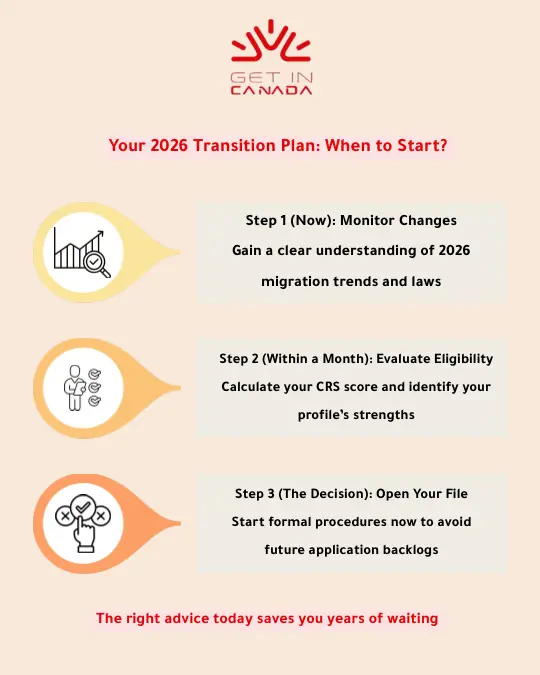
Building a Plan B requires strategic thinking and a clear understanding of your current profile. It is not about applying randomly, but about choosing pathways that align with your qualifications and goals.
Practical steps to build your Plan B:
- Analyze your profile (education, experience, language)
- Select at least two suitable pathways
- Stay updated with immigration policy changes
- Prepare documents in advance
Working with trusted advisors like Get In Canada can also help you make informed and effective decisions.
8. Common Mistakes When Ignoring Plan B
Despite its importance, many applicants still rely on a single pathway, which can lead to missed opportunities if circumstances change.
Common mistakes include:
- Relying entirely on one plan
- Delaying applications
- Ignoring global changes and their impact
- Not following immigration updates
- Making decisions based on outdated information
In today’s fast-changing world, these mistakes can significantly affect your immigration success.
Book Your Consultation Session →
9. What Does Plan B Mean for Your Future?
Having a Plan B is not just about having a backup, it reflects a strategic mindset. In an unpredictable world, preparing for multiple scenarios gives you a strong advantage.
It also provides peace of mind and confidence, as you are no longer dependent on one uncertain outcome. Instead, you are prepared, adaptable, and in control of your journey.
10. Comparison: With vs Without Plan B
| Factor | Without Plan B | With Plan B |
|---|---|---|
| Success Rate | Low | Higher |
| Flexibility | Limited | High |
| Risk Level | High | Lower |
| Adaptability | Weak | Strong |
This comparison clearly shows that having a Plan B is not optional, it is essential for success.
11. Conclusion
awareness, preparation, and the ability to adapt to uncertainty. With global instability, economic shifts, and rapidly evolving immigration policies, relying on a single pathway is no longer a safe option.
Today, success in immigration is not about luck, it is about planning smarter than others. And this is exactly where having an Immigration Plan B becomes your strongest advantage.
A well-structured Plan B is not simply a backup, it is a mindset. It means you are prepared for change, ready to pivot, and in control of your future regardless of external circumstances. While others wait and react, you move forward with clarity and confidence.
So the real question is not “Do you need a Plan B?”
It is: “Can you afford not to have one?”
Start early, plan strategically, and take control of your journeybecause your future in Canada should be built by choice, not by chance.