How to Improve Your Resume for the Canadian Job Market
1. How Do Canadian Employers Actually Read a Resume?
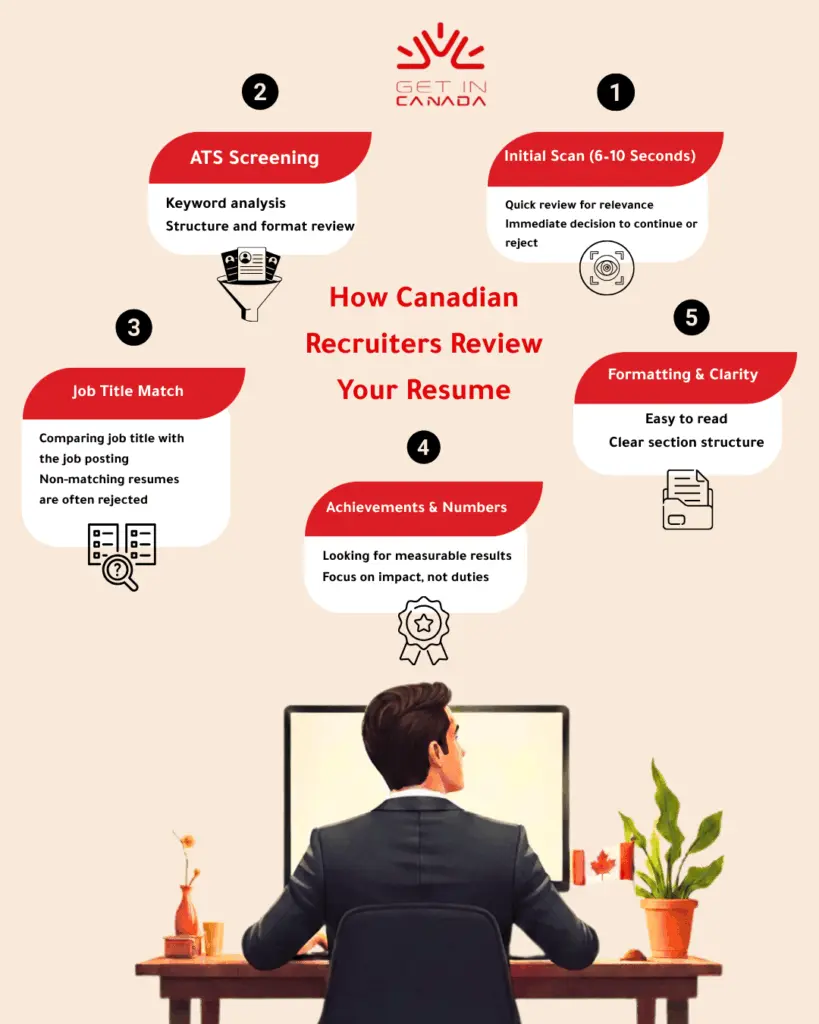
In the Canadian job market, resumes are not read line by line as many candidates assume. Recruiters typically spend 6 to 10 seconds scanning a resume during the first screening. In that short time, they are not looking for your full career story; they are looking for clear signals that you are worth moving forward.
In addition to human review, most Canadian employers; especially medium and large organizations use Applicant Tracking Systems (ATS) to filter resumes before they ever reach a recruiter. This means your resume must be readable both by humans and by software. If it fails either one, it is likely to be rejected automatically.
What recruiters look for in the first 10 seconds:
- A job title that matches the position being advertised
- Clear and easy-to-scan work experience
- Evidence of impact or measurable results
- Clean, professional formatting
2. Why Are Most Immigrant Resumes Rejected in Canada?
One of the biggest reasons for rejection is not lack of experience, but how that experience is presented. Many immigrants have strong professional backgrounds, yet their resumes fail to communicate value in a way that aligns with Canadian workplace culture. In Canada, it is not enough to say what you did employers want to know what difference you made.
Another common issue is reusing a resume from another country without adapting it. What may be considered professional elsewhere long descriptions, excessive detail, or personal information can be seen in Canada as unfocused or unprofessional.
The difference between local experience and transferable experience:
- Canadian experience is not always required
- Your experience must be translated into Canadian terminology
- Skills and results matter more than company names
3. The Canadian Resume Structure: Not a Format, but a Logic
The Canadian resume structure exists for a reason. It reflects how decision-makers think and how quickly they need to access relevant information. Each section of the resume serves a specific purpose in helping the employer decide whether to move forward.
When the structure is unclear or unfamiliar, even strong candidates may be overlooked. A poorly structured resume feels difficult to read, which often leads recruiters to move on. Following the Canadian structure means aligning with how the market evaluates talent, not just how the resume looks.
- It provides a fast snapshot of who you are professionally
- It helps recruiters immediately place your profile
- It determines whether they continue reading
Why achievements matter more than job titles:
- Job titles vary widely across countries
- Achievements demonstrate real value
- Numbers communicate impact faster than descriptions
4. How to Write Work Experience the Canadian Way
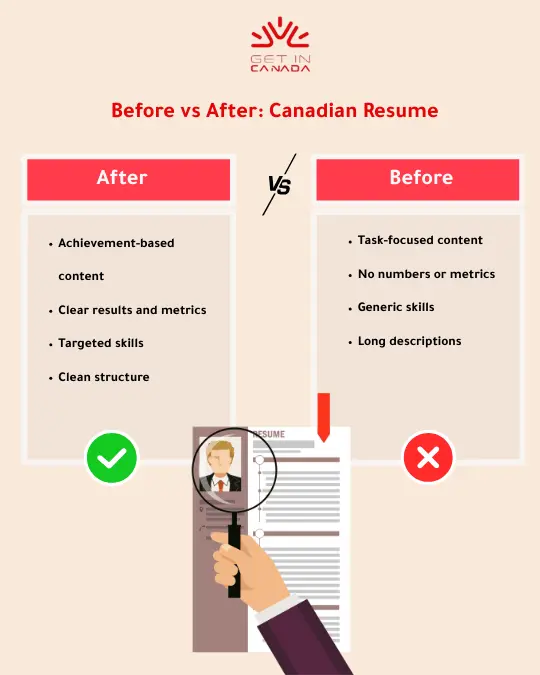
In Canada, work experience is not written as a list of duties, it is written as a record of impact. This shift in mindset is what separates an average resume from a strong one. Employers are less interested in what kept you busy and more interested in what you actually accomplished.
The language should be direct, factual, and results-oriented. Every bullet point should answer one implicit question: Why should we hire you?
The Canadian achievement formula:
- Strong action verb (Led, Improved, Increased)
- What you did
- The result or outcome
- A number or percentage when possible
5. ATS Is Not the Enemy—But Ignoring It Is a Critical Mistake
ATS systems are not designed to judge your talent; they are designed to identify relevance. They scan for keywords, section headings, and formatting before a human ever sees your resume. Many strong resumes are rejected simply because they are not ATS-friendly.
Understanding how ATS works allows you to pass the system without sacrificing clarity or professionalism. The key is balance—write for humans, but structure for systems.
Where keywords should appear:
- Professional summary
- Work experience
- Skills section
- Naturally, without forced repetition
Formatting mistakes that lead to automatic rejection:
- Complex tables
- Multiple columns
- Icons and graphics
- Unsupported file formats
Book Your Consultation Session →
6. What Must Be Completely Removed from a Canadian Resume
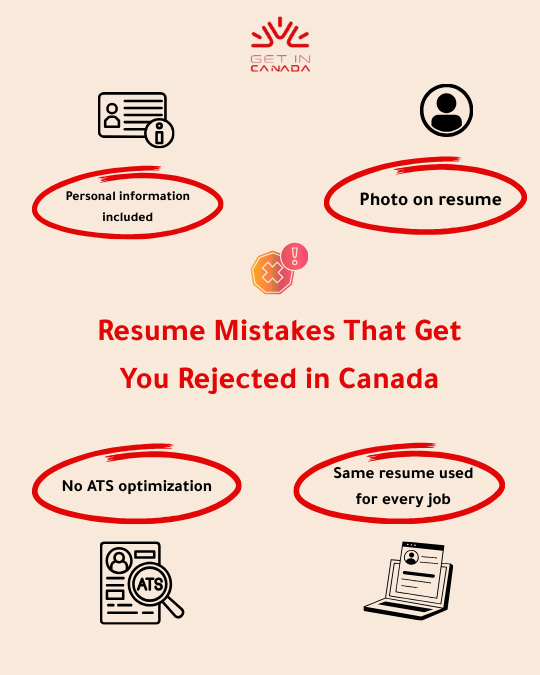
Canadian employment laws and workplace culture are strict about discrimination. Including unnecessary personal information can raise concerns and may cause employers to skip your resume altogether to avoid legal risk.
A Canadian resume should focus only on your professional qualifications. Anything unrelated to your ability to perform the job should be removed.
Information considered red flags in Canada:
- Personal photo
- Age or date of birth
- Marital status
- Religion or nationality
7. Cover Letters in Canada: A Decision-Making Document, Not a Formality
In many hiring processes, the interview decision is influenced as much by the cover letter as by the resume. A strong cover letter answers a critical question: Why are you the right person for this specific role at this specific company?
It is your opportunity to connect your experience to the employer’s needs, demonstrate understanding of the role, and show professional personality, something a resume alone cannot do.
How a strong cover letter connects you to the employer:
- Explains why you are interested in the company
- Links your experience to their challenges
- Clearly states the value you bring
8. Practical Examples: Turning a Resume into a Canadian-Style Resume
Understanding the theory is important, but real clarity comes from examples. Below are common resume sections before and after being adapted to Canadian standards—without changing the actual experience.
Example 1: Work Experience
Before (Traditional):
- Responsible for managing the sales team
- Following up with clients and achieving monthly targets
After (Canadian Style):
- Led a sales team of 5 and increased annual revenue by 22%
- Improved client follow-up processes, increasing customer retention by 18%
Example 2: Professional Summary
Before:
- I have long experience in accounting and am looking for a suitable job opportunity
After:
- Professional accountant with 8 years of experience in financial reporting and tax compliance, reducing accounting errors by 30% and improving operational efficiency
Example 3: Skills Section
Before:
- Communication skills
- Ability to work under pressure
- Computer skills
After:
- Business communication with cross-functional teams
- Deadline-driven performance in fast-paced environments
- Advanced proficiency in Excel and financial reporting tools
9. How Get In Canada Helps You Build a Strong Canadian Resume
Knowing the rules is one thing; applying them correctly is another. This is where Get In Canada provides real value. Instead of generic advice, Get In Canada works hands-on to transform your experience into a resume that speaks the language of the Canadian job market.
Their services are built on a deep understanding of Canadian hiring practices, employer expectations, and ATS requirements.
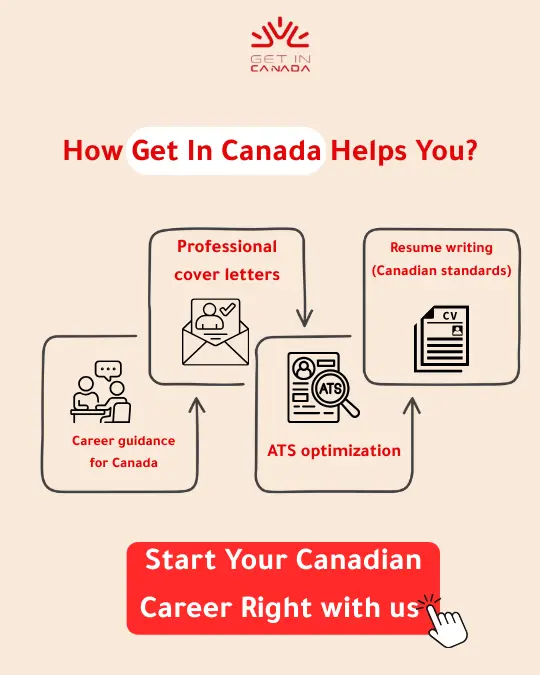
What Get In Canada offers:
- Canadian-standard resume writing and editing
- ATS optimization
- Resume customization by industry and role
- Professionally written, tailored cover letters
- Career consultations for navigating the Canadian job market
Book Your Consultation Session →
10. When Do You Actually Need Professional Help?
Not every job seeker needs the same level of support, but professional guidance becomes essential if:
- You are new to Canada
- You are not getting interviews despite strong experience
- You are changing careers or industries
- You are unsure how to translate your experience for Canada
- Your resume does not reflect your true professional value
In these cases, investing in a professionally written Canadian resume can save months of frustration and missed opportunities.
11. A Canadian Resume Is a Strategic Document
When you understand how recruiters think, write in the language of the market, and present your experience strategically, your resume shifts from being just another application to becoming a strong professional asset.
In Canada, a resume is not a formality; it is a decision-making tool. Every line should serve a single purpose: proving that you are a smart investment for the employer.
12. Final Conclusion and Your Next Step
If you are serious about entering the Canadian job market, do not leave this critical step to guesswork. Working with a team that understands the market; such as Get In Canada can dramatically increase your chances of reaching the right opportunities faster.
👉 Your next step:
Review your current resume, identify the gap between it and Canadian standards, and get professional support to present yourself the way the Canadian job market expects.