When Is a Refugee Claim Ineligible in Canada? Common Cases Explained
1. What does “ineligible refugee claim” mean?
An “ineligible refugee claim” simply means that the individual applying for asylum cannot legally move forward to a full hearing before the Immigration and Refugee Board (IRB). Under Canadian immigration laws, specifically the recent updates under Bill C-12, officers from Immigration, Refugees and Citizenship Canada (IRCC) or the Canada Border Services Agency (CBSA) conduct an initial, rapid screening of the claim. If it is found that the applicant triggers any of the statutory prevention bars, their processing is immediately halted at this administrative stage, depriving them of the opportunity to present their case before a judge.
Book Your Consultation Session →
2. Refusal vs. Ineligibility: What is the difference?
It is absolutely vital for asylum seekers to understand the massive difference between having a claim refused and having it deemed ineligible from the start:
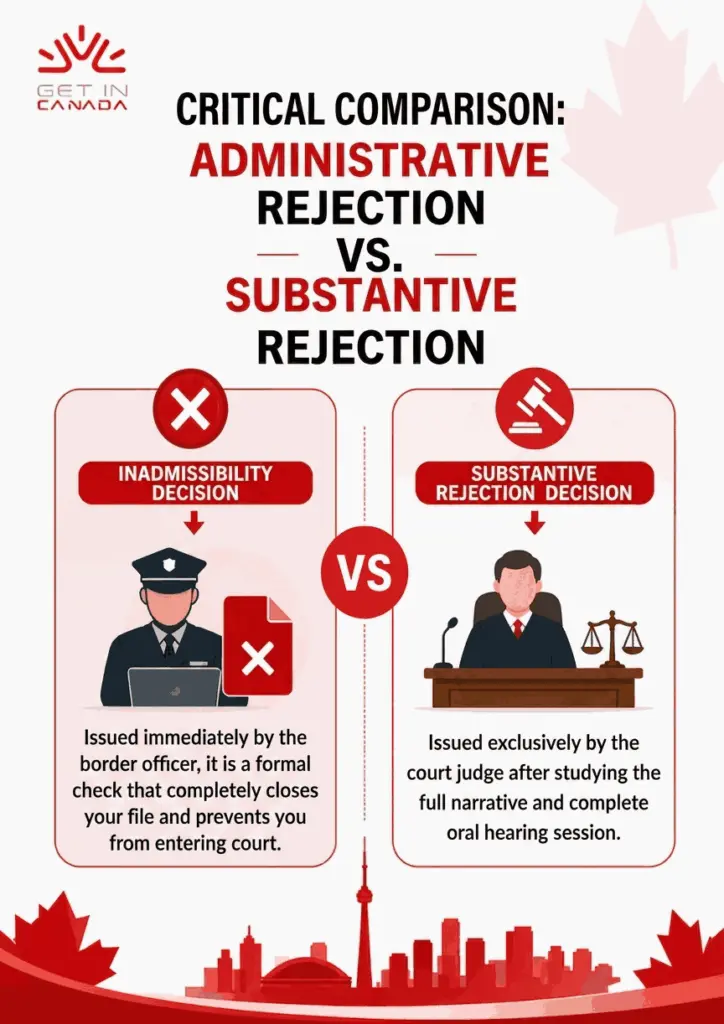
- Ineligible Refugee Claim: This decision is made by immigration or border officers during the initial screening based on procedural conditions (such as missing deadlines or having filed a prior claim in another country). In this case, the file is transferred directly to the CBSA to begin deportation tracking.
- Refused Refugee Claim: This decision is handed down by an independent judge at the IRB tribunal after a full merit-based hearing. The refusal happens because the court is not convinced of a credible, substantive threat to the person’s life in their home country. In this scenario, the applicant retains the right to enter the standard legal appeal system.
3. Who is not eligible to claim asylum in Canada?
Canada generally provides safe haven to individuals fleeing persecution, torture, or risks that threaten their lives. However, the Canadian system strictly bars individuals who have bypassed specific legal avenues, failed to declare prior safety options in other nations, or who present a domestic security threat to the public. Anyone who fails the primary initial administrative assessment is immediately excluded from the stream and cannot access the court.
Book Your Consultation Session →
4. Common reasons for refugee claim ineligibility
Canada has established strict rules to minimize system backlogs and deter exploitation. The most common reasons a claim is found ineligible include:
A- The One-Year Temporal Bar
Under aggressive legislative updates, any refugee claim made more than one year (365 days) after the individual’s first entry into Canada is automatically deemed ineligible. Leaving Canada and re-entering later does not reset this 365-day countdown. (Note: Unaccompanied minors under the age of 18 are officially exempt from this specific rule under a policy enacted in May 2026).
B- The 14-Day Irregular Entry Bar
Claimants who cross the Canada-US land border irregularly (outside official ports of entry) and wait 14 days or longer before presenting their refugee claim are automatically barred from the IRB stream.
C- Prior Claims or Existing Protected Status
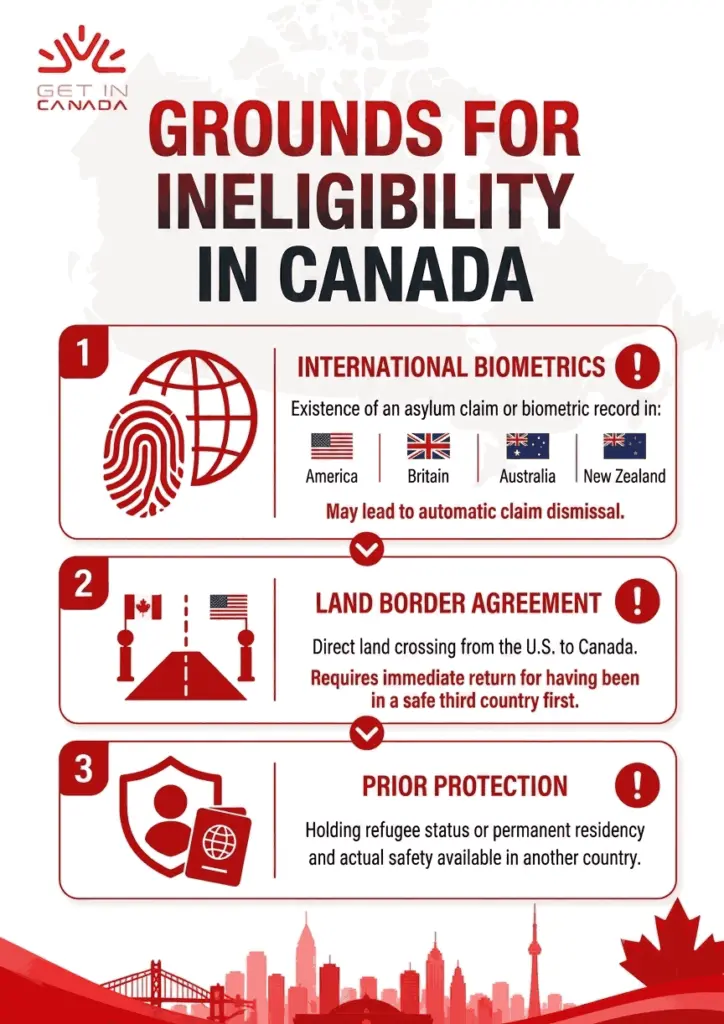
Individuals who have already been granted protected person or Convention refugee status inside Canada cannot file a new claim. Similarly, if a past claim inside Canada was rejected, abandoned, or withdrawn, the individual is permanently barred from applying again.
5. Previous refugee claims in another country
Canada relies heavily on digital and security data-sharing networks with global allies (such as the US, UK, Australia, and New Zealand). If the system reveals that you have previously filed an asylum application in any of these countries, your claim in Canada will instantly be declared ineligible. Additionally, if you have already been formally recognized as a Convention refugee by a third safe country and can legally return there, Canada will not assess your file.
6. Safe Third Country Agreement (STCA) explained
The STCA is a bilateral treaty between Canada and the United States dictating that individuals must request protection in the first safe country they arrive in. This agreement expanded to cover the entire land border, secondary crossings, and adjacent waterways. If you travel through the US and try to claim asylum at a Canadian land border, you will be immediately returned to US authorities, unless you qualify for narrow exceptions (such as having close family members holding legal status in Canada).
7. Criminality and security concerns
Public safety and national security remain absolute red lines in Canada. A refugee claim is immediately rendered ineligible if the applicant is determined to be inadmissible due to serious criminality, organized crime, security threats, or human rights violations. Serious criminality is triggered by an infraction inside Canada carrying a maximum potential prison sentence of 10 years or more, or a foreign offense that would yield an equivalent 10-year maximum sentence under Canadian federal law.
8. What happens if your claim is found ineligible?
Once an ineligibility decision is issued, a fast-moving, structured administrative process begins:
A- Activation of the Removal Order
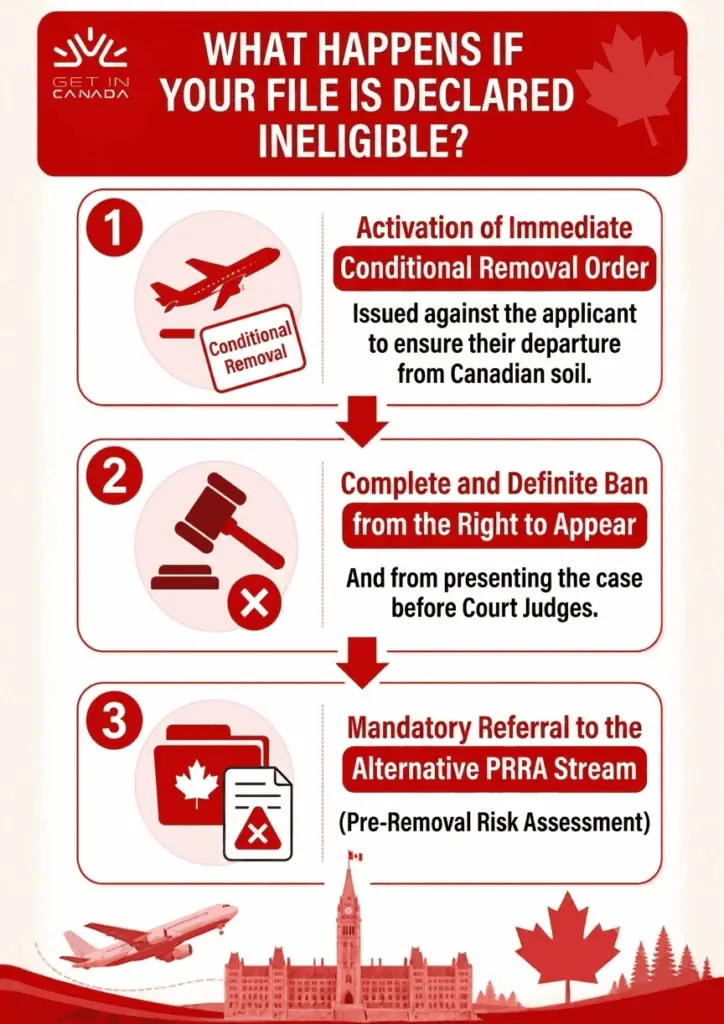
The file is immediately handed over to the Canada Border Services Agency (CBSA). The conditional removal order becomes fully enforceable exactly 7 days after the ineligibility decision date.
Book Your Consultation Session →
B- Pre-Removal Risk Assessment (PRRA)
To honor international non-refoulement obligations, the CBSA will evaluate whether the individual qualifies for a paper-based review to check if deportation would expose them to torture or danger to life. However, PRRA approval rates are historically very low and represent a much higher legal hurdle than a standard court stream.
C- Work and Study Permit Status
Under a temporary public policy implemented in March 2026, individuals with ineligible claims waiting for their PRRA assessment are allowed to apply for or renew open work permits to ensure they can sustain themselves financially. Study permits, however, are legally cancelled automatically unless a specific judicial stay of removal is secured.ط
9. Can you appeal or request a review?
Unlike standard IRB refusals, individuals whose claims are found ineligible have no legal right to file an appeal before the Refugee Appeal Division (RAD). The sole legal remedy available is to file an application for leave and judicial review before the Federal Court of Canada to evaluate if the officer made a legal error. It is crucial to note that filing for judicial review does not grant an automatic stay of deportation; a separate, urgent motion to stay the removal must be argued before a judge to halt physical removal while the court reviews the case.
For more Canadian visa inquiries? Click here to start the process with our help →
Conclusion
Ultimately, Canada’s asylum stream has grown significantly more complex and strict, particularly with the implementation of recent legislative updates aimed at securing borders and speeding up administrative timelines. A clear understanding of the grounds for ineligibility, and how they structurally differ from a standard refusal is the vital first step to avoiding sudden removal enforcement actions.
Because Canadian immigration matters are highly sensitive and bound by rigid, unforgiving deadlines, consulting a licensed and experienced immigration lawyer early on remains the safest strategy to protect your legal position and explore alternative avenues, such as a PRRA or Federal Court judicial review, to ensure a secure path forward.