The Difference Between Federal Immigration Programs and Canadian Provincial Programs
When planning to immigrate and settle in Canada, applicants always face a fundamental question: “Is it better to apply through the general Federal Program, or through Provincial Programs?”. Choosing the right pathway for your profile from the very beginning is the key to avoiding application rejections and shortening years of waiting. In this guide, we will break down the difference between Express Entry and PNP for 2026 in a direct and accessible way, highlighting the pros and cons of each path to help you make the safest decision for your personal profile.
1. What is the Canadian Federal Program (Express Entry)?
The Federal System is the centralized, unified electronic platform managed by the federal Canadian government (IRCC) to select skilled workers from around the world and distribute them efficiently based on economic needs.
- How it Works: This system relies on digital competition; applicants enter a unified “selection pool,” and the system automatically ranks profiles based on the Comprehensive Ranking System (CRS) score.
- Core Programs: Under the Express Entry umbrella, the federal system manages three main programs: the Federal Skilled Worker Program (FSWP), the Canadian Experience Class (CEC), and the Federal Skilled Trades Program (FSTP).
- Selection Method: The government conducts periodic draws to select top-scoring profiles and issue them an official Invitation to Apply (ITA). A key feature of this pathway is the total freedom to settle and work in any Canadian city (except for the province of Quebec, which operates its own independent system).
2. What are the Canadian Provincial Nominee Programs (PNP)?
Provincial Nominee Programs (PNP) are independent immigration streams managed by each individual Canadian province or territory to address specific labor shortages and demographic needs in their local markets.
- How it Works: If a specific province (such as Ontario, Alberta, or Saskatchewan) faces a shortage in certain occupations, it opens its own selection gateways to target applicants holding those exact credentials, even if their scores in the general federal pool are not high enough to compete.
- Selection Method: These programs are divided into Express Entry-aligned streams and independent (Base) streams. Once your file is accepted by a province, you receive a “Provincial Nomination Certificate,” which automatically injects 600 points into your federal Express Entry profile, virtually guaranteeing your selection in the very next draw.
- Legal Commitment: These programs require a genuine intention and a legal commitment from the applicant to settle and work within the nominating province for a specified number of years upon arrival.
3. Key Differences Between Federal Immigration and PNP
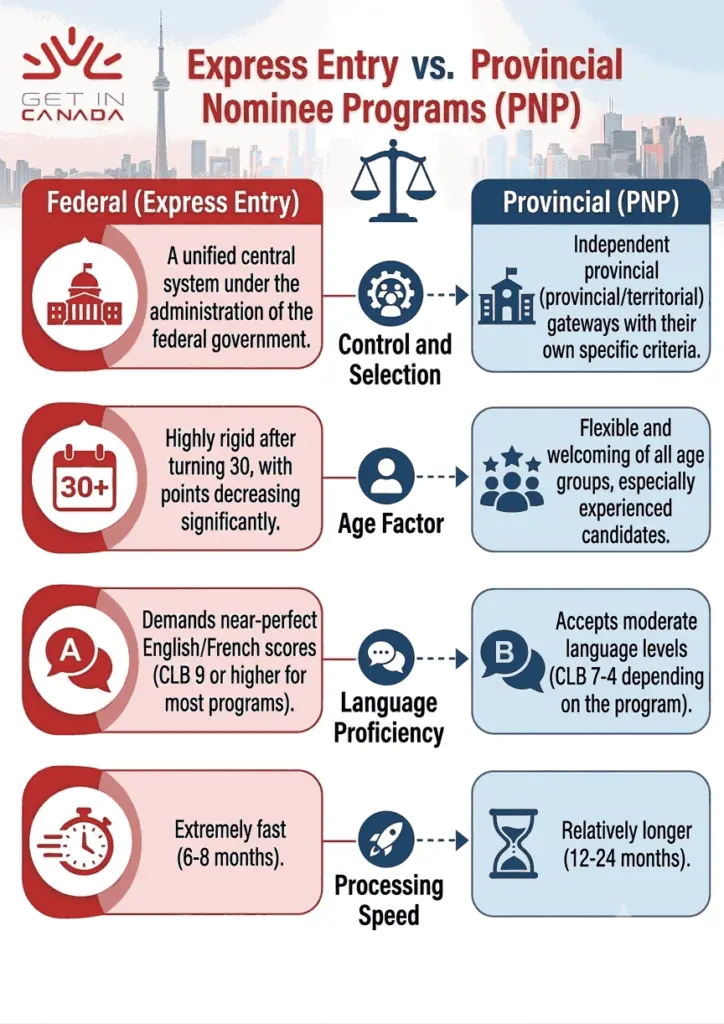
The fundamental structural difference between the two pathways is clearly reflected in the flexibility of the admission requirements and the authority controlling the application:
- Age and Education: The federal system is highly rigid regarding age, progressively deducting points after an applicant turns 30. Conversely, provincial programs demonstrate greater flexibility and may overlook advanced age if your professional occupation is highly in demand in their region.
- Language Proficiency: The federal system demands advanced language benchmarks (such as CLB 9) for serious competition. Meanwhile, provinces open doors to moderate and flexible language scores (such as CLB 4 or 5) for specific targeted trades and professions.
- Tie to the Province: Express Entry relies purely on your global profile points. In contrast, provincial streams heavily prioritize a genuine connection to the territory such as holding a degree from the province, previous local work experience, or a profession listed on their active in-demand skills matrix.
4. Comprehensive Analysis: Pros and Cons of Each Pathway
To simplify your evaluation and strategic mapping, the table below outlines the analytical comparison of both streams under the current 2026 framework:
| Legal Pathway | Key Advantages (Pros) | Main Challenges (Cons) | Processing Speed |
| Federal Immigration (Express Entry) | • Full freedom to choose your living and working location across Canada. • Lower government fees and a single, unified paperwork track. • Permanent residency is issued directly from the initial stage. | • Fierce competition and consistently high draw point thresholds. • Strict point penalties for applicants over 30 years old. • Requires high and sometimes challenging language scores. | The Absolute Fastest: Application processing and visa issuance take only 6 to 8 months. |
| Provincial Programs (PNP) | • Highly flexible and flexible requirements for language and education. • Excellent immigration prospects for individuals with advanced age. • Boosts your file with 600 decisive points, securing an instant draw. | • Obligatory requirement to reside and settle in the nominating province. • Additional processing fees specific to the province itself. • A two-stage procedural track (Province first, then Federal government). | Relatively Slower: The pathway takes 12 to 24 months depending on the specific provincial stream chosen. |
5. How to Choose the Safest Pathway for Your Profile?
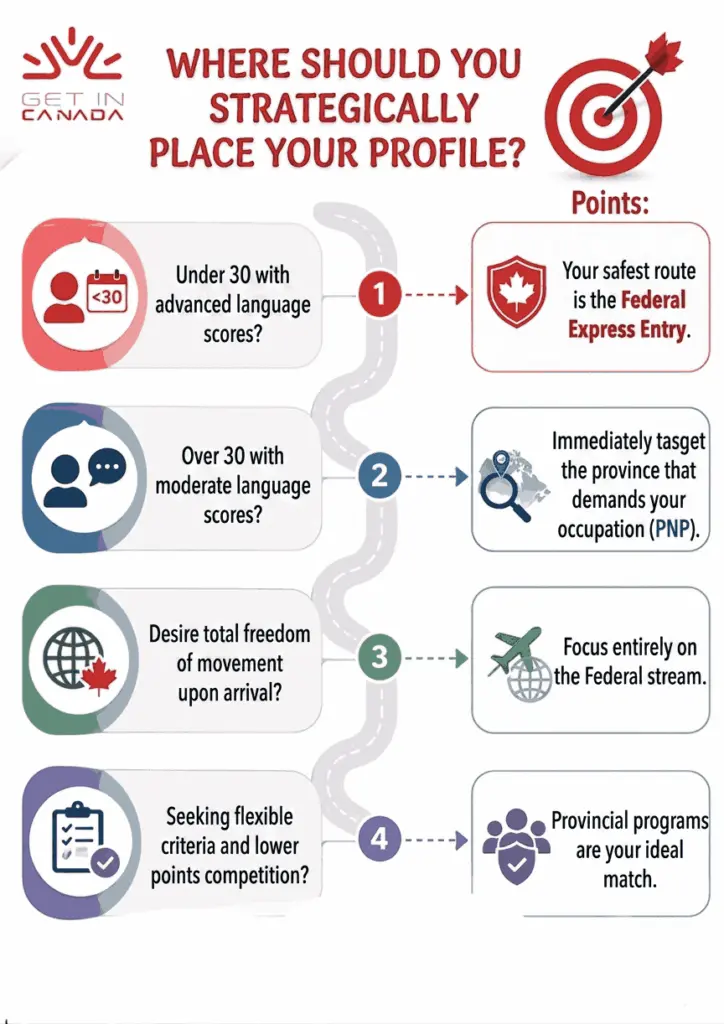
The correct choice does not depend on finding the “easiest” program, but rather on identifying the stream that aligns with the current strong suits in your documentation:
- Choose the Federal Pathway (Express Entry) if: You are between 18 and 30 years old, hold a higher academic degree (such as a Master’s), achieved advanced scores in your language test, and desire absolute freedom to choose the Canadian city you will live in the moment you land.
- Choose the Provincial Pathway (PNP) if: You have an advanced age or moderate language scores, but your specific professional background is highly in demand in a particular province, or if you hold a previous local qualification or immediate family ties in a specific territory that grant you adaptability points.
FAQs About The Difference Between Federal Immigration Programs and Canadian Provincial Programs
How to Determine Your Safest Pathway Without Risk?
Understanding the subtle nuances between the federal framework and provincial programs is the first step, but the ultimate challenge lies in identifying the exact strategic pathway that guarantees your profile the highest probability of success under this year’s updates. Applying blindly to the wrong stream can result in a flat refusal and years of wasted effort, whereas a choice rooted in professional legal analysis guides you straight to permanent residency.
Don’t leave your goals to guesswork. Book your legal consultation now with the experts at Get In Canada. Let us put your credentials, experience, and age under the microscope to map out the fastest, most reliable stream tailored entirely to your background. Your right move begins with a smart decision today!