Does Age Affect Your Chances of Immigrating to Canada?

Age stands as one of the most critical pillars determining the fate of immigration applications to Canada, often causing anxiety for seasoned professionals who have crossed their thirties or forties. While the Canadian government actively seeks younger candidates to ensure long-term economic productivity, it concurrently opens innovative alternative pathways that highly value deep professional experience and stable capital. In this comprehensive and expanded 2026 guide, we put age requirements and the federal points system under a clear digital microscope, revealing exactly how your age is calculated, and more importantly: the smart strategies and safest alternatives to offset any point deductions and reach your goal securely.
1. How Are Age Points Calculated in the Express Entry System?
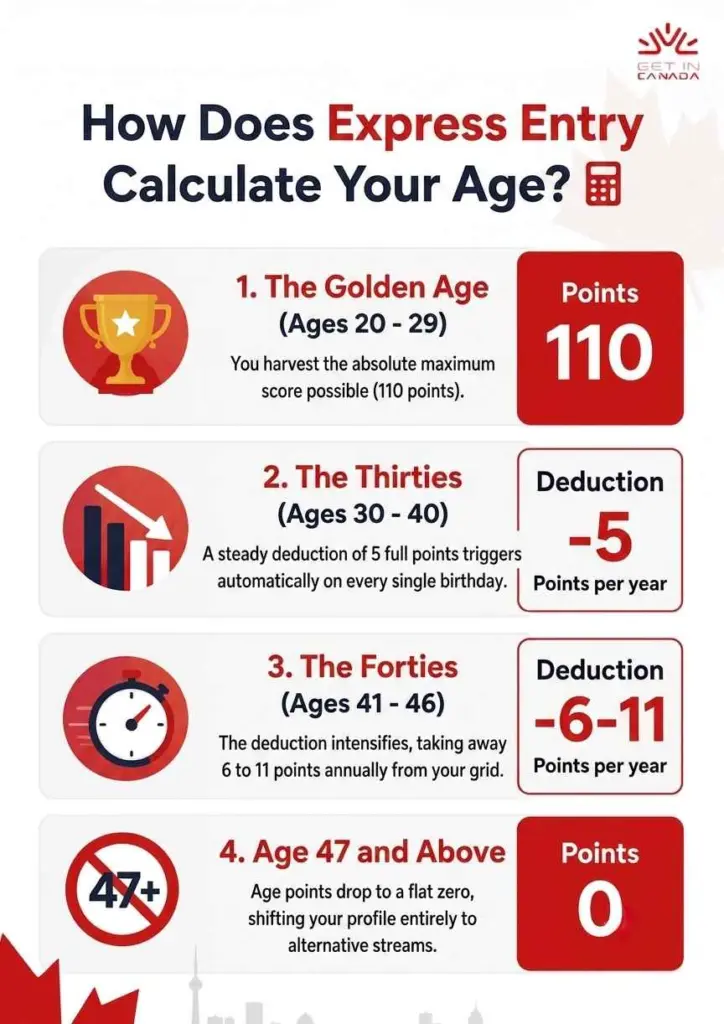
In the federal Express Entry system, age is treated as a decisive and rigid numerical metric within the Comprehensive Ranking System (CRS). A maximum of 110 points is allocated for the age factor to single applicants, and 105 points to married applicants or those including a partner in their application.
The exact numerical distribution for the age factor operates as follows:
- Ages 18 to 19: Single applicants receive between 95 to 100 points.
- Ages 20 to 29 (The Peak Phase): Applicants harvest the absolute maximum points here (110 points for single, and 105 points for married profiles).
- At Age 30: The direct downward deduction begins, immediately dropping the balance to 95 points for single applicants.
- Ages 31 to 40: The system continues to automatically deduct 5 full points with every new birthday (for example: at age 35, an applicant has only 70 points remaining, and at age 39, only 50 points remain).
- Ages 41 to 46: The deduction intensifies to 6 to 11 points deducted annually, until age points reach an absolute zero the moment the applicant enters age 47.
Book Your Consultation Session →
2. Moving to Canada After 30 and 35: The Digital Reality
Relocating at this stage of life absolutely does not mean losing your immigration prospects. Instead, it requires re-engineering your profile’s calculation strategy, relying on structural career strengths that candidates in their twenties simply do not possess.
- The Impact of Accumulated Work Experience: While an applicant at age 35 might lose 40 points on age compared to a 25-year-old, they can structurally bridge this gap using points from “Skill Transferability” factors. The system awards substantial bonus points when combining over 3 years of continuous foreign work experience with an advanced language benchmark, balancing out the age point deficit.
3. Immigrating to Canada After 40: Is It Possible?
Many highly qualified professionals ask: “Does advanced age completely bar a federal application?”. The straightforward legal answer is no; the Canadian government does not set a maximum age limit that prevents you from creating an immigration profile. However, the reality of competitive draws imposes complex challenges, as your age score at 40 drops to 45 points for single applicants and 40 for married ones.
- The Necessity of Exiting the General Pool: Competing in general federal draws after age 40 based on personal credentials alone has become incredibly difficult amid current high draw thresholds. The strategic legal exit here is to stop targeting the general federal pool and pivot directly toward “Regional Experience-Targeted Streams” designed by Canada to attract senior professionals and capital holders without focusing heavily on age.
4. How to Offset Point Reductions Caused by Age
If you have entered the age deduction zone, there are 4 smart, verified mechanisms to elevate your comprehensive CRS score and bypass the competitive hurdle:
- Maxing Out First Language Competency (Achieving CLB9): Hitting this benchmark in IELTS or CELPIP gives your profile a massive qualitative leap. It doesn’t just add language points; it unlocks heavy bonus points under the education and work experience combination matrices.
- The Strongest Winning Card (Adding French): Canada currently places a historic priority on French speakers, injecting 50 additional points directly into your profile. It also qualifies you for French-language category draws (Category-based selection), which issue invitations at significantly lower thresholds, bypassing the age deduction burden entirely.
- Academic Advancement (Master’s Degrees and Dual Diplomas): Upgrading from a Bachelor’s to a Master’s degree injects immediate points into your education grid, maximizing your score when linked with your years of work experience.
- Spouse or Partner Qualifications: In joint profiles, your partner can actively balance the deficit by scoring high in language proficiency and evaluating their university degree, injecting vital points that boost the overall pool score.
Book Your Consultation Session →
5. Safe Alternative Programs for Mature Applicants in 2026
Canadian provinces understand that professionals over 35 and 40 possess substantial career stability and financial resources that instantly support the local economy. Consequently, they open specialized gateways that bypass rigid age criteria:
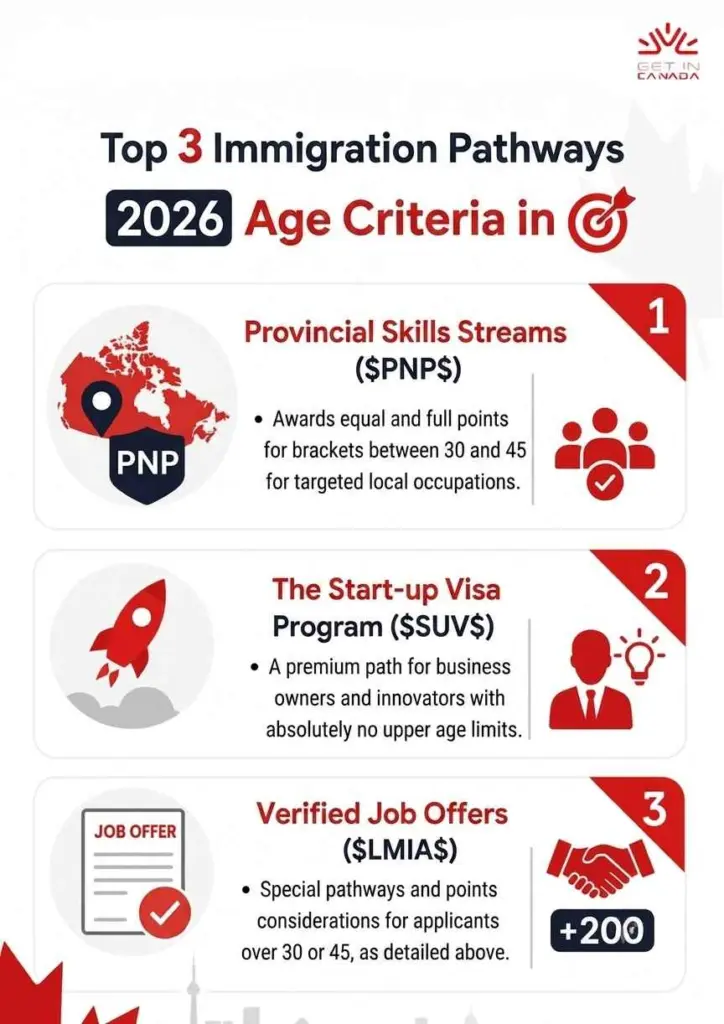
- Provincial Experience & Skills Streams (PNP): Programs such as Saskatchewan ($SINP$) or Alberta ($AAIP$) utilize highly flexible assessment grids for the age factor, awarding equal and maximum points to age brackets between 30 and 45 in certain tracks, as long as your occupation is actively in-demand in the province.
- The Start-up Visa Program (SUV): The premium path for entrepreneurs, innovators, and executive managers. This program does not mandate an age limit, and approval rests 100% on the business concept, liquid capital, and securing a letter of support from an authorized Canadian incubator or angel group.
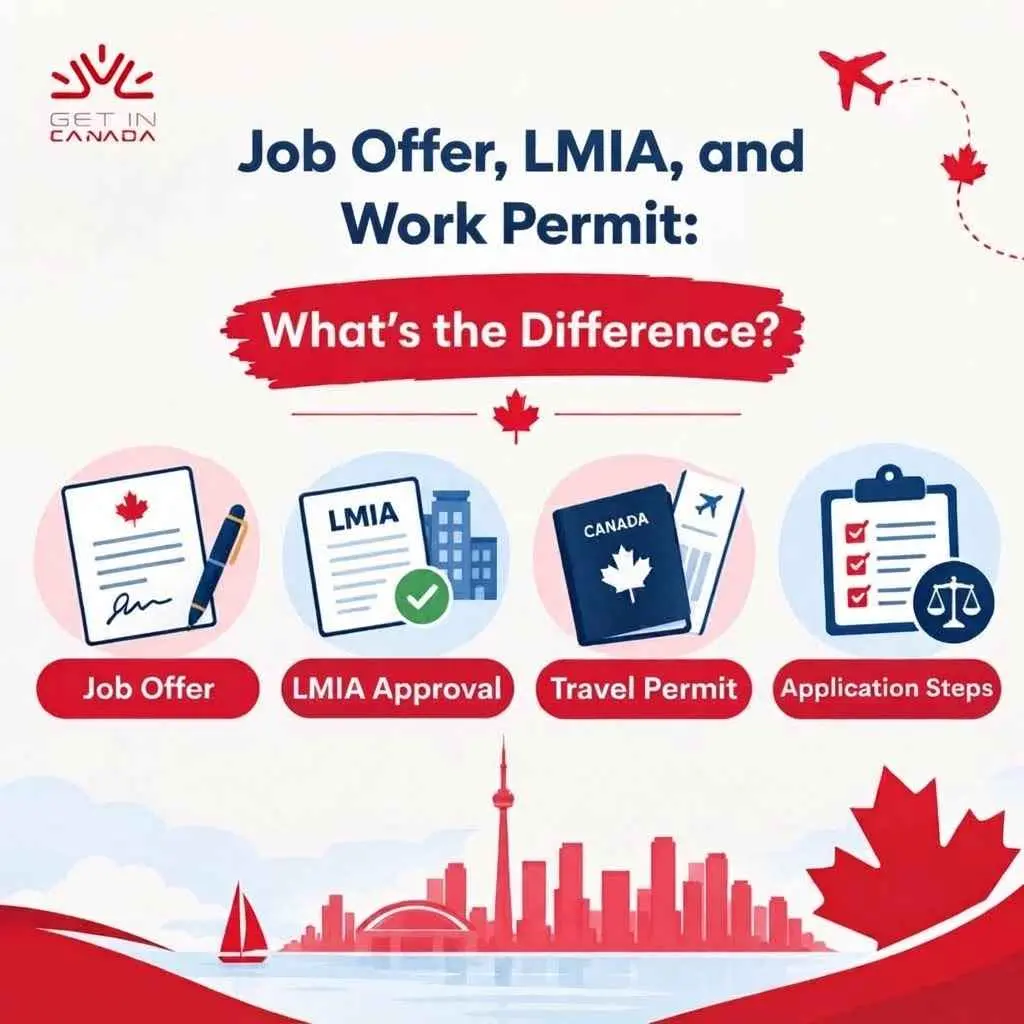
- Securing Verified Job Offers (LMIA): Acquiring a formal, verified job offer from a Canadian employer grants your federal profile an immediate boost of 50 to 200 points. This numerical jump is fully capable of overriding the age hurdle, pulling your file forward in the very next draw.
FAQs About Does Age Affect Your Chances of Immigrating to Canada?
For more Canadian visa inquiries? Click here to start the process with our help →
How to Flip the Age Equation in Your Favor and Secure Approval?
Age in modern Canadian immigration frameworks is not an exclusion sentence; it is simply a numerical indicator telling you to rebalance your strategy and step away from overcrowded, traditional tracks. The secret lies not in competing with youth for age points, but in heading toward smart, alternative streams that value your decades of career experience, advanced academic level, and direct investment capabilities. Blindly attempting tracks unsuited to your current profile wastes valuable capital and precious time, whereas correct strategic planning opens Canada’s doors wide through the most direct means possible.
Do not let age stand as a hurdle to your ambition or dictate your future. Book your legal consultation now with the experts at Get In Canada.