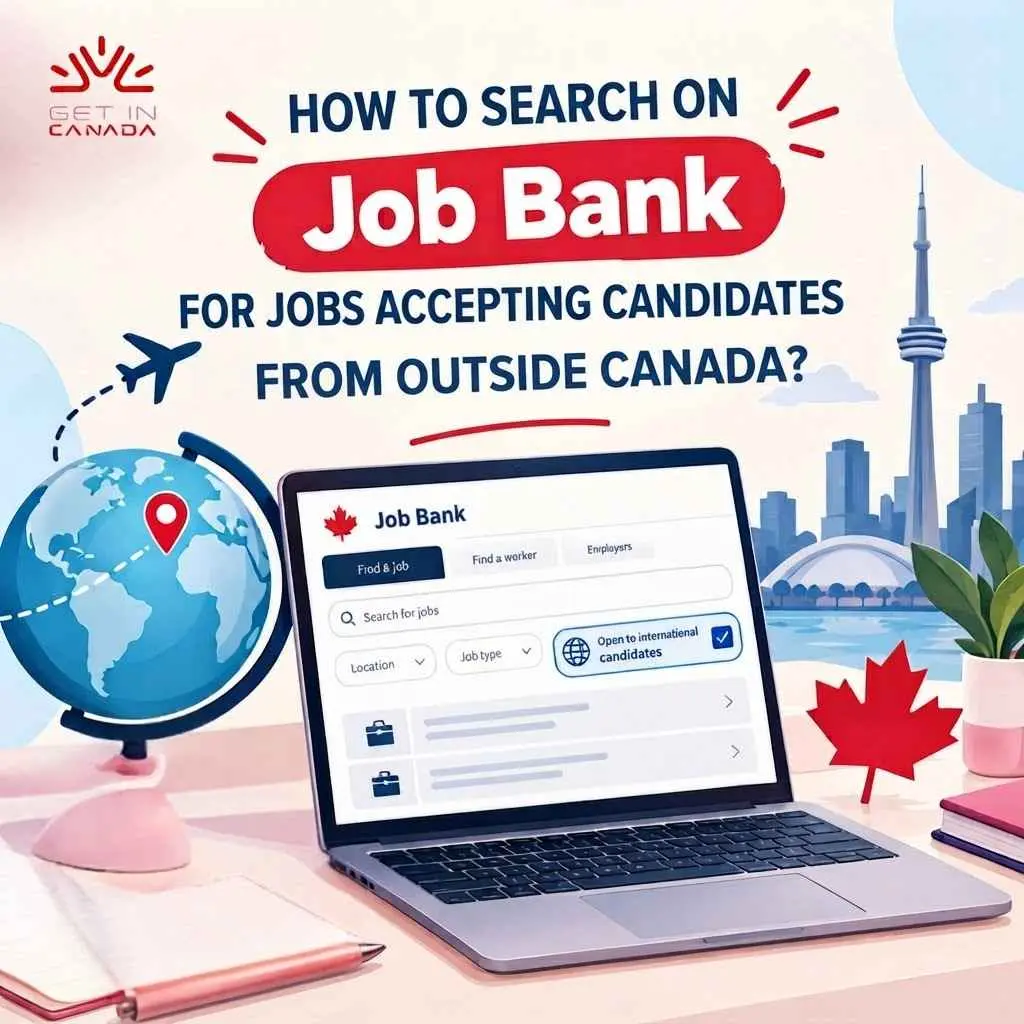
How to Find Jobs Open to International Candidates on Job Bank?
The official Government of Canada Job Bank is the country’s largest public employment clearinghouse, hosting tens of thousands of active listings across all ten provinces and three territories. However, international job seekers living outside Canada routinely encounter immediate rejections because the vast majority of postings are restricted strictly to domestic job seekers who already hold valid Canadian work authorization.
Succeeding on Job Bank requires knowing how to configure the platform’s advanced search parameters. By filtering specifically for employers who possess or have applied for federal authorization to recruit foreign nationals, you can target your applications toward companies ready to support an LMIA and facilitate your Canadian work permit.
1. Use the Foreign Candidates Page
Job Bank features a dedicated portal engineered specifically for global job seekers known as the international candidates pathway. Accessing the platform through this interface automatically isolates positions where employers have indicated an interest in hiring candidates currently living outside of Canada.
Bypassing the standard homepage and using this tailored section prevents you from wasting time on domestic-only listings. It connects your credentials directly with Canadian hiring managers who understand the procedural steps of international recruitment and visa sponsorship.
- Direct Gateway: Navigate to the official site (
jobbank.gc.ca) and enter through the dedicated “Temporary Foreign Workers / Candidates outside Canada” section. - Pre-Set Filters: This pathway automatically filters out employers that lack the administrative capacity to hire outside the domestic labor market.
- Vetted Listings: Postings on Job Bank undergo basic government screening, significantly lowering your exposure to employment fraud compared to open social media boards.
Book Your Consultation Session →
2. Search With the Correct Job Title
Using literal translations of your regional job title often causes search algorithms to miss relevant openings. Canadian employers rely on standardized terminology established within the domestic labor market to write job descriptions and technical requisites.
Before querying the database, translate your day-to-day duties into the standard industry terms used across Canada. Identifying your exact Canadian occupational match guarantees that the search engine retrieves all applicable vacancies across different provinces.
- Adopt Standard Industry Terms: Replace ambiguous regional titles with Canadian equivalents (e.g., use “Software Engineer” instead of “IT Specialist,” or “Heavy Duty Mechanic” instead of “Workshop Technician”).
- Avoid Overly Broad Keywords: Broad search terms like “Manager” or “Officer” produce generic, unhelpful results; pinpoint your specific discipline (e.g., “Logistics Supervisor”).
- Audit Core Competencies: Review multiple postings to confirm that the bulleted daily tasks match your verifiable past experience.
3. Use Your NOC Code
Canada’s immigration and labor system is categorized under the National Occupational Classification (NOC) using the TEER (Training, Education, Experience, and Responsibilities) matrix. Every occupation in the Canadian economy is assigned a standardized 5-digit numerical code that defines the job’s baseline education level and essential duties.
Searching Job Bank via your 5-digit NOC code bypasses variations in company-specific job titles. It aggregates every posting in the national database that legally aligns with your professional background under Canadian immigration definitions.
- Identify Your 5-Digit Code: Use the federal NOC search directory to locate the code that mirrors at least 80% of your verifiable past duties.
- Direct Numerical Search: Type the 5-digit NOC code directly into the Job Bank search field to capture every matching vacancy nationwide.
- Verify TEER Prerequisites: Confirm that your academic background and total years of work experience align with the TEER category assigned to your code.
Book Your Consultation Session →
4. Filter by Province and City
International applicants frequently limit their search to major metropolitan centers like Toronto, Vancouver, or Montreal. These tier-one urban hubs feature deep local labor reserves, meaning employers there rarely face the acute labor shortages needed to justify foreign recruitment to the federal government.
Shifting your target to smaller provinces, mid-sized cities, and rural or regional areas yields significantly better results. Employers in regions such as the Atlantic provinces, Saskatchewan, Alberta, and designated rural communities experience chronic labor deficits and are far more motivated to navigate the LMIA process for qualified foreign talent.
- Broaden Geographic Scope: Search across entire provinces (e.g., Alberta or Nova Scotia) rather than narrowing your query to a single metropolitan area.
- Target Regional Immigration Programs: Look in jurisdictions with active employer-driven immigration pathways, such as the Atlantic Immigration Program (AIP) or the Rural and Northern initiatives.
- Evaluate Practical Trade-Offs: Smaller employment markets offer lower housing costs and easier retention criteria, making your application far more attractive to regional recruiters.
5. How to Identify International Postings
Job Bank includes clear compliance badges at the bottom of each job posting that explicitly state who is legally permitted to apply. Inspecting this section before drafting your application will tell you whether the employer holds or is seeking an approved Labour Market Impact Assessment (LMIA).
Understanding these visual badges ensures you only invest effort where an employer possesses the legal green light to sponsor an international applicant.
- The Globe Icon (International Eligibility): Accompanied by the statement “Other candidates with or without a valid Canadian work permit.” This is the mandatory clearance signal for foreign applicants.
- LMIA Status Indicator: Look for declarations reading “This employer has applied for a Labour Market Impact Assessment” or “LMIA approved,” confirming federal authorization is underway.
- The Maple Leaf Restriction: If a posting shows the red maple leaf and states “Only apply if you are a Canadian citizen, permanent resident, or hold a valid work permit,” your application will be automatically rejected.
6. How to Read Job Requirements
Job descriptions on Job Bank outline statutory qualifications that you must assess with precision. Pay close attention to standard legal phrases, particularly the ubiquitous condition: “You must be authorized to work in Canada.”
How that phrase applies to you depends entirely on which applicant category the employer selected in the posting:
- Domestic Restriction Postings: If listed alongside the maple leaf icon, the employer requires you to possess valid, active Canadian work status immediately; they will not sponsor a permit.
- International Clearance Postings: If listed under a posting open to international candidates, it means the employer will provide the qualifying job offer and LMIA so you can obtain authorization prior to entry.
- Mandatory Prerequisites: Differentiate between “preferred” skills and “essential” prerequisites, such as specific software proficiencies, certifications, or licensing requirements.
Book Your Consultation Session →
7. When Not to Apply
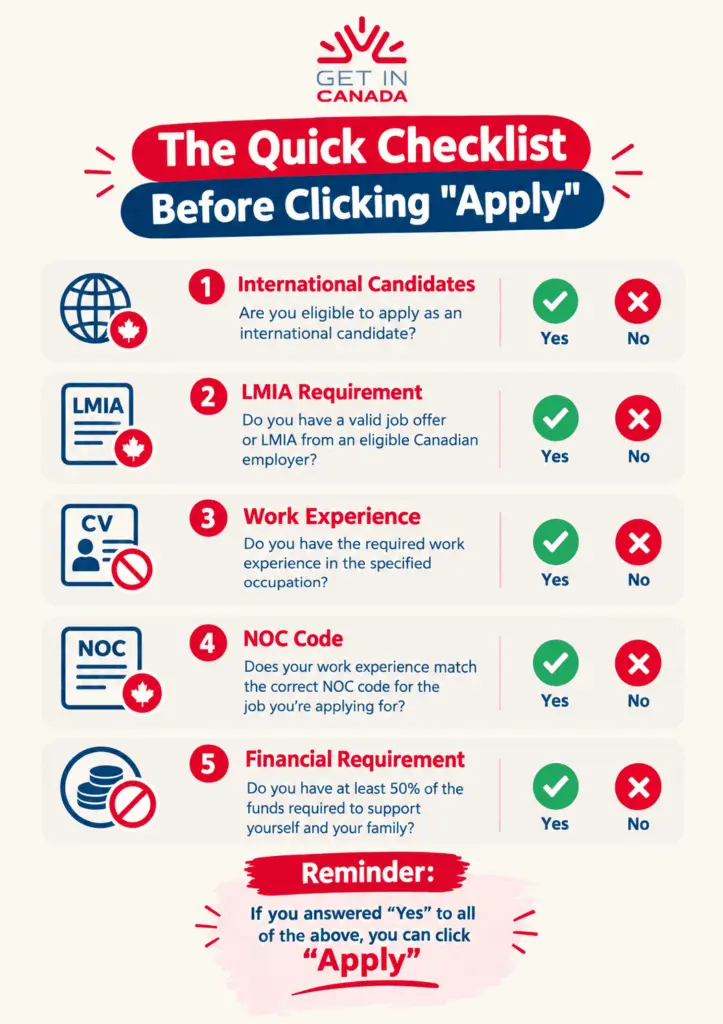
Submitting applications for roles where you fail to meet fundamental regulatory conditions is counterproductive. Applying indiscriminately flags your credentials across automated hiring systems, damages your sender reputation, and consumes valuable time.
You should immediately skip postings that match any of the following parameters:
- Explicit Geographic Bans: Any listing that contains the disclaimer: “Do not apply if you are not currently located in Canada.”
- Regulated Professions Without Prior Clearance: Roles in healthcare (nursing, medicine), engineering, or public education that require provincial licensing or certification before practicing.
- Unmatched Language Requirements: Positions specifying fluent French in Quebec or bilingual competency when you only communicate in English.
- Requests for Placement Fees: Legitimate Canadian employers never request money for job offers, interviews, or LMIA filings. Any demand for payment indicates an illegal operation.
8. Practical Example
To illustrate how to locate an actionable opportunity on Job Bank, follow this structured execution sequence:
- Visit
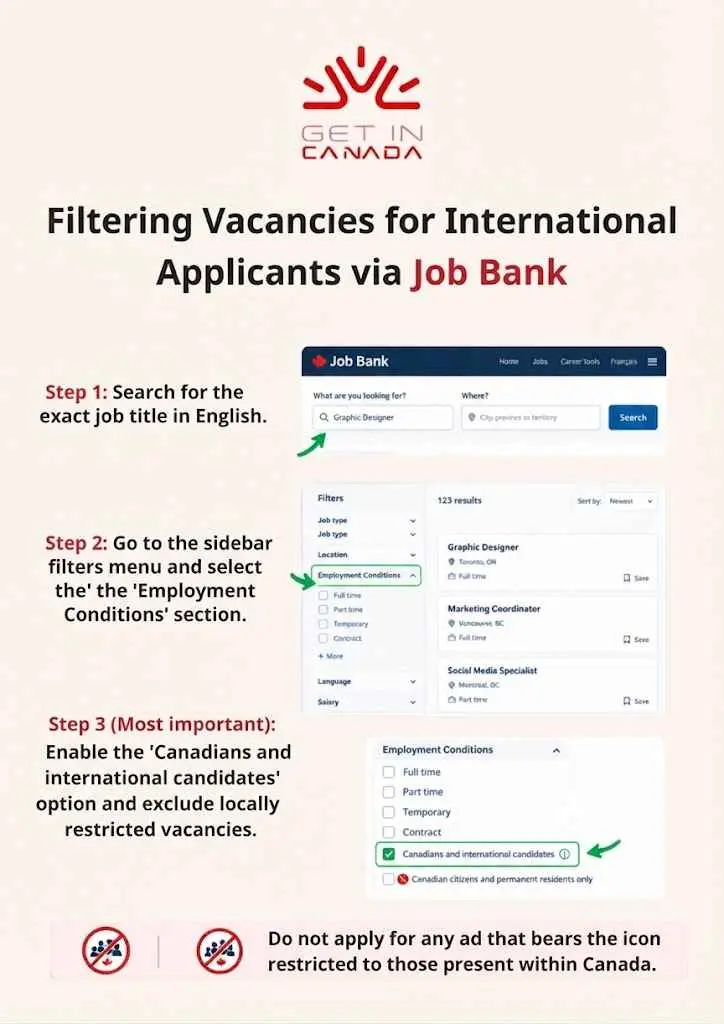
jobbank.gc.caand enter your occupation and NOC code (e.g.,Industrial Electrician 72400). - Run the search, open the Advanced filters tab, and scroll to Intended applicants.
- Select the checkbox: “Other candidates with or without a valid Canadian work permit.”
- Open the filtered postings and navigate straight to the bottom compliance box to verify the presence of the Globe icon and active LMIA notation.
- Click “Show how to apply” to retrieve the employer’s direct recruitment email or application tracking portal link.
- Submit a tailored, ATS-compliant Canadian resume accompanied by a targeted cover letter referencing the Job Bank job posting number.
9. Application Tracking Sheet
Securing an overseas job offer is a numbers-driven process that requires discipline and organization. Because processing times are longer for international applicants, maintaining a structured tracking system prevents administrative oversights and prepares you for unexpected recruiter callbacks.
- Log Critical Metrics: Build a spreadsheet tracking the company name, Job Bank reference ID, NOC code, date applied, and the direct contact details provided.
- Archive Postings Locally: Canadian employers frequently archive job ads once their initial intake target is met; save a PDF copy of the job description for future interview preparation.
- Monitor Communication Channels: Check your inbox and spam folders daily, as unfamiliar automated notifications from Canadian applicant tracking systems can be misrouted.
- Professional Response Turnaround: Reply to any employer communications within 24 business hours to demonstrate reliability and proactive interest.
FAQs
Book Your Consultation Session →
Taking the Next Step
Navigating Canada’s Job Bank from abroad requires targeted execution: using specialized filters for international candidates, matching your skills to standard NOC definitions, and presenting your background using an ATS-optimized Canadian resume.
If you are uncertain about your occupational classification, need to evaluate the legitimacy of an employment offer, or require professional support navigating the LMIA and work permit application process, book a consultation with a licensed Regulated Canadian Immigration Consultant (RCIC). Professional guidance ensures your efforts are spent on compliant pathways, minimizing procedural delays and keeping your relocation strategy on track.