Francophone Mobility Work Permit Requirements: Eligibility, French Language & Documents
1. What Is the Francophone Mobility Work Permit?
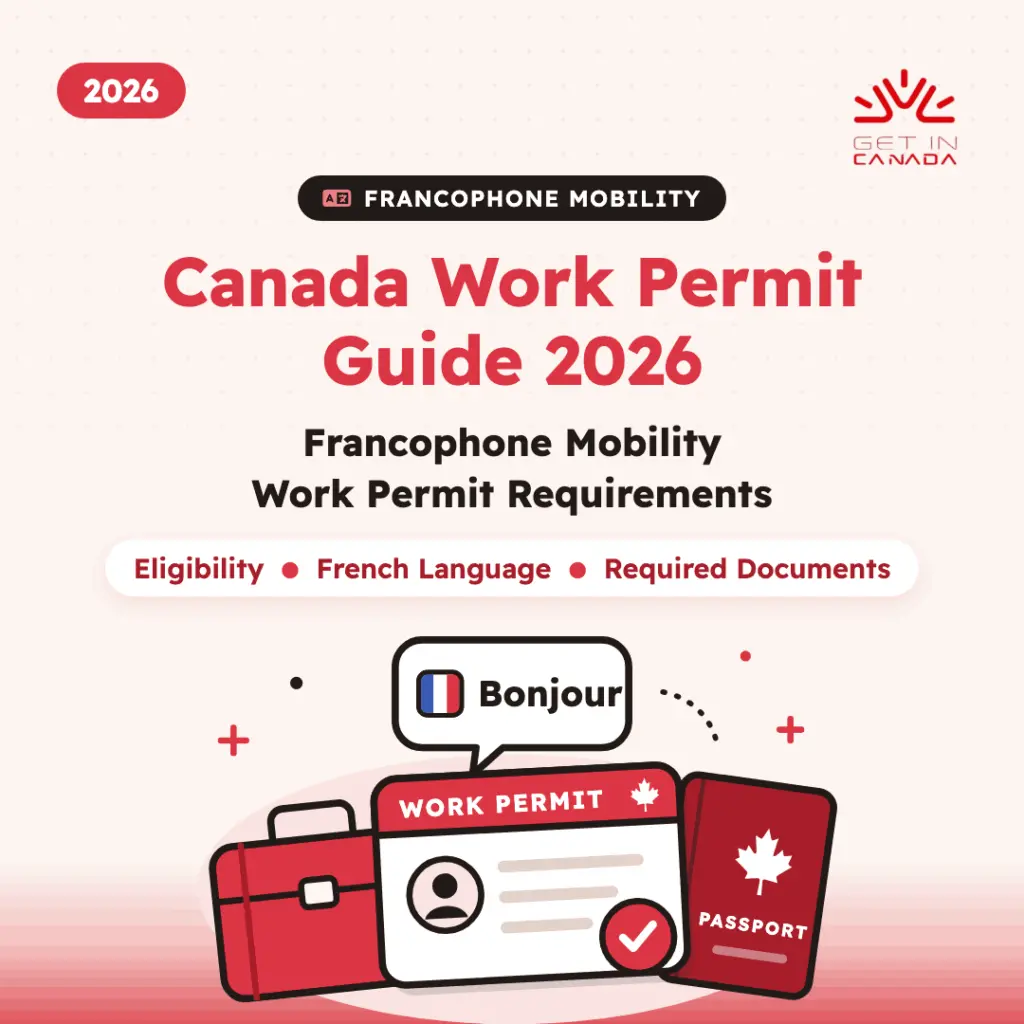
The Francophone Mobility Program allows eligible French-speaking foreign nationals to work in Canada outside Quebec without an LMIA. As part of Canada’s International Mobility Program (IMP), it aims to attract French-speaking workers and strengthen Francophone communities across the country.
Through this program, Canadian employers can hire eligible foreign workers using LMIA exemption code C16. Applicants must still meet the program’s eligibility criteria and general work permit requirements.
Book Your Consultation Session →
2. Who Is Eligible for the Francophone Mobility Work Permit?
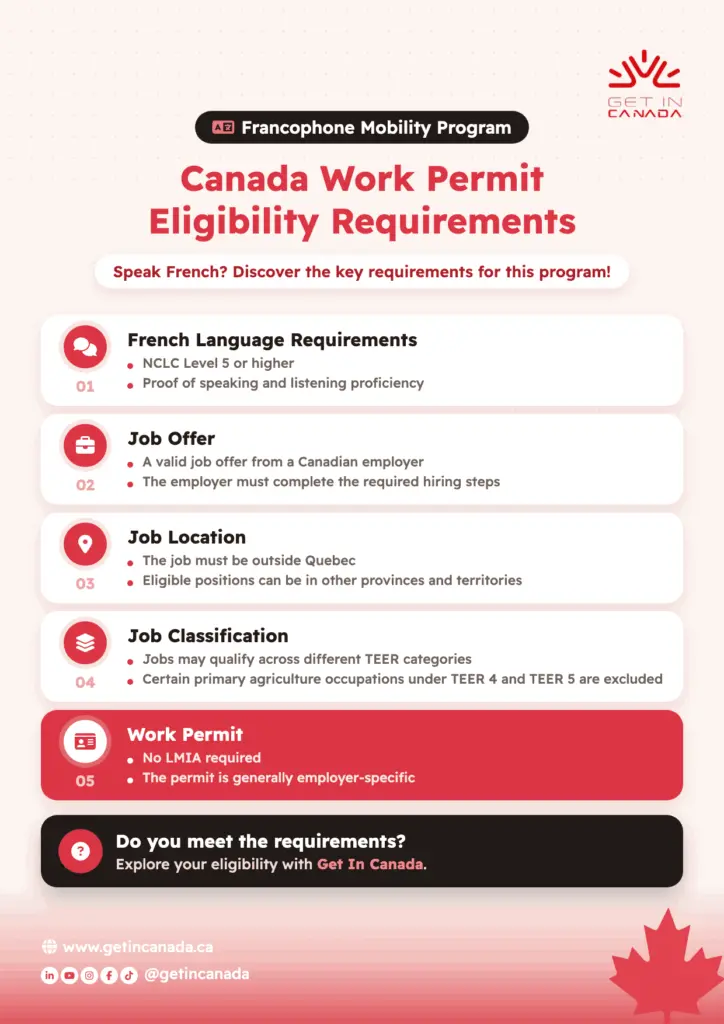
To qualify for the Francophone Mobility Work Permit, applicants must:
- Demonstrate French speaking and listening abilities equivalent to NCLC 5 or higher.
- Have a valid job offer from a Canadian employer.
- Intend to live and work in one of Canada’s nine provinces or three territories outside Quebec.
- Have an occupation classified under an eligible NOC TEER category. Primary agriculture occupations under TEER 4 and 5 are excluded.
- Meet Canada’s general work permit eligibility and admissibility requirements.
French Language Requirements for Francophone Mobility
Applicants must demonstrate intermediate French-speaking and listening abilities equivalent to NCLC 5 or higher. Unlike some other Canadian immigration pathways, this program does not require applicants to demonstrate French reading and writing proficiency.
Acceptable supporting evidence includes:
- TEF Canada speaking and listening results.
- TCF Canada speaking and listening results.
- Official transcripts or a confirmation letter showing completion of a college or university program in French.
- Other documents demonstrating French-language education.
Applicants should ensure that their documents clearly establish the required oral language proficiency.
Job Offer and Work Location Requirements
The job offer must be for a position located outside Quebec. Eligible destinations include:
- Ontario
- British Columbia
- Alberta
- Manitoba
- Saskatchewan
- Nova Scotia
- New Brunswick
- Newfoundland and Labrador
- Prince Edward Island
- Yukon
- Northwest Territories
- Nunavut
The position can fall under any NOC TEER category, except primary agriculture occupations classified under TEER 4 and 5.
Before the applicant submits their application, the employer must:
- Submit the employment offer through the IRCC Employer Portal.
- Select LMIA exemption code C16.
- Pay the CAD $230 employer compliance fee.
- Provide the applicant with the seven-digit offer of employment number and a signed job offer.
The job offer must accurately describe the position, duties, salary, and working conditions.
Book Your Consultation Session →
3. Francophone Mobility Work Permit Document Checklist
Applicants should prepare their supporting documents before submitting their application. Although the exact requirements depend on individual circumstances, the main documents generally include:
Applicant documents:
- Valid passport.
- French language test results or proof of French-language education.
- Signed employment offer or job contract.
- Seven-digit offer of employment number.
- CV or résumé.
- Educational certificates and work experience documents, where applicable.
- Proof of legal status in the country of application, if applicable.
- Additional documents requested by IRCC.
Employer requirements:
- Employment offer submitted through the IRCC Employer Portal.
- LMIA exemption code C16.
- Payment of the CAD $230 employer compliance fee.
- Signed employment agreement.
- Seven-digit offer of employment number provided to the applicant.
Medical examinations and police certificates may also be required depending on the applicant’s circumstances. Applicants should always follow their personalized IRCC document checklist.
4. How to Apply for a Francophone Mobility Work Permit
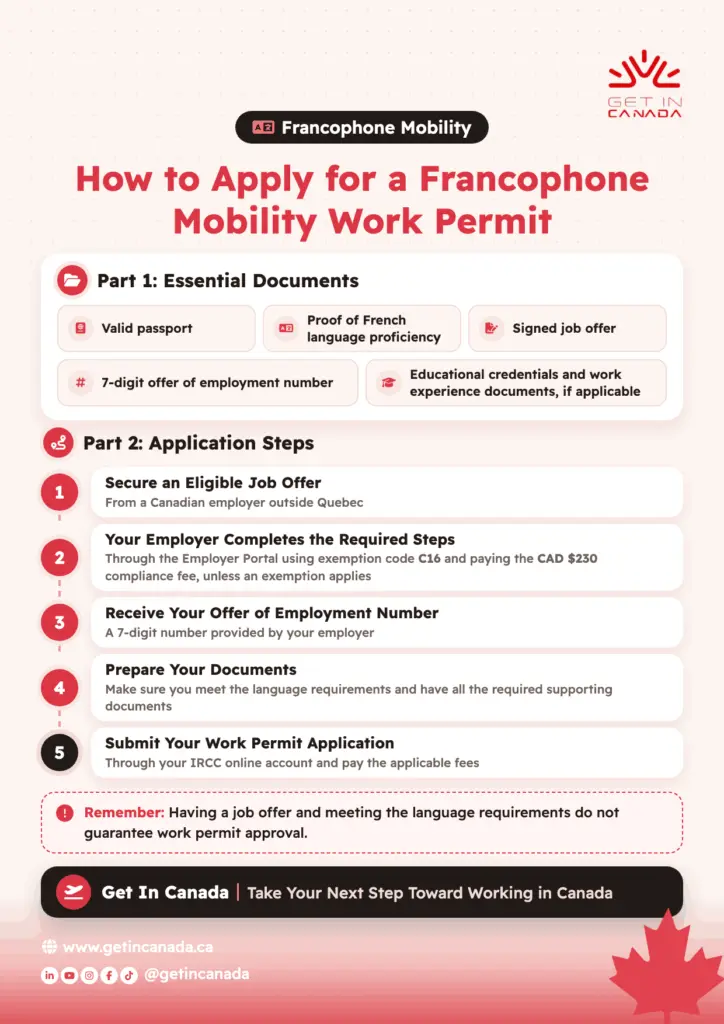
Once applicants meet the eligibility criteria and secure a qualifying job offer, they can proceed with the application.
The process generally involves these steps:
- Secure a job offer: Find a Canadian employer offering an eligible position outside Quebec.
- Employer submission: The employer submits the offer through the IRCC Employer Portal using code C16 and pays the compliance fee.
- Receive the offer number: Obtain the seven-digit offer of employment number and signed job offer.
- Prepare supporting documents: Gather your passport, French language evidence, employment documents, and other required paperwork.
- Submit your application: Complete the appropriate online work permit application through your IRCC account.
- Pay the fees: Pay the applicable work permit processing fee and biometrics fee, if required.
- Complete biometrics: Provide biometrics and complete a medical examination if instructed by IRCC.
- Wait for a decision: Monitor your IRCC account for updates or additional document requests.
Applicants should follow the instructions provided by IRCC according to their application location and circumstances.
5. Common Francophone Mobility Application Mistakes
Even applicants who meet the basic eligibility criteria may encounter problems if their applications contain missing or inconsistent information.
Common mistakes include:
- Insufficient French evidence: Failing to demonstrate NCLC 5 in speaking and listening.
- Incorrect work location: Accepting a job offer for a position in Quebec.
- Ineligible occupation: Applying under an excluded primary agriculture occupation classified as TEER 4 or 5.
- Incomplete employer submission: Applying before the employer completes the Employer Portal requirements.
- Missing documents: Failing to provide sufficient language or employment evidence.
- Inconsistent information: Providing conflicting details across employment documents and application forms.
Reviewing the requirements carefully before submission can help applicants avoid preventable application issues.
Book Your Consultation Session →
FAQs
Get Professional Guidance for Your Francophone Mobility Application
Applying for a Francophone Mobility Work Permit requires careful preparation, from meeting the French language requirements to securing an eligible job offer and submitting the correct supporting documents.
If you are considering this pathway but are unsure whether you meet the requirements, an individual assessment can help you understand your eligibility, identify potential challenges, and determine the appropriate next steps.
At Get In Canada, you can book an individual consultation with Luai Walid El Haj, Regulated Canadian Immigration Consultant – RCIC-IRB, Licence Number R513208, to discuss your circumstances and receive professional guidance on your application.
Ready to explore your options?
Book Your Consultation Session →
Important Notice: Every case is assessed individually. No outcome can be guaranteed; the final decision rests with the relevant Canadian authorities.