How Much Does It Actually Cost to Immigrate to Canada in 2026?
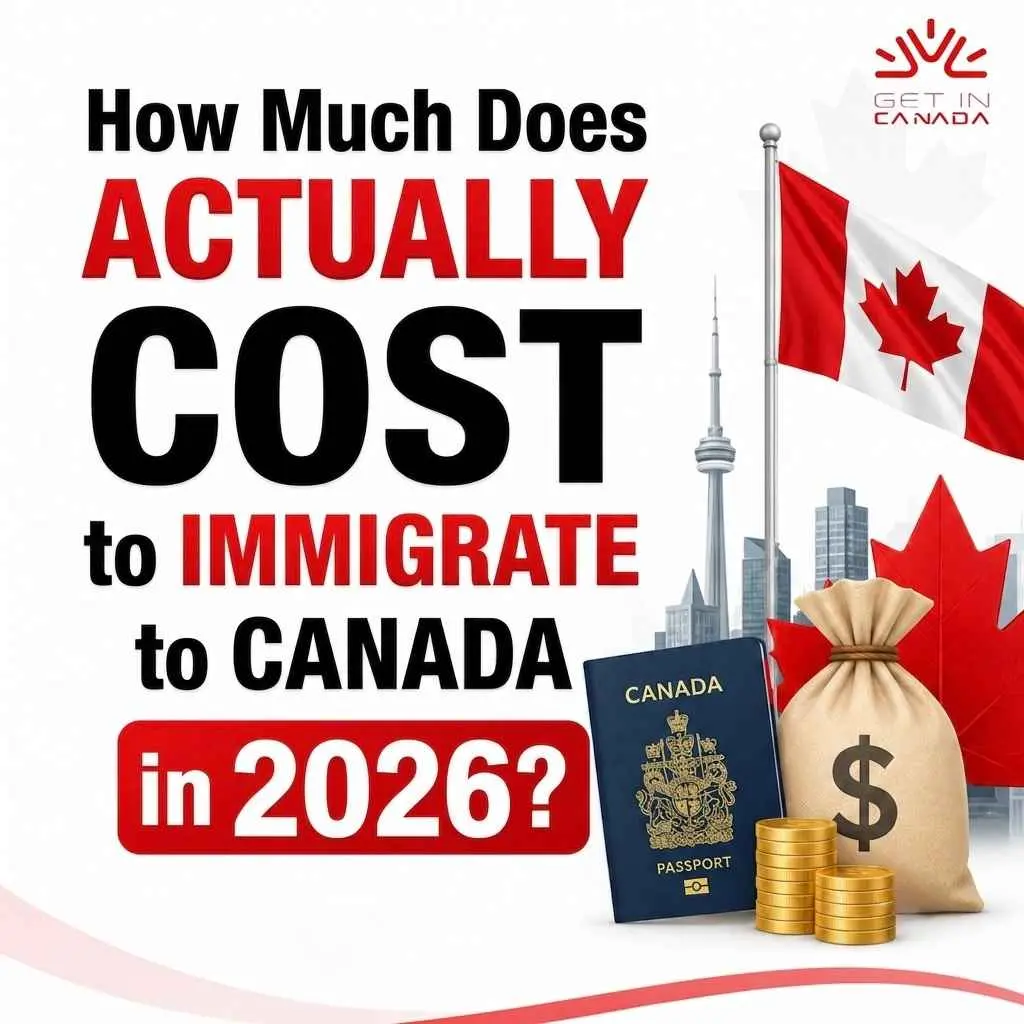
Sound financial planning is the cornerstone of any successful immigration journey that ensures your legal and economic stability in Canada. With continuous price adjustments and regular legislative updates, the most pressing question for applicants remains: “How much money do I actually need to cover all expenses from the initial step until the moment of arrival?”. In this comprehensive and updated 2026 guide, we will put your budget under the microscope to reveal all government fees, as well as hidden or additional costs, allowing you to manage your financial plan strategically and without any unexpected surprises.
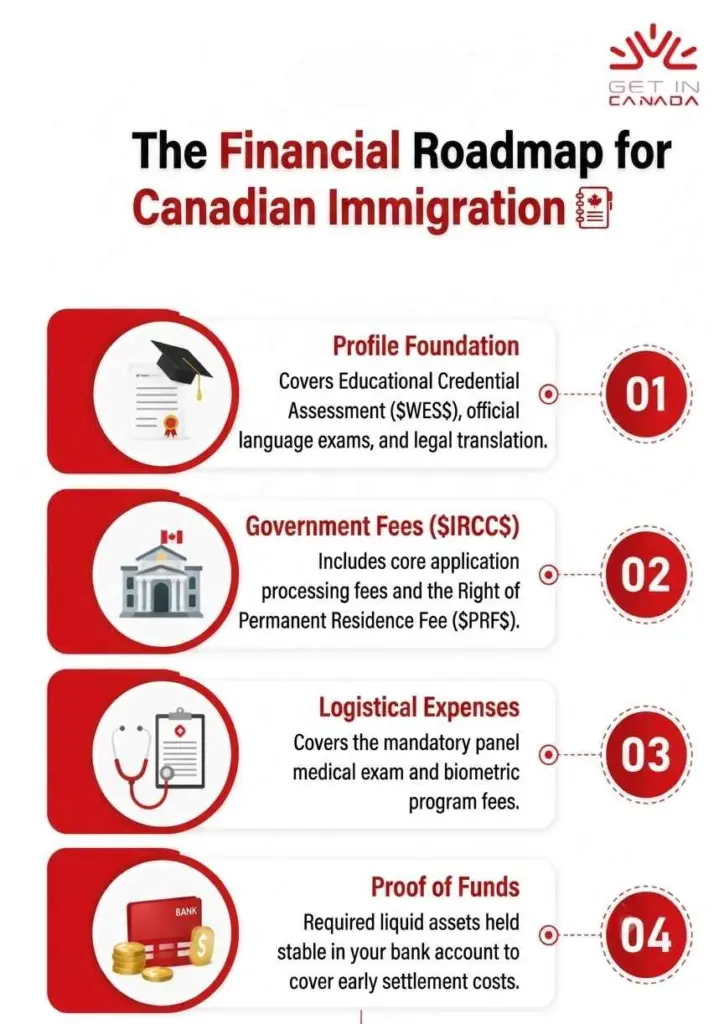
1. Initial Preparation, Educational Credential Assessment (ECA), and Language Test Costs
Before you begin interacting directly with the government’s immigration portal, there are mandatory foundational expenses required to build your document portfolio and prepare your profile to enter the selection pool:
- Educational Credential Assessment ($ECA$): To verify your university degree and match it against Canadian educational standards through approved organizations such as $WES$. The base cost ranges between 220 to 250 Canadian Dollars (CAD), plus international express shipping fees depending on your home country.
- Official Language Proficiency Exams: Whether you take an English language test ($IELTS$ or $CELPIP$) or a French language test ($TEF$ or $TCF$), the cost for a single exam attempt ranges between 250 to 310 CAD, depending on the testing center and country.
- Legal Translation and Document Certification: Translating all vital statistics documents, birth certificates, marriage certificates, and employment reference letters into English or French through certified translation offices. The total estimated cost ranges between 100 to 300 CAD, depending on the volume of documents.
2. Official Government Processing Fees (IRCC)
Once your profile is drawn and you receive an official Invitation to Apply ($ITA$), you enter the mandatory phase of paying direct fees to Immigration, Refugees and Citizenship Canada ($IRCC$). These amounts are explicitly structured as follows:
- Main Application Processing Fees: This costs 950 CAD for the principal applicant, and the same amount (950 CAD) for a legally recognized spouse or common-law partner.
- Right of Permanent Residence Fee ($RPRF$): This costs 575 CAD for the principal applicant, and 575 CAD for the spouse. This is the mandatory fee that grants you the legal right to obtain permanent resident status.
- Dependent Children Fees: This costs 260 CAD per child added to the application, covering all government processing expenses specific to minors.
3. Logistic Expenses, Medical Exams, and Biometrics Costs
These costs emerge during the second half of the application’s procedural track. They are logistical expenses paid directly to third-party centers authorized by the embassy:
- Mandatory Medical Examination: Conducted exclusively by an immigration-approved doctor listed by the Canadian government ($Panel$ $Physician$) to ensure the applicant does not have conditions that could pose an excessive demand on the Canadian healthcare system. The cost ranges between 150 to 300 CAD per person.
- Biometric Program Fees (Fingerprints and Digital Photo): Paid to authorized Visa Application Centers ($VFS$ $Global$). It costs 85 CAD for an individual applicant, or a maximum of 170 CAD for families of two or more individuals when submitting a joint application.
- Police Certificates (Criminal Record Check): The costs associated with extracting official penal certificates from your home country and any country where you lived for 6 consecutive months or more. These are nominal local fees that vary by country.
4. Settlement Funds and Proof of Funds Requirements (Proof of Funds)
Proof of funds is not a fee deducted or paid to any entity; rather, it is a liquid financial reserve that the Canadian government requires to be stable in your bank account for a minimum of 6 months prior to submission. Its purpose is to ensure your capability to cover initial settlement expenses (housing, food, transportation) until you integrate into the Canadian labor market.
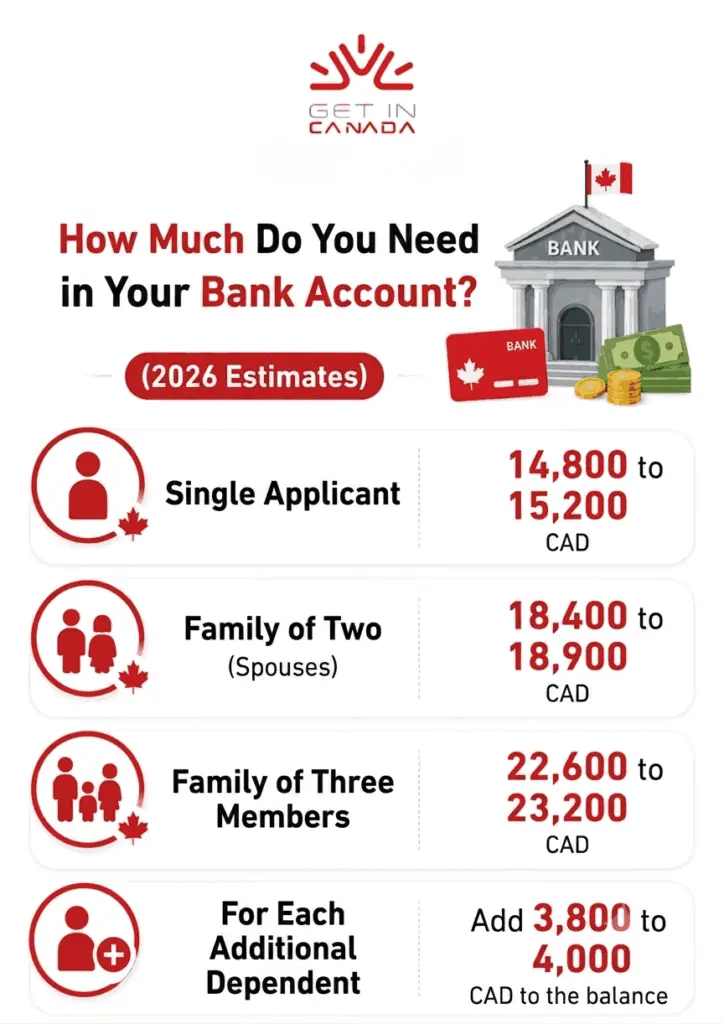
These amounts change annually to keep pace with inflation and cost-of-living indexes, distributed for the year 2026 approximately as follows:
- Single Applicant: Requires a bank budget of no less than 14,800 to 15,200 CAD.
- Family of Two (Spouse and Partner): Requires a budget of no less than 18,400 to 18,900 CAD.
- Family of Three Members: Requires a budget of no less than 22,600 to 23,200 CAD.
- For Each Additional Dependent: The bank account must be increased by approximately 3,800 to 4,000 CAD.
5. Analytical Matrix: Direct Actual Costs Breakdown (Estimated for 2026)
To help you calculate your budget accurately, the table below summarizes the actual direct and spent costs (excluding the settlement fund amount, as it remains under your personal possession):
| Financial Documentation Item | Average Cost for Single Applicant (CAD) | Average Cost for Family of Two (CAD) | Nature and Method of Payment |
|---|---|---|---|
| Foundation Phase (WES + Language + Translation) | $650 – $750 | $1,200 – $1,400 | Advance payments to evaluation bodies and exam centers. |
| Federal Processing Fees ($IRCC$) | $950 | $1,900 | Direct electronic payment via the official immigration portal. |
| Right of Permanent Residence Fee ($RPRF$) | $575 | $1,150 | Mandatory for visa issuance and fully refundable if refused. |
| Medical Exam, Biometrics, and Logistics | $250 – $385 | $500 – $770 | Cash or electronic payment to approved medical centers and $VFS$. |
| Total Actual Expenses Cost | $2,425 – $2,660 | $4,750 – $5,220 | Total capital required for direct procedural expenses. |
FAQs About How Much Does It Actually Cost to Immigrate to Canada in 2026?
How to Secure Your Immigration Budget Without Risk or Loss?
Engineering your profile’s financial architecture is not just about gathering the fees; it’s about presenting bank statements that are fully compliant and stable according to Canadian immigration laws to avoid a harsh refusal under “insufficient financial support.” Ongoing updates require absolute precision in payment timing and proving the legitimacy of fund sources in a 100% verified manner.
Don’t jeopardize your capital or leave your financial documentation to guesswork. Book your legal consultation now with the experts at Get In Canada. Let us put your financial file and bank statements under strict legal audit to guarantee full compliance with official requirements, protecting your investment and future from any procedural gaps! 🇨🇦 Your right move begins with a flawless financial strategy today.