Express Entry Draws 2026: What They Mean for Applicants Outside Canada
If you are planning to immigrate to Canada from abroad, following Express Entry draws in 2026 can help you understand which candidates Canada is inviting, how competitive the pool has become, and which immigration pathway may fit your profile.
However, the lowest Comprehensive Ranking System (CRS) score in a draw is not a universal immigration threshold. The result only reflects the candidates invited in that particular round. Your eligibility, language results, work experience, provincial nomination status, and the type of draw all affect how you should interpret the results.
This guide reviews the latest published Express Entry draw results, explains CRS cut-off scores and pool statistics, examines the 2026 selection trend, and outlines practical steps for applicants outside Canada.
1. Reading an Express Entry Draw
Draw Types
Immigration, Refugees and Citizenship Canada (IRCC) conducts different types of Express Entry draws. Understanding the differences is essential because candidates are not necessarily competing in the same selection round.
- General rounds: Invite the highest-ranking eligible candidates across the programs covered by the round.
- Program-specific rounds: Target candidates eligible for a particular Express Entry program, such as the Canadian Experience Class (CEC) or the Provincial Nominee Program (PNP).
- Category-based draws: Target eligible candidates who meet specific criteria established for an immigration category, such as French-language proficiency or qualifying work experience in selected occupations.
A candidate outside Canada may qualify for some Express Entry programs and category-based draws. However, meeting the criteria for a category does not remove the requirement to qualify for an eligible Express Entry program.
Official source: IRCC — Express Entry rounds of invitations.
What the CRS Cut-Off Means and Why It Changes
The CRS cut-off score is the score of the lowest-ranked candidate invited in a specific round. It does not represent a permanent minimum score for Canadian permanent residence.
Several factors can influence the cut-off:
- Draw type: A French-language or healthcare draw selects candidates who meet that category’s criteria, while a CEC draw targets candidates eligible for that program.
- Number of invitations: A round inviting more candidates may reach further down the ranking, although this does not guarantee a lower cut-off.
- Pool composition: The scores and eligibility of candidates in the pool change as new profiles are submitted, existing profiles expire, and invitations are issued.
- Timing and tie-breaking rules: When multiple candidates have the lowest invited score, IRCC may use the profile submission date and time to determine who receives an invitation.
For example, CEC draws in September 2026 recorded cut-offs of 521, 519, and 518. On October 15, IRCC issued 2,500 invitations with a cut-off of 519. Although the number of invitations increased, the cut-off also rose slightly from the previous CEC round.
The lesson is straightforward: past Express Entry draw results can help you assess competition, but they cannot reliably predict the next CRS cut-off.
Book Your Consultation Session →
Latest Express Entry Draws Results: 2026
The following table summarizes selected recent rounds published by IRCC through October 16, 2026.
| Draw date | Draw type | Invitations issued | Lowest CRS score |
|---|---|---|---|
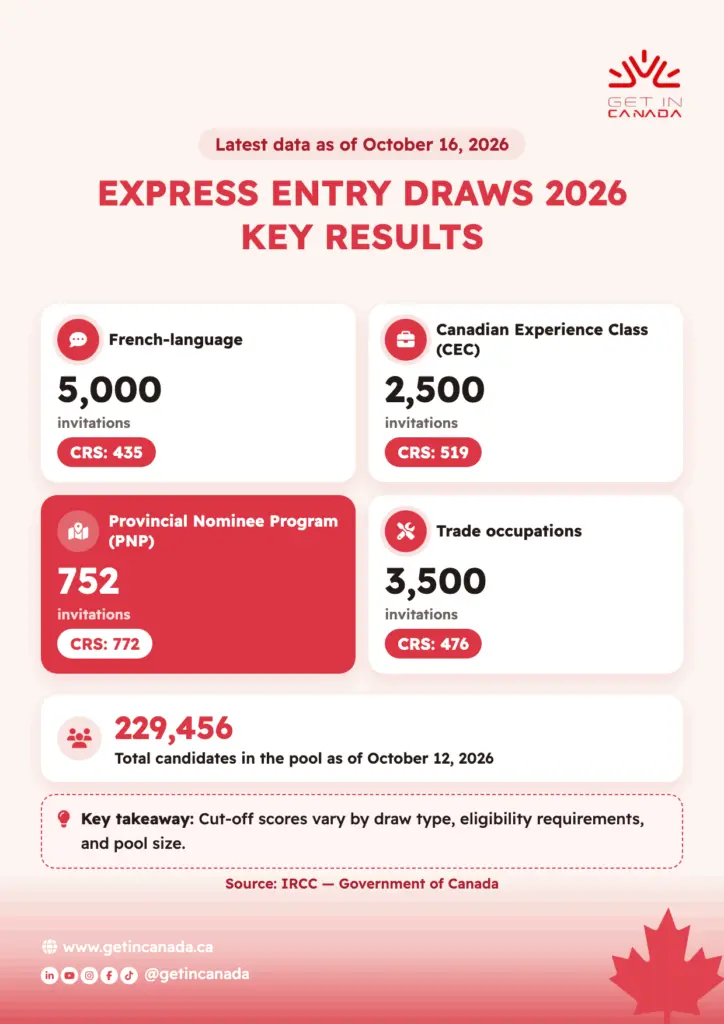
| October 16, 2026 | French-language proficiency | 5,000 | 435 |
| October 15, 2026 | Canadian Experience Class (CEC) | 2,500 | 519 |
| October 13, 2026 | Provincial Nominee Program (PNP) | 752 | 772 |
| October 1, 2026 | Trade occupations | 3,500 | 476 |
| September 29, 2026 | Canadian Experience Class (CEC) | 2,000 | 518 |
| September 28, 2026 | Provincial Nominee Program (PNP) | 733 | 725 |
| September 16, 2026 | Senior managers with Canadian work experience | 250 | 389 |
| September 15, 2026 | Canadian Experience Class (CEC) | 2,000 | 519 |
| September 14, 2026 | Provincial Nominee Program (PNP) | 576 | 734 |
| September 4, 2026 | Healthcare and social services | 3,500 | 475 |
| September 3, 2026 | Physicians with Canadian work experience | 229 | 198 |
| September 1, 2026 | Canadian Experience Class (CEC) | 2,000 | 521 |
Source: Official IRCC draw results.
What do these results tell us?
- The October 16 French-language draw invited 5,000 candidates at a minimum CRS score of 435.
- CEC cut-offs remained within a relatively narrow range in the listed September and October rounds, moving from 521 on September 1 to 518 on September 29, then to 519 on October 15.
- PNP draw cut-offs were substantially higher, ranging from 725 to 772 in the listed rounds. These scores reflect the ranking system and the additional CRS points associated with an eligible Express Entry-linked provincial nomination.
- The physicians-with-Canadian-work-experience draw had a cut-off of 198, but it targeted a specific group and should not be treated as a benchmark for other applicants.
These results demonstrate why candidates should compare like with like. A cut-off from a category-based draw may not be relevant to someone who does not meet that category’s eligibility requirements.
Book Your Consultation Session →
The 2026 Trend: Preference for Candidates with Canadian Experience
Several 2026 rounds have targeted candidates with Canadian experience, including CEC draws and category-based rounds for physicians and senior managers with Canadian work experience.
This pattern is important for applicants outside Canada, but it needs careful interpretation. It does not mean that all Express Entry pathways require Canadian experience or that overseas candidates cannot receive invitations.
The French-language and trade-occupation rounds listed above illustrate that IRCC also invites candidates through other selection criteria. The relevant question is whether you qualify for a particular program or category—not simply whether you already live in Canada.
Applicants abroad should therefore consider two parallel strategies:
- Determine whether they qualify for a category-based draw, such as French-language proficiency or an eligible occupational category.
- Assess their eligibility for the Federal Skilled Worker Program or another suitable Express Entry pathway and identify ways to strengthen their CRS profile.
Selection priorities can change. Review the official draw history and current eligibility rules before making a decision based on an apparent trend.
Pool Size and What It Means
IRCC publishes the distribution of candidates in the Express Entry pool by CRS score range. This information helps explain the level of competition, but it does not show exactly how many candidates qualify for a particular draw.
As of October 12, 2026, the pool contained 229,456 candidates.
| CRS score range | Number of candidates |
|---|---|
| 601–1,200 | 749 |
| 501–600 | 21,638 |
| 451–500 | 71,612 |
| 401–450 | 63,528 |
| 351–400 | 47,167 |
| 301–350 | 17,123 |
| 0–300 | 7,639 |
| Total | 229,456 |
Source: IRCC — Draw results and CRS score distribution.
Three observations stand out:
- The 451–500 range is the largest listed range. It contained 71,612 candidates on October 12, making competition within this broad score band an important consideration.
- More than 21,000 candidates had scores between 501 and 600. A high score may improve ranking, but it does not automatically make someone eligible for every draw.
- The pool changes over time. The total increased by 448 candidates compared with the September 27 snapshot, even as some higher-scoring ranges decreased. New profiles, expired profiles, and invitations all contribute to these changes.
The pool distribution is a snapshot, not a prediction. It cannot tell you exactly when the next draw will occur, what its cut-off will be, or how many candidates ahead of you qualify for a particular category.
Book Your Consultation Session →
2. Your Plan by Draw Type
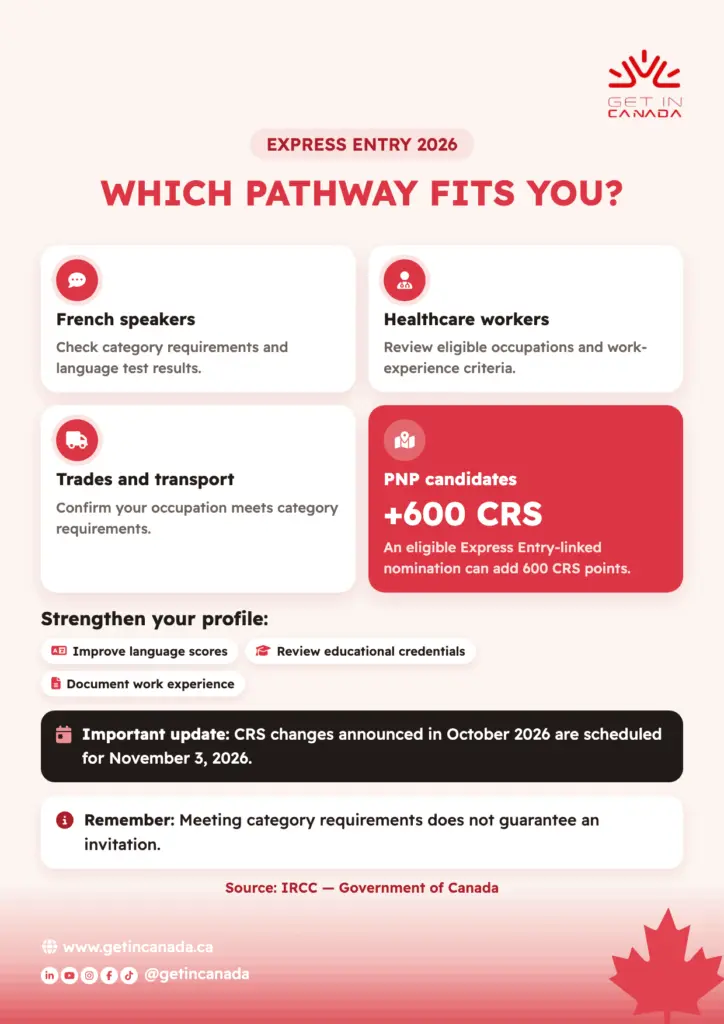
Your best strategy depends on your qualifications, language results, work experience, and eligibility. If you are applying from outside Canada, start by identifying the draw types you could realistically qualify for rather than focusing on the lowest CRS score in the latest results.
If You Speak French
French-language proficiency may create an additional pathway for candidates who qualify for an Express Entry program and meet the category’s language requirements.
- Check your test results: The French-language category generally requires a minimum of NCLC 7 in all four language abilities under the applicable criteria.
- Confirm program eligibility: Meeting the language threshold alone is not enough. You must also qualify for an eligible Express Entry program.
- Compare relevant draw results: The October 16, 2026 round issued 5,000 invitations at a CRS cut-off of 435. Treat this as a historical result, not a promise that the next cut-off will be similar.
- Assess your full language profile: Stronger approved language-test results may affect your CRS score, depending on your current results and other profile factors.
Your next step: Review the official French-language category criteria, confirm your eligibility, and calculate your current CRS score. If you have not taken an approved French test, determine whether doing so is a realistic way to strengthen your profile.
If You Work in Healthcare
Healthcare and social services draws target eligible occupations, not everyone employed in a healthcare setting. Your job title alone does not determine whether your work experience qualifies.
- Check your National Occupational Classification (NOC): Compare your actual duties with the official occupation description and the current category list.
- Review the work-experience requirement: The applicable category criteria specify qualifying experience requirements, including the required duration and reference period. Check the current IRCC instructions before relying on a particular threshold.
- Match your duties to the occupation: Eligibility may depend on the work you actually performed, not simply your employer or job title.
- Compare the relevant draw results: On September 4, 2026, IRCC issued 3,500 invitations in a healthcare and social services round with a CRS cut-off of 475.
That cut-off is useful context, but it does not guarantee an invitation for every healthcare professional with the same score. You must qualify for the category and an eligible Express Entry program.
Your next step: Identify your NOC, check the current category list and work-experience rules, and compare your CRS score with relevant healthcare draws.
If You Work in Trades or Transport
Some trade occupations and transport occupations may qualify for category-based selection, but not every job in construction, maintenance, logistics, or transportation is included.
- Check the eligible occupation list: Verify your NOC and actual job duties against the current IRCC criteria.
- Review the experience rules: Confirm the required duration, reference period, and other conditions for the category you are targeting.
- Distinguish category eligibility from program eligibility: Qualifying for a category-based draw does not replace the requirement to qualify for an eligible Express Entry program.
- Do not confuse a category draw with a separate immigration program: The Federal Skilled Trades Program has its own eligibility rules, which may differ from those for a trade-occupation category draw.
- Compare only relevant results: The October 1, 2026 trade-occupation draw issued 3,500 invitations at a CRS cut-off of 476. Transport occupations have separate criteria and draw history; do not assume the trade cut-off applies to transport applicants.
Your next step: Confirm your occupation against the official category list, check the experience requirements, and determine whether you qualify for a category-based round, the Federal Skilled Trades Program, or another Express Entry pathway.
If You Have a Provincial Nomination (PNP)
A provincial nomination may significantly improve your ranking if it is issued through a pathway linked to Express Entry and you meet the applicable requirements.
- Research suitable provincial programs: Provinces and territories have different eligibility criteria and priorities. Some pathways may consider occupation, work experience, education, language, or other factors.
- Confirm that the pathway is linked to Express Entry: Not every provincial nomination stream operates through Express Entry.
- Understand the CRS impact: An eligible provincial nomination linked to Express Entry can add 600 CRS points.
- Check the conditions before applying: A nomination is not automatic. You must meet the requirements of the specific provincial or territorial program.
- Interpret PNP cut-offs correctly: The October 13, 2026 PNP round issued 752 invitations at a CRS cut-off of 772. The high cut-off reflects the ranking structure of that round and should not be compared directly with category-based draws.
Your next step: Identify provinces where your profile may be a match, review their official nomination requirements, and confirm how a nomination would affect your Express Entry profile.
Book Your Consultation Session →
How to Track Draws Yourself
Following official Express Entry draws helps you make decisions based on current information rather than predictions or outdated figures.
- Use the official IRCC draw page. Start with the Rounds of invitations page.
- Record the date and draw type. Note whether the round was general, program-specific, or category-based.
- Track invitations and the CRS cut-off. Keep a simple record so you can compare similar draws over time.
- Check the tie-breaking rule. If your CRS score matches the cut-off, the profile submission date and time may affect whether you are invited.
- Read the category criteria. A score above a published cut-off does not make you eligible if you do not meet the draw’s requirements.
- Review the pool distribution. Use it to understand the broad score landscape, not to predict the next draw or calculate your exact odds.
- Check policy changes before updating your plan. Changes to CRS rules or program eligibility can affect your strategy, so consult IRCC announcements before making decisions.
Remember that a draw result is a record of a completed round—not a guarantee of the next one. Applicants outside Canada should combine regular monitoring with an eligibility assessment and a realistic plan to improve their profiles.
Book Your Consultation Session →
3. How to Improve Your CRS Score in 2026
If your current CRS score is below the cut-offs in relevant draws, review which factors you can realistically improve. The impact of each change depends on your qualifications and circumstances.
- Improve your language results: Higher scores in approved language tests may increase your CRS points. The effect depends on your existing results and other profile factors.
- Review your education credentials: Check whether you need an Educational Credential Assessment (ECA) for foreign education and make sure your credentials are correctly reported.
- Document your work experience accurately: Ensure that your work history supports the program and category requirements you are claiming.
- Explore provincial nomination options: Research PNP pathways that match your background and confirm their current requirements.
- Check category-based eligibility: French-language proficiency or qualifying occupational experience may open an additional route if you meet the official criteria.
- Keep your profile up to date: Correctly report changes to education, language results, work experience, and other relevant details.
Use the official CRS score calculator to estimate your score, then compare it with rounds for which you meet the eligibility requirements.
Important Update: CRS Changes Announced in October 2026
On October 16, 2026, IRCC announced changes to the CRS and job-offer requirements scheduled to take effect on November 3, 2026. The changes introduce a Labour Market Integration factor and affect how points are awarded for eligible Canadian work experience and qualifying job offers in high-wage occupations.
Under the announced rules:
- Candidates may receive points for eligible Canadian work experience, with additional points for qualifying experience in eligible high-wage occupations, or for a qualifying job offer in an eligible high-wage occupation.
- Candidates cannot combine points for Canadian work experience and a qualifying job offer under this factor; the system will use whichever option gives the higher score.
- The Labour Market Integration factor can provide up to 150 points for candidates without an accompanying spouse or common-law partner, or up to 140 points for candidates with an accompanying spouse or common-law partner.
- Qualifying job offers will no longer require a Labour Market Impact Assessment (LMIA) to qualify for program eligibility or CRS points under the announced changes. IRCC will still assess whether the offer is genuine and meets the applicable requirements.
- IRCC has announced that existing profiles will be recalculated after the changes take effect. The process may take up to two weeks, during which invitation rounds will be paused.
These changes are particularly important when interpreting earlier Express Entry draw results. A CRS score calculated before the new rules take effect may not reflect a candidate’s ranking after recalculation.
For full details, review the official IRCC explanation of the 2026 CRS and job-offer changes.
FAQs
Book Your Consultation Session →
Conclusion
Following Express Entry draws in 2026 can help you understand competition, assess CRS cut-off scores, and identify immigration pathways that may match your profile. However, the lowest score in a particular draw is not a universal threshold, and past results cannot guarantee a future invitation.
If you are applying from outside Canada, start by confirming your eligibility, identifying relevant draw types, and reviewing realistic ways to strengthen your profile. French-language proficiency, eligible occupational experience, and provincial nomination pathways may be worth investigating if you meet their criteria.
Finally, keep track of official IRCC updates. The CRS changes announced for November 3, 2026, may affect candidate scores and rankings, making it especially important to verify the current rules before making immigration decisions.