How Much Does It Cost to Immigrate to Canada in 2026?
How much does it cost to immigrate to Canada in 2026, and how much money should you prepare before applying for permanent residence? The cost of immigrating to Canada depends on your immigration program, family size, application fees, language tests, document preparation, and settlement expenses.
If you are planning to apply through Express Entry, understanding the total Express Entry cost involves more than paying government fees. You may also need to meet Canada’s proof of funds requirement and budget for medical examinations, educational credential assessments (ECA), translations, travel, and your first few months in Canada.
In this guide, we break down the main costs of immigrating to Canada in 2026, including Canada PR application fees and estimated expenses in Canadian dollars (CAD), Egyptian pounds (EGP), and Saudi riyals (SAR). You will also learn how much money you may need based on your family size, which applicants are exempt from proof of funds, and how to plan your budget before starting the application process.
Cost of Immigrating to Canada in 2026: An Overview
The total cost of immigrating to Canada varies depending on the immigration pathway you choose and the number of family members included in your application.
For applicants using Express Entry, expenses generally fall into three categories:
- Government fees: Permanent residence processing fees, the right of permanent residence fee, and biometrics.
- Preparation costs: Language tests, educational credential assessments, medical examinations, translations, and police certificates.
- Settlement funds and landing costs: Money required to support yourself and your family after arrival, including housing, food, transportation, and other essential expenses.
It is important to distinguish between money you must pay during the application process and money you must have available to demonstrate that you can support yourself in Canada. Proof of funds is not an application fee; it is money that remains yours and must be accessible when required.
Book Your Consultation Session →
1. Government Fees for Canadian Permanent Residence
Government fees are a major component of the cost of immigrating to Canada. For many economic immigration programs, including Express Entry, applicants must pay processing fees and, in most cases, the right of permanent residence fee.
The fees below reflect the updated rates effective April 30, 2026, for the relevant economic immigration categories. Always verify the fee schedule for your specific program before submitting your application. Official IRCC fee schedule.
Canada PR Application Fees
| Fee type | Cost (CAD) |
|---|---|
| Principal applicant processing fee | $990 |
| Right of permanent residence fee (principal applicant) | $600 |
| Spouse or common-law partner processing fee | $990 |
| Right of permanent residence fee (spouse or partner) | $600 |
| Dependent child | $270 per child |
| Biometrics — individual | $85 |
| Biometrics — family maximum | $170 |
The right of permanent residence fee is generally payable for the principal applicant and accompanying spouse or partner. It may be paid with the processing fee or later, before permanent residence is granted.
For example, a single applicant who pays both the processing fee and the right of permanent residence fee would pay CAD $1,590 in government fees, excluding biometrics and other expenses.
A couple applying together would generally pay CAD $3,180 for both adults’ processing and right of permanent residence fees, before biometrics and any other costs. Dependent children are charged separately according to the applicable fee schedule.
These figures apply to the relevant economic immigration categories and should not be assumed to cover every Canadian immigration pathway.
Biometrics and Medical Examination Costs
Applicants may need to pay additional fees for biometrics and an immigration medical examination as part of the Canadian immigration process. The biometrics fee is generally CAD $85 per person, with a maximum of CAD $170 for an eligible family applying together. Medical examination costs vary by country, clinic, and required tests, so applicants should confirm the fees with an IRCC-approved panel physician before applying.
2. Additional Costs Before Applying
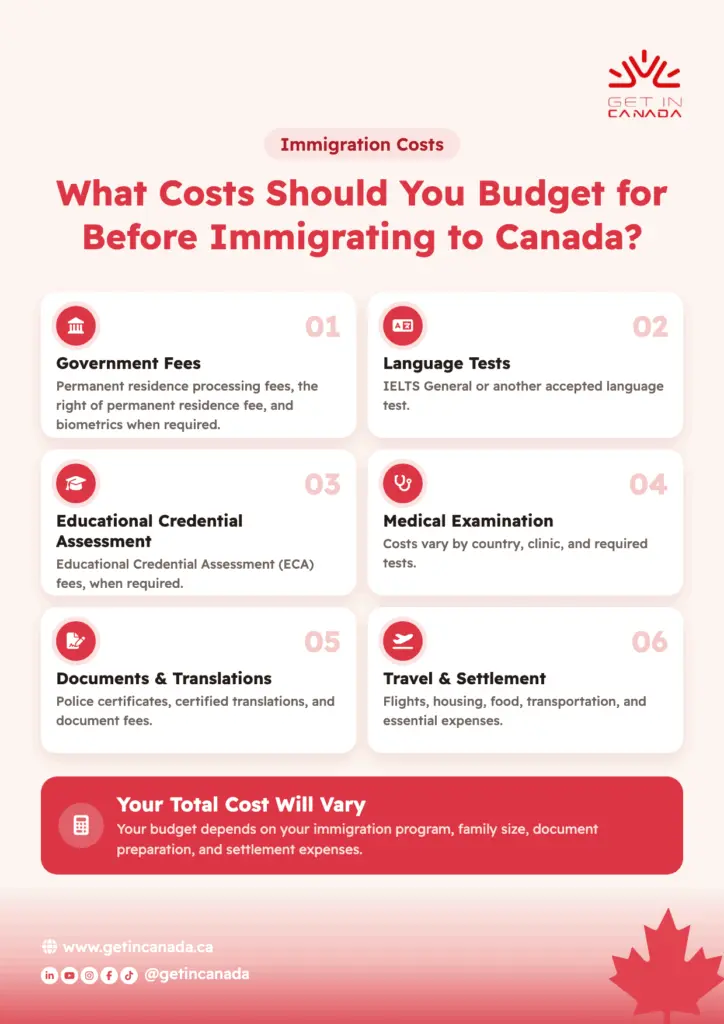
Government fees are only part of the total cost of immigrating to Canada. Preparing the documents required for your application can also involve several expenses.
Language Tests
Express Entry applicants generally need valid language test results that meet the requirements of their immigration program.
Accepted tests for English or French may include:
- IELTS General Training
- CELPIP-General
- PTE Core
- TEF Canada
- TCF Canada
Test prices vary by country, test centre, and test type. Check the official test provider in your country for the current fee and available dates.
If you need to retake a test to achieve the required language score, include the possibility of another test fee in your budget.
Book Your Consultation Session →
Educational Credential Assessment (ECA)
If you completed your education outside Canada, you may need an Educational Credential Assessment to establish how your foreign qualification compares with a Canadian credential.
The cost depends on the designated organization, the type of assessment, and any additional services you require. Other potential expenses include having transcripts issued, obtaining documents from your educational institution, and paying for international delivery.
Check the requirements of the designated organization before ordering an assessment.
Translation and Police Certificates
Some documents may need certified translations into English or French, depending on the requirements of your application.
Potential costs include:
- Certified translations of civil documents, education records, and other supporting documents.
- Police certificates from countries where you have lived.
- Document issuance, certification, or notarization where required.
- Courier or international delivery charges.
The amount you pay depends on the number of documents, the countries involved, and local service providers. Check the specific instructions for each document rather than assuming that every document needs translation or notarization.
Estimated Preparation Costs
| Expense | What affects the cost? |
|---|---|
| Language test | Test type, location, and possible retakes |
| Educational Credential Assessment | Designated organization and assessment services |
| Medical examination | Country, clinic, age, and additional tests |
| Police certificates | Country and document requirements |
| Translation | Number of pages, language pair, and certification |
| Biometrics | Individual or eligible family fee |
| Document delivery | Courier, postage, or international shipping |
There is no single preparation-cost total that applies to every applicant. The best approach is to obtain current quotes from the relevant test providers, assessment organizations, clinics, and translation services.
3. Cost of Immigrating to Canada in EGP and SAR
For applicants living in Egypt or Saudi Arabia, converting Canadian immigration costs into local currency can make budgeting easier.
The following table uses illustrative exchange rates of CAD 1 ≈ EGP 40.14 and CAD 1 ≈ SAR 2.6776. These rates are reference estimates, not guaranteed bank or payment-provider rates. They may change, and the amount charged to you may include conversion fees.
Government Fees in CAD, EGP, and SAR
| Fee | CAD | Approx. EGP | Approx. SAR |
|---|---|---|---|
| Principal applicant processing fee | $990 | 39,739 | 2,651 |
| Right of permanent residence fee | $600 | 24,084 | 1,607 |
| Spouse processing fee | $990 | 39,739 | 2,651 |
| Spouse right of permanent residence fee | $600 | 24,084 | 1,607 |
| Dependent child | $270 | 10,896 | 723 |
| Individual biometrics | $85 | 3,412 | 228 |
| Family biometrics maximum | $170 | 6,824 | 455 |
Currency conversions are rounded estimates. The dependent-child conversion is approximately EGP 10,838 at the stated rate; check the figures against the exchange rate on the day you use the table. Actual payment amounts may differ.
How Much Does It Cost to Immigrate from Egypt?
The cost of immigrating to Canada from Egypt depends on the immigration program, family size, and the documents you need to prepare.
An Egyptian applicant should budget for:
- Canadian permanent residence processing fees.
- The right of permanent residence fee, where applicable.
- Biometrics and medical examinations.
- Language testing and educational credential assessment, if required.
- Police certificates, translations, and document delivery.
- Proof of funds, if the selected pathway requires it.
- Flights, accommodation, and initial living expenses in Canada.
For a single Express Entry applicant, the processing and right of permanent residence fees total CAD $1,590 before biometrics and preparation costs. The equivalent in Egyptian pounds depends on the exchange rate and payment fees at the time of payment.
Book Your Consultation Session →
How Much Does It Cost to Immigrate from Saudi Arabia?
Applicants living in Saudi Arabia should plan for the same main categories of expenses, although local service prices and currency conversion costs may differ.
Before applying, check the current price of your language test, medical examination, translations, and any required certificates in Saudi Arabia. Also consider the cost of flights, temporary accommodation, rental deposits, and daily expenses during your first months in Canada.
Important: Your country of residence does not determine your Canadian immigration fee by itself. The applicable fees depend primarily on your immigration program and the family members included in your application.
4. Proof of Funds Canada: How Much Money Do You Need?
One of the most important financial requirements for some Express Entry applicants is proof of funds.
Proof of funds demonstrates that you have enough money to support yourself and your family after arriving in Canada. It is separate from the government fees paid to process your permanent residence application.
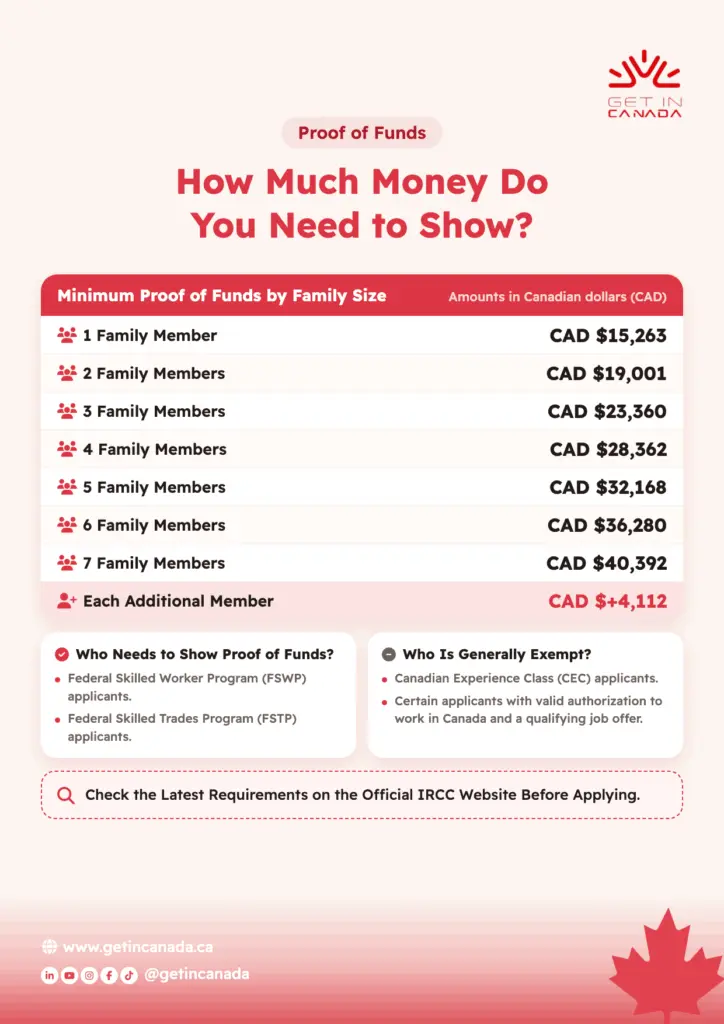
According to IRCC’s published Express Entry requirements, the minimum settlement funds depend on family size. The following figures were updated by IRCC on July 7, 2025; check the official page before applying in case the amounts have changed. IRCC proof of funds requirements.
Minimum Proof of Funds by Family Size
| Family members | Required funds (CAD) | Approx. EGP | Approx. SAR |
|---|---|---|---|
| 1 | $15,263 | 612,659 | 40,868 |
| 2 | $19,001 | 762,100 | 50,888 |
| 3 | $23,360 | 937,070 | 62,558 |
| 4 | $28,362 | 1,138,244 | 75,952 |
| 5 | $32,168 | 1,290,023 | 86,126 |
| 6 | $36,280 | 1,456,279 | 97,147 |
| 7 | $40,392 | 1,622,535 | 108,168 |
| Each additional family member | $4,112 | 165,056 | 11,015 |
Local currency amounts are estimates based on CAD 1 ≈ EGP 40.14 and CAD 1 ≈ SAR 2.6776. They are not additional government fees.
Who Must Show Proof of Funds?
You generally need to meet the proof of funds requirement if you apply through:
- The Federal Skilled Worker Program (FSWP).
- The Federal Skilled Trades Program (FSTP).
Who Does Not Need Proof of Funds?
You generally do not need to meet the Express Entry proof of funds requirement if:
- You apply under the Canadian Experience Class (CEC).
- You are authorized to work in Canada and have a valid job offer, under the conditions specified by IRCC, even if you apply through the Federal Skilled Worker Program or Federal Skilled Trades Program.
Your circumstances and program eligibility matter. Review IRCC’s current rules carefully, particularly if you qualify for more than one Express Entry program.
How to Document Proof of Funds
IRCC requires official letters from banks or financial institutions where you hold accounts. These letters must generally include:
- The financial institution’s contact information.
- Your name.
- Outstanding debts, such as loans or credit card balances.
- Account numbers and account opening dates.
- Current account balances.
- Average balances for the previous six months.
Your money must be legally available to you when you apply and when IRCC issues your permanent resident visa, if approved.
You generally cannot use the equity in real estate or money borrowed from another person to satisfy this requirement. If you use funds held in a joint account with your spouse or partner, ensure that the documentation demonstrates your access to the money.
The family-size calculation includes you, your spouse or common-law partner, and dependent children, including eligible family members who are not accompanying you to Canada.
Book Your Consultation Session →
5. First Three Months in Canada: Landing Costs
Meeting the proof of funds requirement does not mean you should spend all your savings on the move. You will also need a practical budget for the period immediately after arrival.
Your actual expenses depend on where you settle, your household size, whether you have accommodation arranged, and how quickly you find employment.
Main Settlement Expenses
Housing
You may need to pay for temporary accommodation before securing a long-term rental. Depending on the rental arrangement, you may also need money for a deposit, initial rent, and basic household supplies.
Food and groceries
Plan for regular grocery shopping and basic household necessities. Your spending will depend on the number of people in your household and your lifestyle.
Transportation
Include public transportation, local travel, and any necessary transportation from the airport. Costs vary significantly between cities and neighbourhoods.
Phone and internet
You may need a Canadian phone number and internet access for job applications, banking, housing, and communication.
Clothing and essential items
Depending on your arrival date and destination, you may need seasonal clothing, bedding, kitchen supplies, and other essentials.
Emergency expenses
Set aside money for unexpected costs, delays in finding work, additional accommodation, or other urgent needs.
How to Prepare a First-Three-Month Budget
Before travelling, estimate the following costs for your intended destination:
| Budget category | What to estimate |
|---|---|
| Accommodation | Temporary stay, initial rent, and deposit |
| Food | Groceries and essential household items |
| Transportation | Airport transfer and local travel |
| Phone and internet | Initial setup and monthly plan |
| Clothing and supplies | Essential items for the season |
| Employment preparation | Necessary documents, travel, or equipment |
| Emergency reserve | Unexpected expenses and delays |
Research housing and living costs in the city where you intend to settle. Living expenses can differ considerably between large metropolitan areas and smaller communities. IRCC also provides guidance on preparing financially for life in Canada.
6. Hidden Costs to Consider Before Immigrating
Even after calculating government fees, preparation expenses, and proof of funds, some costs can be overlooked.
Before submitting your application, consider the following:
- Additional document requests: You may need to obtain updated documents or additional certificates.
- Language test retakes: Another test attempt can increase your total preparation costs.
- Translation and delivery: More documents or international shipping may increase the cost.
- Currency conversion: Banks and payment providers may apply different exchange rates or transaction fees.
- Travel expenses: Flights, baggage, airport transfers, and temporary accommodation may add up.
- Family-related expenses: Each family member can affect document, medical, travel, and settlement costs.
- Delays: A longer wait before finding work or securing permanent housing may require a larger financial reserve.
The best way to avoid unexpected expenses is to prepare a personalized budget based on your immigration pathway, family size, current document requirements, and destination in Canada.
Book Your Consultation Session →
7. How to Reduce the Cost of Immigrating to Canada
You cannot avoid mandatory government fees, but you can manage some of the other costs involved in preparing your application.
1. Prepare Your Documents Carefully
Review the official document checklist before ordering certificates, translations, or assessments. This can help you avoid paying for unnecessary services or repeating work.
2. Choose the Right Language Test
Compare accepted language tests, local prices, test dates, and available preparation resources. Choose a test accepted for your immigration program and prepare thoroughly to reduce the risk of paying for a retake.
3. Compare Assessment and Translation Services
Check the requirements of the relevant assessment organization and compare service fees where you have a choice. Make sure any service you select meets the official requirements.
4. Keep Your Financial Documents Organized
Prepare your bank documentation early and check that it contains the information IRCC requires. This may help you identify missing details before submitting your application.
5. Plan Your Settlement Budget
Research rental costs, transportation, and living expenses in your intended destination. Consider whether a smaller city or a lower-cost neighbourhood would better fit your budget and employment plans.
6. Use Official Sources
Check the IRCC fee schedule and the official proof of funds page before making payments or finalizing your budget. Immigration rules and fees can change.
FAQs
Book Your Consultation Session →
Plan Your Immigration Budget Before Applying
The cost of immigrating to Canada in 2026 involves more than permanent residence application fees. Applicants may also need to pay for language tests, educational credential assessments, medical examinations, translations, and other documents. Depending on their immigration program, they may also need to demonstrate that they have sufficient settlement funds.
Before you apply, calculate your expected expenses based on your family size, immigration pathway, and intended destination. Verify government fees and proof of funds using the latest IRCC instructions, and use current exchange rates when estimating the amount in Egyptian pounds or Saudi riyals.
A realistic budget can help you prepare for the application process and make a more informed decision about your plans to immigrate to Canada.
Planning your move to Canada? Explore more immigration guides on Get in Canada to understand eligibility requirements, application steps, and the documents you may need.