Cost of Immigration to Canada from the Gulf in 2026: A Full Breakdown
Immigrating to Canada in 2026 is a strategic life project that requires financial awareness far beyond simply paying government fees; it is an investment in a “Plan B” that provides long-term security and stability for your family. This journey begins at testing centers in Dubai, Riyadh, and Doha, passes through the halls of Immigration, Refugees and Citizenship Canada (IRCC), and ends at your new home in one of Canada’s vibrant provinces. We at Get In Canada have prepared this integrated guide to be your most accurate reference for calculating the Cost of Immigrating to Canada in detail, categorized by destinations and pathways to ensure a smart and well-studied decision.
Read Also: Why Do You Need an Immigration Plan B in 2026?
1. Fixed Federal Costs of Immigration to Canada : Your “Entry Ticket” for the Express Entry Pathway
Whether your destination is bustling Toronto or peaceful Winnipeg, there is a unified government bill that must be paid to IRCC to process your application and grant you Permanent Residency. these fees are a mandatory investment covering administrative processing, security screening, and building your legal profile within the Canadian federal system. It is absolutely essential to be precise with these payments, as any deficiency could lead to delays in your file and negatively impact the total Cost of Immigrating to Canada, especially with the updates scheduled for Spring 2026.
1.1 Immigration to Canada Application Processing and Residency Fees (Until April 30, 2026)
These fees include the costs for the primary applicant and their accompanying family members, representing the largest portion of the initial Express Entry budget. You must plan for these amounts in Canadian Dollars (CAD), taking into account bank transfer commissions from local currencies in the Gulf. Any error in estimating these amounts will result in an unexpected increase in the Cost of Immigration to Canada for your family profile. Here is the breakdown for each family member:
- Primary Applicant (Adult): $1,525 (Includes $950 processing + $575 RPRF).
- Spouse/Partner: $1,525 (Same breakdown).
- Dependent Child: $260 per child.
- Biometrics: $85 per individual, or $170 maximum for a family.
1.2 Preparatory Costs and Testing in the Gulf Countries
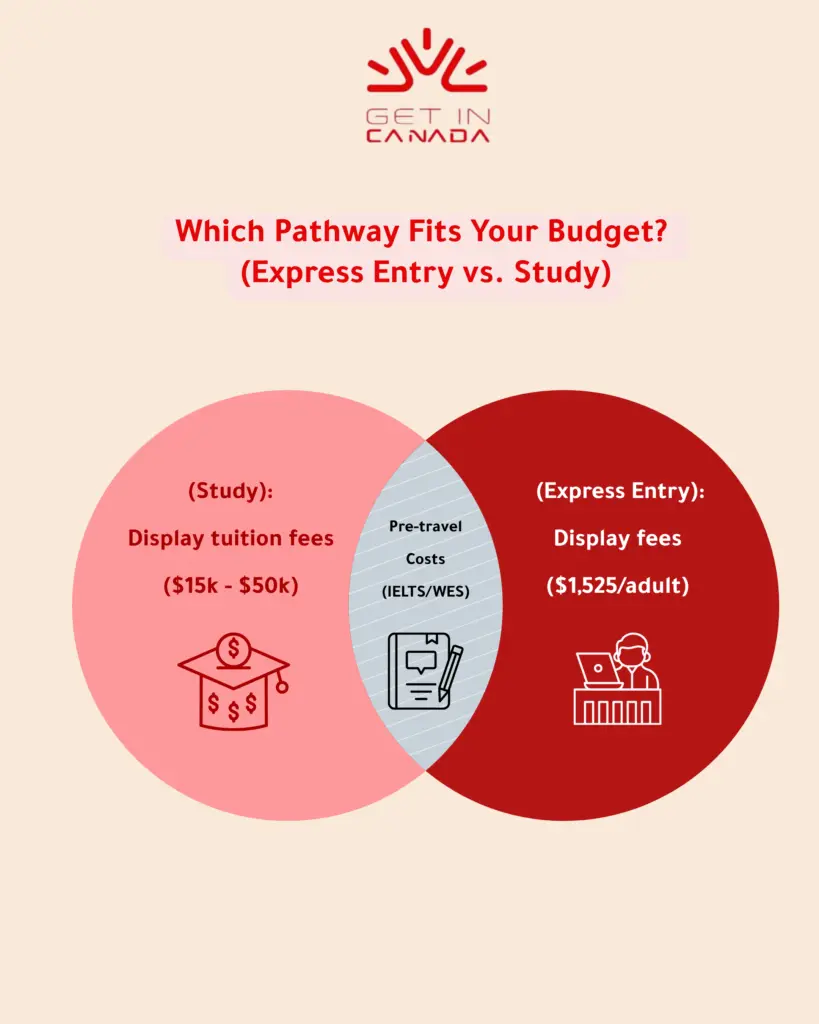
Before the official submission, there is an “operational” budget spent within the Gulf countries to prepare the required international documents and verify your eligibility. These costs include language proficiency tests (IELTS/CELPIP), Educational Credential Assessments (ECA), and the mandatory medical examination, all of which add directly to the Cost of Immigrating to Canada for the year 2026. Here are our estimates based on accredited centers in the UAE, Saudi Arabia, and Qatar:
- IELTS Exam (UAE): ~1,470 AED.
- IELTS Exam (Saudi Arabia): ~1,636 SAR.
- Educational Credential Assessment (WES): $278 to $361 CAD (Including international shipping).
- Immigration Medical Exam: $250 to $450 CAD per person (Depending on the panel physician).
Book Your Consultation Session →
2. Ontario (Toronto): The Beating Economic Heart
Ontario remains the premier destination for immigrants seeking global corporations and limitless professional opportunities, but it also requires the highest budget in Canada. Housing and education in Toronto represent a financial challenge that necessitates deep prior planning, as calculating the Cost of Immigrating to Canada through Ontario reflects the high quality of life and services available. If your budget allows for investment in this province, you will be at the center of the Canadian economic scene in 2026.
2.1 Study and Settlement Pathways in Toronto
Ontario hosts Canada’s most prestigious universities, but it also records the highest average tuition fees, while colleges provide strong economic alternatives that qualify you for the labor market quickly. Housing in Toronto requires a “generous” budget to cover high rents, furnishing costs, and transportation, which are essential elements when evaluating the Cost of Immigrating to Canada for students and families alike.
- University Tuition (Undergraduate): Average $49,802 per year.
- College Option (e.g., Seneca): Starting from $16,732 per year.
- Rent (2-Bedroom Apartment): Average $2,495 per month.
- First 3-Month Settlement Budget: $12,000 to $13,000 (Includes rent, living, and setup).
3. British Columbia (Vancouver): Nature and Opportunity
British Columbia is a unique destination that combines stunning natural beauty with a diverse economy, attracting thousands from the Gulf region annually. The province is characterized by an organized health system and tuition costs that rank second after Ontario, making it a “premium” choice for settlement. Calculating the Cost of Immigrating to Canada for 2026 in this province grants you direct access to technology and global trade markets, but with a budget that requires careful financial management.
3.1 Education and Healthcare Costs in BC
Studying in British Columbia provides students with a world-class academic environment, especially in major universities, with technical college options at competitive prices for mid-range budgets. The province imposes additional monthly fees for international student health coverage (MSP), which must be factored in when calculating the total Cost of Immigrating to Canada for this specific pathway. It is the province that balances academic excellence with a healthy and active lifestyle.
- University Tuition: Average $39,851 per year.
- College Option (Douglas College): Approximately $19,875 per year.
- Health Insurance: $75 per month ($900 per year).
4. Manitoba (Winnipeg): The Smart Family Choice
Manitoba is considered the ideal destination for immigrant families from the Gulf seeking a true balance between employment income and low living costs. The city of Winnipeg provides a stable social environment and excellent educational services, with housing costs considered very “merciful” and helpful in reducing the overall Cost of Immigrating to Canada. Planning to immigrate to Manitoba in 2026 gives you a greater opportunity for savings and rapid stability thanks to the province’s supportive programs.
4.1 Housing and Economic Stability in Winnipeg
Winnipeg is characterized by a variety of housing options at reasonable prices, making the first three-month budget less stressful on your personal savings than anywhere else. A new immigrant in Winnipeg can start in a comfortable apartment with a budget equivalent to half of what they might need in Toronto, making it the top choice for those looking to save on the Cost of Immigrating to Canada.
- University Tuition: Average $21,424 per year.
- College Option (Red River): Approximately $17,739 per year.
- Rent (2-Bedroom Apartment): Average $1,571 per month.
- First 3-Month Settlement Budget: $9,500 to $10,500 (Includes rent and living).
5. Saskatchewan (Saskatoon): Superior Health Protection
Saskatchewan stands out as a unique strategic choice due to its major advantage in providing free government healthcare to eligible international students and their families. The province maintains a stable economy and its cities provide a quiet environment ideal for raising children in a safe and organized community. If you prioritize “health security” when calculating the Cost of Immigrating to Canada for 2026, then Saskatchewan is undoubtedly your top destination.
5.1 Healthcare Advantage and Cost of Living
Although university tuition in Saskatchewan may seem high, the savings on private health insurance costs significantly balance the Cost of Immigrating to Canada budget. Housing in cities like Saskatoon is among the most affordable in Canada, providing families with a golden opportunity for rapid stability and building a solid financial future without the burden of private medical premiums.
- University Tuition: Average $33,064 per year.
- College Option: Approximately $15,000 to $21,000 per year.
- Rent (2-Bedroom Apartment): Average $1,559 per month.
- Health Insurance: $0 (Free government coverage for eligible students).
- First 3-Month Settlement Budget: $9,500 to $10,500.
Book Your Consultation Session →
6. Nova Scotia (Halifax): Atlantic Charm and Economy
Nova Scotia is characterized by accelerating economic growth in technology and logistics, and it welcomes new immigrants through flexible and effective Provincial Nominee Programs (PNP). Its capital, Halifax, is a vibrant coastal city combining natural beauty with increasing job opportunities, offering clear financial benefits in the Cost of Immigrating to Canada through the college pathway. Planning for this province means choosing a socially warm environment and a promising, sustainable professional future in Atlantic Canada.
6.1 Education and Housing in Halifax
Nova Scotia provides excellent educational options through its regional colleges (NSCC), which offer vocational programs at very competitive prices for Gulf students. Calculating the Cost of Immigrating to Canada from a housing perspective in Halifax shows that prices have seen an increase in demand, so the settlement budget here remains slightly higher than Manitoba but still lower than Ontario.
- University Tuition: Average $29,893 per year.
- College Option (NSCC): Approximately $14,060 per year.
- Rent (2-Bedroom Apartment): Average $2,260 per month.
- First 3-Month Settlement Budget: $10,500 to $12,500.
Read also:
- How to Get Canadian PR with a Two-Year College Degree
- The 8 Most Strategic Cities for Newcomers to Canada 2026
- Government Instructions Leave the Door Open for PGP Canada to Return in 2026
- Express Entry CEC Draw Sees Lower Cut-Off Score
7. Quebec (Montreal): Cultural Diversity and Savings
Quebec is considered a world of its own within Canada, where French and English cultures merge to offer a unique and different life experience for every resident. Montreal, its largest city, is a global student capital characterized by highly competitive rental prices that positively impact reducing the overall Cost of Immigrating to Canada. Planning to immigrate to Quebec requires language awareness, but it provides significant financial advantages in living, education, and social integration.
7.1 Unique Education System and Health Insurance in Quebec
Quebec adopts the “CÉGEP” education system, which provides technical and academic programs at reasonable prices, alongside world-class universities like “McGill.” When studying the Cost of Immigrating to Canada through Quebec, we find that health insurance is professionally managed through educational institutions with clear budgets, alongside housing options that suit all financial levels.
- University Tuition: Average $36,279 per year.
- College Option (CÉGEPs): Approximately $7,354 to $11,398 per full-time session.
- Health Insurance: Approximately $900 to $1,155 per year.
- Rent (Montreal): Average $1,913 per month.
- First 3-Month Settlement Budget: $10,500 to $11,500.
8. Alberta (Calgary): Economic Power and Stability
Alberta is the dream destination for those seeking work in the energy and engineering sectors, as it is known for having the lowest taxes in Canada (with no provincial sales tax). The city of Calgary combines modernity with rapid growth and provides a high standard of living, making the Cost of Immigrating to Canada through this province a long-term investment. Settling in Alberta is a strategic decision for those who want to maximize the “net profit” from their monthly salary away from provincial tax pressures.
- Rent (Calgary): Average $1,815 per month.
- First 3-Month Settlement Budget: $10,000 to $11,000 (Includes rent, living, and setup).
9. Flight Budget and Proof of Funds for 2026
No immigration plan is complete without calculating the cost of “air travel” from the Gulf, in addition to providing the “Proof of Funds” amount required by the government. Flight tickets from Dubai, Riyadh, or Doha vary sharply by season, so timing is the key to saving on the total Cost of Immigrating to Canada. As for proof of funds, it is not a fee, but a bank “safety net” that ensures you and your family can face the burdens of life in Canada before obtaining your first job.
9.1 Flights from the Gulf (Practical Examples)
Long-haul ticket prices are affected by peak seasons (Summer and New Year), so we advise Gulf applicants to choose “low season” travel times to reduce the initial Cost of Immigrating to Canada. Here are the average prices for 2026 (Round trip per person):
- From Riyadh: February (~$1,056) | August (~$1,528).
- From Dubai: Low Season (~$1,125 – $1,235).
- From Doha: Low Season (~$1,349 – $1,431).
9.2 Settlement Funds for Express Entry
This amount is a legal requirement for federal pathways to ensure your ability to settle, and it must be “liquid” and readily available to serve the Cost of Immigrating to Canada in your early days:
- 1 Person: $15,263 CAD.
- Family of 3: $23,360 CAD.
- Family of 4: $28,362 CAD.
Book Your Consultation Session →
10. Comprehensive Provincial Comparison: How to Choose Your Destination?
Choosing the most suitable province in 2026 is the real key to successfully managing the total Cost of Immigrating to Canada; as the financial gaps between Canadian cities can save you and your family thousands of dollars annually. This comparison is not just about rent prices or tuition fees, but about the “Value Added” by each province, such as free government healthcare, lower provincial taxes, or the speed of employment in your professional field. At Get In Canada, we provide you with this comparison table to be your final compass in making a decision that balances your career ambitions with your financial capabilities.
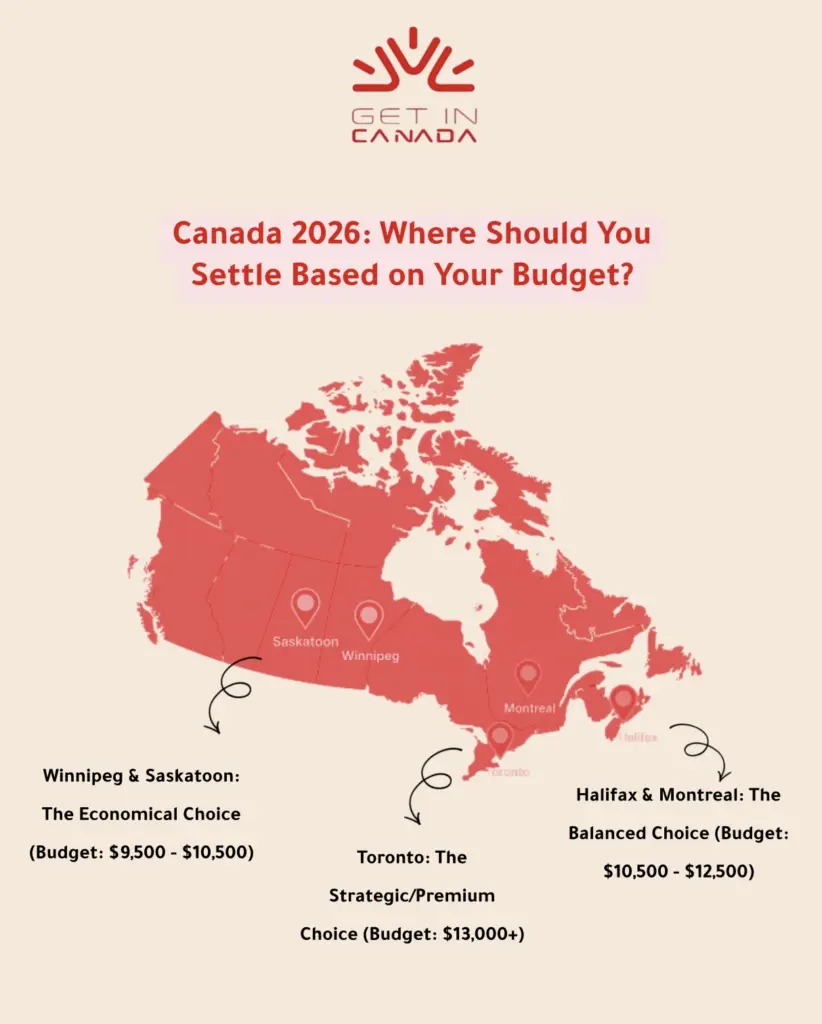
2026 Settlement and Education Cost Comparison Table
| Province (City) | Key Advantage | Avg. 2-Bedroom Rent (Monthly) | 3-Month Settlement Budget |
| Ontario (Toronto) | Global Financial & Job Hub | $2,495 | $12,000 – $13,000 |
| Manitoba (Winnipeg) | Most Economical Choice for Families | $1,571 | $9,500 – $10,500 |
| Saskatchewan (Saskatoon) | Free Government Healthcare for Students | $1,559 | $9,500 – $10,500 |
| Nova Scotia (Halifax) | Rapid Growth & Lower College Costs | $2,260 | $10,500 – $12,500 |
| Quebec (Montreal) | Cultural Diversity & Moderate Living Costs | $1,913 | $10,500 – $11,500 |
| Alberta (Calgary) | Lower Taxes & High Average Income | $1,815 | $10,000 – $11,000 |
Fee Update on April 30, 2026
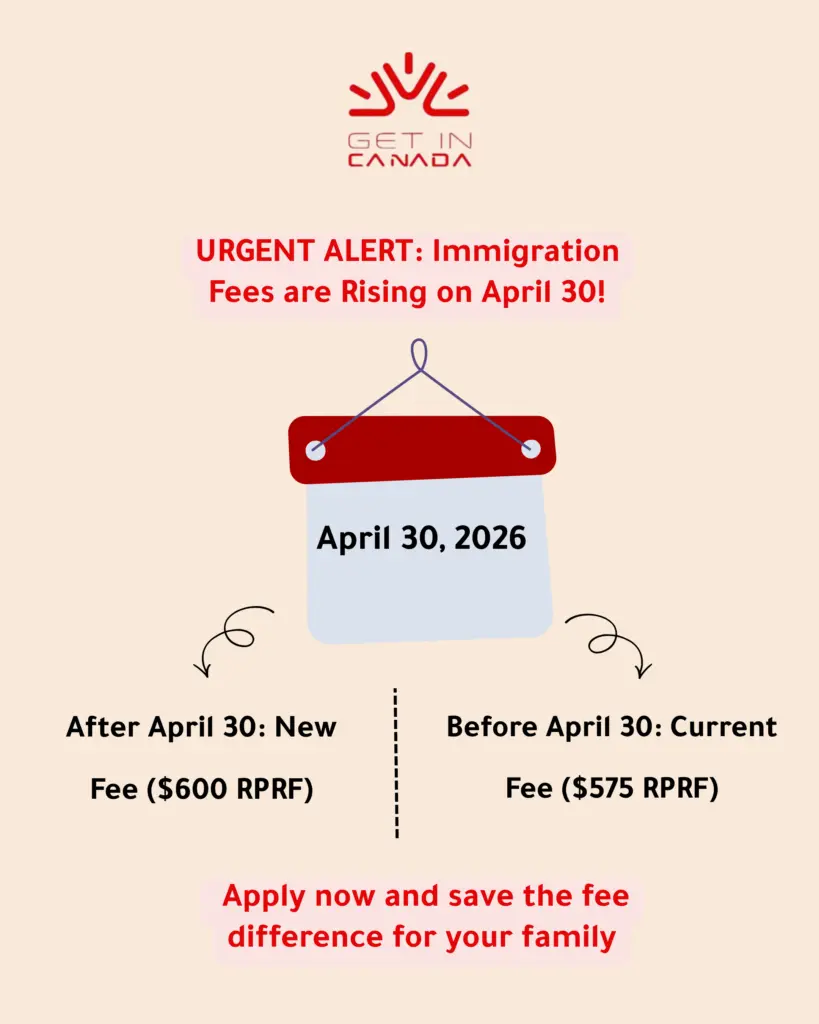
Everyone planning to immigrate in 2026 must pay close attention to this pivotal date; IRCC has announced an official increase in the Right of Permanent Residence Fee (RPRF). The fee will rise from $575 to $600 CAD per adult, meaning a total increase in the Cost of Immigrating to Canada for your family profile. If you have the required documents now, applying before the end of April 2026 is a wise financial decision that saves you from these new fee increments.
Note: All prices mentioned are estimates based on official and market figures for 2026 and are subject to change according to government policies and testing center updates.
Get In Canada Tip:
Always remember that the Cost of Immigrating to Canada is a long-term investment; a province that may seem more expensive at first (like Ontario) may offer faster job opportunities, while economic provinces (like Manitoba or Saskatchewan) grant you immediate financial stability and protection for your family from day one.