Study in Canada with a Work Permit: IRCC’s New Policy
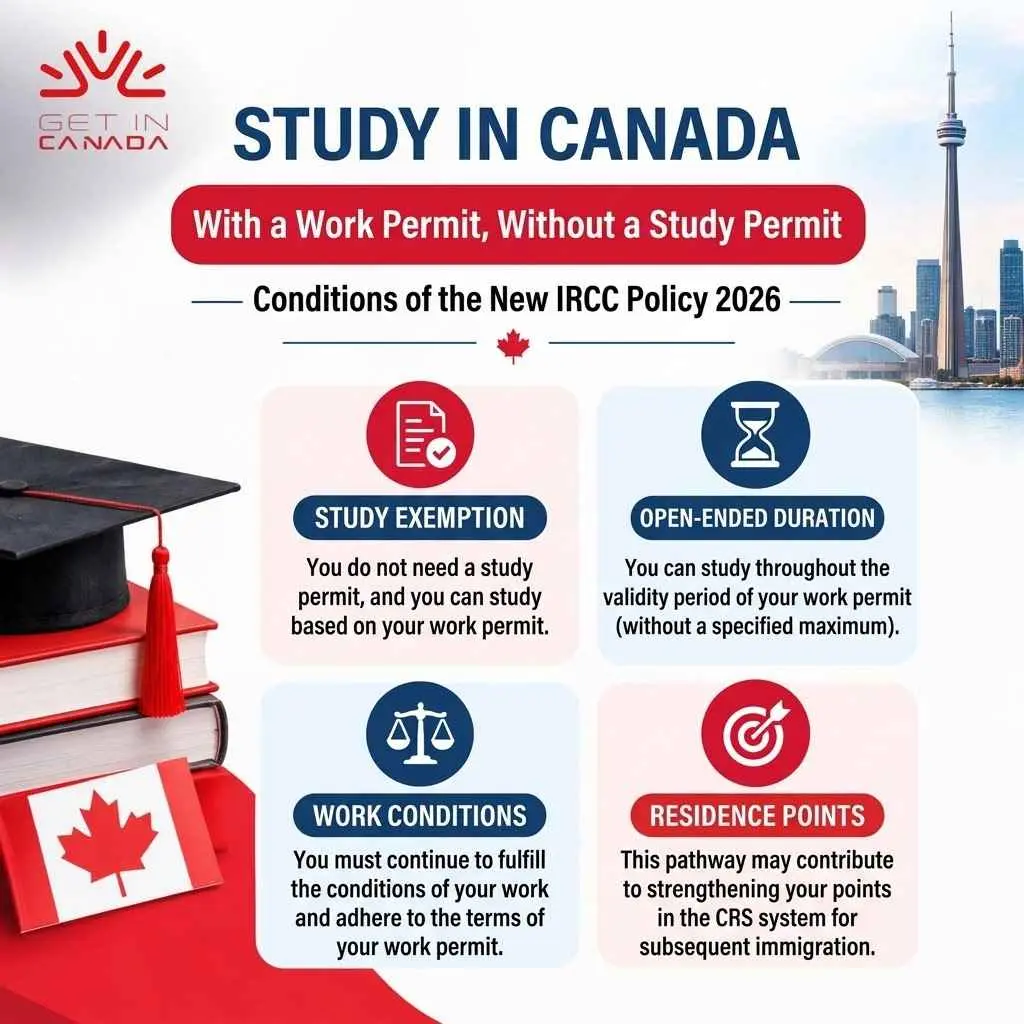
Can you study in Canada without a study permit? Under IRCC’s latest public policy, foreign nationals holding a valid Canadian work permit can enroll in full-time or part-time programs of any duration without applying for a separate student visa. This guide covers eligibility criteria, program duration limits, working while studying, and the critical rules governing Canadian Experience Class (CEC) points.
1. What Is IRCC’s New Study Policy?
This policy removes the traditional restriction that prevented foreign workers from taking courses longer than six months without a formal study permit. It allows qualifying temporary workers to enroll in full-time or part-time programs of any duration at Designated Learning Institutions (DLIs) while keeping their primary status as workers.
- Core Objective: Enables temporary workers to upgrade credentials, gain Canadian training, and transition into higher-skilled roles.
- Duration Waiver: Waives Section 188(1) limits, allowing participation in multi-year diplomas, degrees, or certifications.
- Regulatory Exemption: Eliminates the administrative step of applying for a standard study permit for qualified workers.
2. Who Can Study Without a Study Permit?
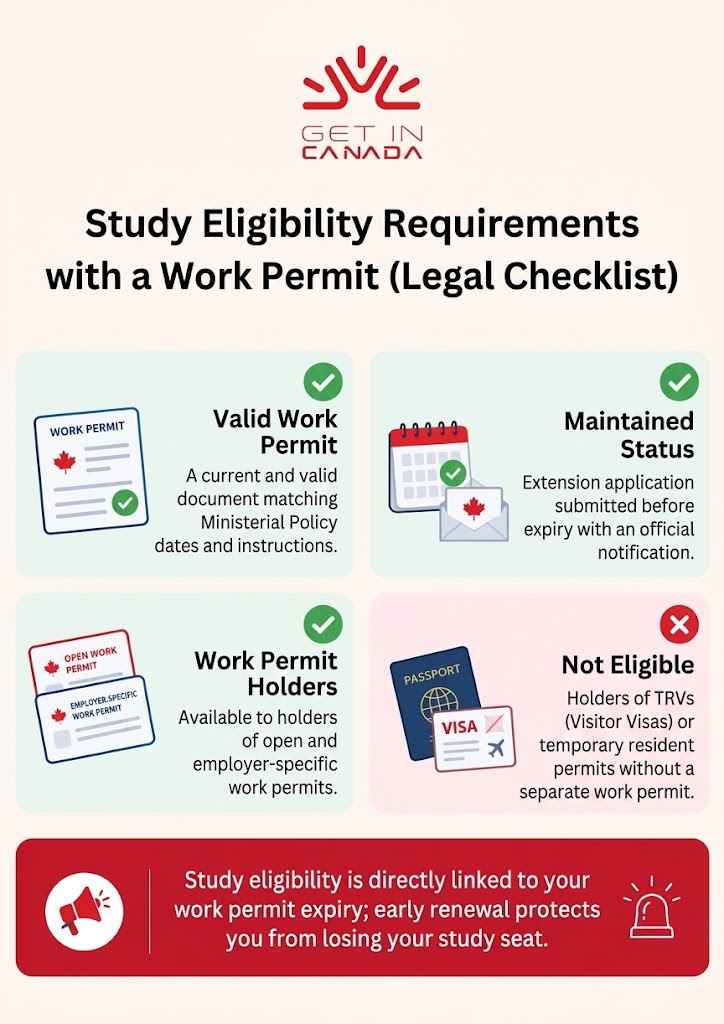
The exemption applies to foreign nationals who held a valid work permit or had a pending renewal application submitted before the qualifying cut-off dates. Eligible candidates must maintain legal status and continuous work authorization throughout their academic studies.
- Valid Work Permit Holders: Individuals possessing an active, unexpired open or employer-specific work permit issued under standard federal streams.
- Maintained Status Applicants: Workers who submitted a timely extension or renewal application prior to permit expiry and hold maintained status.
- Open & Closed Permits: Covers Post-Graduation Work Permits (PGWP), spousal open work permits, and LMIA-based closed permits alike.
- Excluded Profiles: Visitors, undocumented individuals, and holders of temporary resident permits without work authorization cannot use this exemption.
3. How Long Can You Study?
Under this policy, IRCC places no restriction on the length of your educational program, whether it is a micro-credential or a degree. However, your authorization to study without a study permit is strictly tied to the expiration date of your underlying work permit.
What If Your Work Permit Expires?
Your permission to study terminates immediately on the day your work permit expires, regardless of whether your semester has ended. To continue your education lawfully, you must apply for a standard study permit or successfully renew your work authorization before that deadline.
- Loss of Authorization: You cannot attend lectures or complete exams without an active work permit or an approved study permit.
- No Automatic Student Status: The policy does not grant student status; you remain categorized legally as a temporary foreign worker.
- Timely Transition: You must submit a formal study permit application prior to permit expiration if you cannot extend your work status.
What If the Program Exceeds Six Months?
You may enroll in programs extending past six months, but you must ensure your work permit covers the entire period of study. If the academic program outlasts your work document, you will need to obtain a separate study permit to complete the remaining credits.
- Multi-Year Programs: Enrolling in two-year diplomas or four-year degrees is legal, but requires a long-term status strategy.
- DLI Verification: The educational institution must verify your ongoing legal authorization to study as your permit expiry approaches.
- No Additional PGWP: Completing studies under this work-permit exemption does not grant eligibility for a second Post-Graduation Work Permit.
4. Documents Required to Prove Eligibility
You must present verified proof of your legal status to your school’s registrar before enrolling, as IRCC does not issue a specific study authorization letter. Providing accurate documentation ensures the educational institution confirms your eligibility under the temporary public policy without delays.
- Valid Work Permit: The physical or digital copy of your current, unexpired Canadian work permit showing the valid issuance date.
- Acknowledgment of Receipt (AOR): Official IRCC proof of application submission if you are currently studying under maintained status.
- Public Policy Reference: A copy of IRCC’s published operational instructions detailing the temporary exemption for institutional records.
- Valid Passport: An unexpired travel document confirming that your personal identification matches your immigration documents.
5. Working While Studying
Your primary obligation under immigration law remains complete compliance with the statutory conditions listed on your work permit. Enrolling in courses does not excuse you from fulfilling mandatory employment duties or contracted work hours.
- Employer-Specific Permits: You must continue working for the employer named on your LMIA or permit for the full required hours.
- Reducing Work Hours for Study: Hours on a closed permit can only be reduced if approved by the employer and compliant with minimum LMIA wage thresholds.
- Open Work Permit Flexibility: Open permit holders may adjust, reduce, or pause employment to accommodate study schedules without violating conditions.
- No Campus Work Rights: Work permit holders cannot access standard international student work benefits, such as student on/off-campus work hours under IRPR 186(v).
6. Studying in Quebec and the CAQ Exemption
Quebec maintains autonomous jurisdiction over educational admissions and requires international students to obtain a Certificat d’acceptation du Québec (CAQ). Foreign workers planning to study in Quebec must review both federal regulations and provincial rules to ensure full compliance.
- Provincial CAQ Rules: Quebec law traditionally mandates a CAQ for any educational program running longer than six months.
- MIFI Harmonization: Workers must check if their selected institution applies provincial exemptions aligned with IRCC’s federal study policy.
- Registrar Confirmation: Confirm directly with your Quebec institution’s international office whether a CAQ waiver covers your specific permit.
- Dual Compliance: An exemption from an IRCC study permit does not automatically waive provincial immigration requirements in Quebec.
7. Co-op Work Placement Requirements
Academic programs that require internships or co-op work placements to graduate demand careful review of your work authorization type. Your ability to complete practical training without additional permits depends on whether your work document is open or employer-specific.
- Open Work Permits: An open work permit allows you to complete any internship, practicum, or co-op placement without an additional permit.
- Closed Work Permits: An employer-specific permit strictly restricts you to one employer; you cannot legally work for an outside internship host.
- Applying for a Co-op Permit: Closed permit holders enrolled in programs with mandatory work terms must apply for a separate Co-op Work Permit from IRCC.
8. Impact on Express Entry and CEC
Studying while working can affect your Comprehensive Ranking System (CRS) score and eligibility under Express Entry streams. The timing of your studies and whether enrollment is full-time or part-time dictates how IRCC assesses your accumulated Canadian work experience.
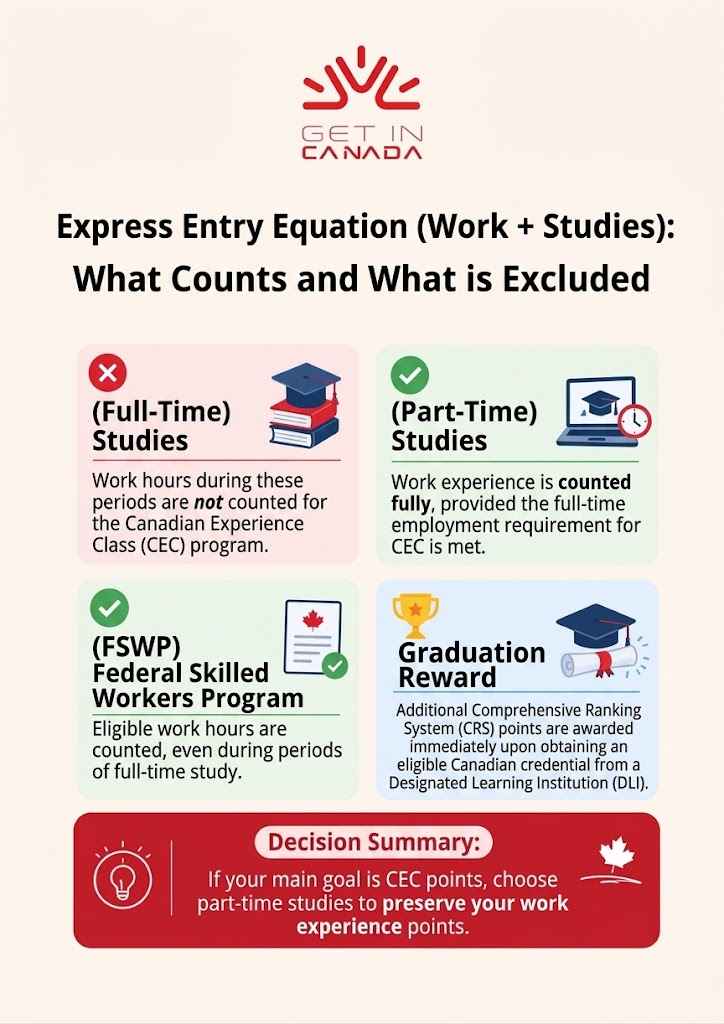
- Canadian Experience Class (CEC) Exclusion: Canadian work experience acquired while enrolled in full-time studies cannot be counted toward CEC eligibility requirements.
- Part-Time Study Allowance: Work performed while studying part-time can qualify for CEC, provided you maintain continuous qualifying full-time employment.
- Federal Skilled Worker Program (FSWP): Work experience gained during full-time studies remains creditable for FSWP eligibility if it was paid, continuous, and skilled.
- CRS Education Points: Completing a Canadian credential at an eligible DLI allows you to claim additional education points under the Express Entry matrix.
9. New Policy vs. the Previous Policy
The following comparison details the operational differences between the historic regulatory baseline and the temporary public policy. Understanding these distinctions helps workers assess their options for advancing their education while employed in Canada.
| Parameter | Previous Historical Regime | IRCC Temporary Public Policy |
| Maximum Study Duration | Capped strictly at 6 months or less. | Unlimited duration (within permit validity). |
| Degree/Diploma Enrollment | Prohibited without an approved study permit. | Fully permitted without a study permit. |
| Application Process | Required a formal study permit application and processing fee. | Zero application; automatic exemption for eligible workers. |
| Program Type | Short-term courses or micro-credentials only. | Full-time, part-time, undergraduate, or graduate programs. |
| Worker Autonomy | High friction; forced workers to choose between jobs and study. | Streamlined upskilling alongside active employment. |
10. Policy Duration and Possible Early Revocation
This policy is a discretionary ministerial initiative that operates with a defined statutory end date established by IRCC. Because it is not a permanent statutory amendment, IRCC can modify, shorten, or revoke the policy based on labor market priorities.
- Fixed Expiration Date: The policy operates until its statutory expiry date unless formally renewed or extended by ministerial instructions.
- Discretionary Modification: The Minister of Immigration holds authority to amend eligibility conditions or revoke the measure early.
- Grandfathering Considerations: IRCC typically protects candidates who started studies under an active policy, but future multi-year extensions are never guaranteed.
- Policy Monitoring: Foreign workers must monitor IRCC updates to avoid committing to multi-year tuition without a contingency plan.
11. When Do You Need a Study Permit?
The public policy provides flexibility, but certain practical circumstances still make a formal study permit necessary or beneficial. Transitioning to an official study permit ensures continuous legal status and resolves employment conflicts.
- Work Permit Expiring Soon: If your academic program continues past your work permit expiry date, apply for a study permit well in advance.
- Employment Termination: If you hold a closed permit and lose your job, securing a study permit allows you to remain in Canada legally to study.
- Accessing Student Funding: Certain scholarships, grants, and provincial institutional bursaries require documented international student status.
- Co-op Placements on Closed Permits: When an employer-specific permit prevents an outside practicum, a study and co-op permit resolves the restriction.
12. What to Check Before Enrolling
Before committing to non-refundable tuition fees or signing institutional contracts, complete an upfront eligibility check. Evaluating institutional rules and academic schedules prevents administrative problems and legal status violations.
- DLI Verification: Confirm that the post-secondary school is on the official federal list of Designated Learning Institutions.
- Tuition Fee Assessment: Verify whether the school charges domestic or international tuition rates, as most institutions bill temporary workers international rates.
- Class Schedule Conflicts: Ensure lecture hours do not overlap with mandatory shifts on an employer-specific work permit.
- Refund Policies: Review withdrawal and refund guidelines in case your work permit extension is refused or your legal status changes.
FAQs
Book Your Consultation Session →
Final Takeaway
IRCC’s study policy gives foreign workers in Canada an efficient way to gain credentials and expand career opportunities without pausing their employment. However, you must balance program lengths with permit expiry dates, maintain your work obligations, and factor in the impacts on permanent residency.
If your study program outlasts your work permit, or if you need strategic guidance on managing CEC experience and transitioning statuses, book a consultation with a licensed Regulated Canadian Immigration Consultant (RCIC). Professional advice ensures you stay fully compliant with immigration laws while pursuing your educational and career goals in Canada.
Official Sources
- Immigration, Refugees and Citizenship Canada (IRCC):Public policy allowing certain work permit holders to study without a study permit.
- Immigration and Refugee Protection Regulations (IRPR):Part 9, Division 3 – Work and Study in Canada; Section 188 (Study without a permit).
- Government of Canada:Designated Learning Institutions (DLI) List and Operational Bulletins.
- Employment and Social Development Canada (ESDC):Temporary Foreign Worker Program compliance standards and prevailing wage guidelines.