Canada Express Entry Changes in 2027

Immigration, Refugees and Citizenship Canada (IRCC) has launched public consultations and surveys to establish the final features and future direction of category-based selection within the Express Entry system for 2027. This government initiative aims to reshape economic immigration priorities to meet real labor market demands and attract top global talent. In this guide, we break down all the details, the proposed new categories, and how you can proactively prepare for these upcoming changes.
1. Key Changes and Objectives of Express Entry 2027
Through current consultations, Canada seeks to transition from broad, long occupational lists to more precise, focused categories. This shift reflects the government’s commitment to filling critical labor gaps while maintaining stable immigration targets.
The primary objectives of the 2027 updates include:
- Addressing Long-Term Labor Shortages: A sharp focus on foundational sectors such as healthcare, education, skilled trades, and transportation.
- Attracting and Retaining Global Talent: Creating dedicated pathways to encourage innovation leaders, tech experts, and scientists to settle permanently in Canada.
- Boosting Economic Growth via Francophone Immigration: Continuing to increase the proportion of French-speaking immigrants outside Quebec based on progressive government targets.
Book Your Consultation Session →
Timeline and Progressive Targets for Francophone Immigration
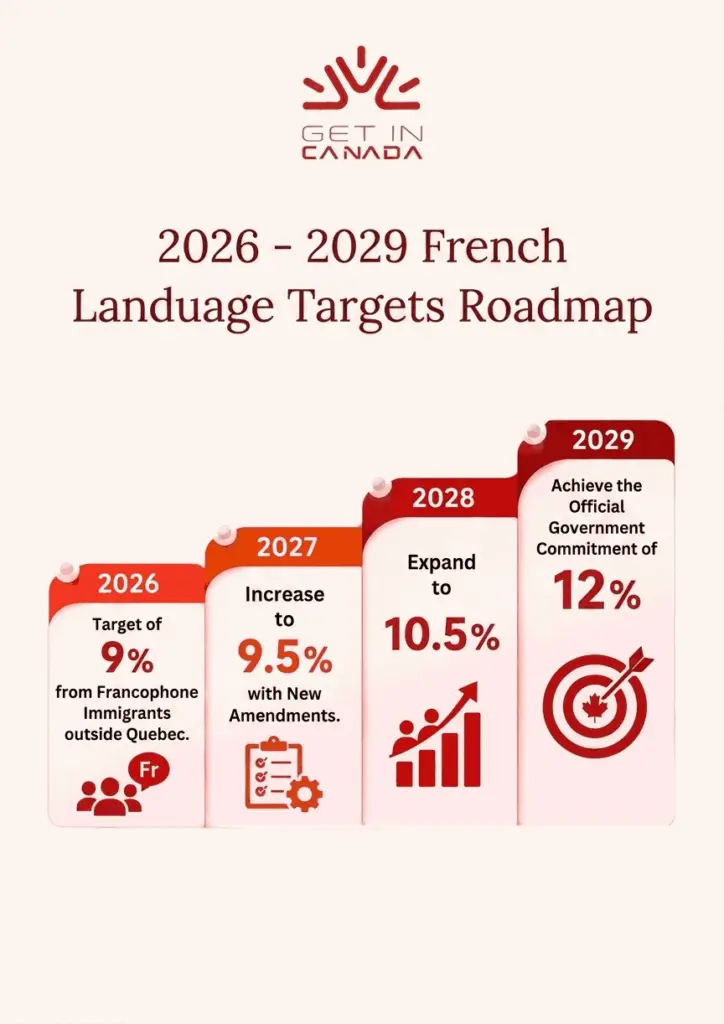
French-language proficiency remains a key driver for category-based draws. Canada has set incremental targets for the percentage of Francophone immigrants admitted outside Quebec, as outlined in the table below:
| Year | Target Percentage Outside Quebec | Description & Strategic Goal |
| 2026 | 9% | Increasing the cultural and economic presence of Francophones. |
| 2027 | 9.5% | Initial implementation of updated category-based selection rules. |
| 2028 | 10.5% | Expanding recruitment of candidates with high French proficiency. |
| 2029 | 12% | Achieving the official, sustainable federal commitment. |
2. The 4 Proposed Talent-Focused Categories
One of the most significant proposals in IRCC’s 2027 consultation document is the launch of 4 new categories tailored to recruit highly specialized global talent.
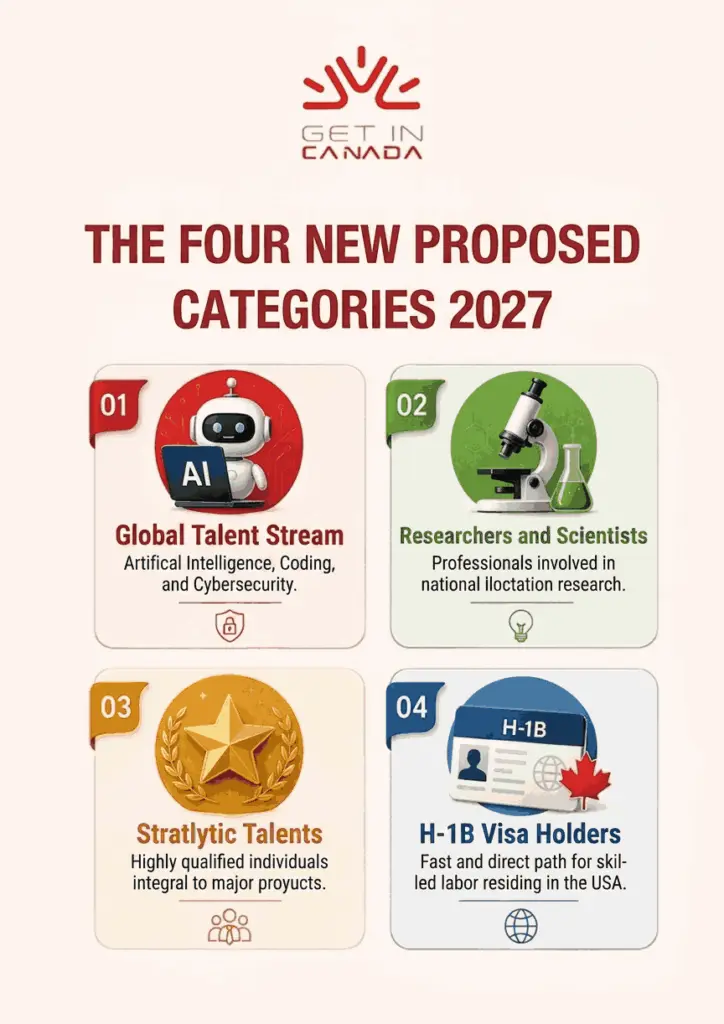
The table below outlines the proposed categories, target demographics, and specific occupations covered:
| Proposed Category | Target Demographic | Included Occupations & Profiles |
| Global Talent Stream (GTS) | Advanced tech professionals | Artificial Intelligence (AI) experts, software engineers, cybersecurity specialists, and big data analysts. |
| Researchers & Scientists | Academic and research talent | Scientists, innovation research specialists, and academic researchers in tech and biomedical sectors. |
| Strategic International Talent | High-level professionals | Specialists holding valid job offers and high qualifications tied to major federal economic initiatives. |
| U.S. H-1B Visa Holders | Skilled U.S. temporary residents | Specialty occupation workers in technology, engineering, and science holding U.S. H-1B visas who wish to transition to Canadian PR. |
The Impact of the Pathway for U.S. H-1B Visa Holders
Canada aims to leverage the vast pool of highly skilled talent currently in the United States under H-1B visas. This dedicated pathway offers tech and engineering professionals a fast, direct transition to Canadian permanent residency, avoiding lengthy processing delays.
Book Your Consultation Session →
3. Restructuring and Narrowing Occupational Lists for High-Demand Sectors
IRCC is moving toward narrowing and refining eligible occupation lists to target specific industries experiencing persistent shortages, rather than relying on broad NOC code lists.
The table below compares current draw practices with the proposed 2027 adjustments for key sectors:
| Targeted Sector | Current Draw Style (2026 & Prior) | Proposed 2027 Adjustment | Targeted Specific Occupations |
| Healthcare | Broad list covering 35+ NOC codes | Narrowed to critical shortage roles only | Physicians, registered nurses, physical therapists, and direct care assistants. |
| Skilled Trades | Comprehensive construction/technical coverage | Focused strictly on core industrial and construction trades | Electricians, plumbers, and heavy-duty equipment mechanics. |
| Transportation & Logistics | Broad acceptance across transport roles | Targeted toward heavy-haul and supply chain transport | Long-haul truck drivers and logistics supply chain managers. |
| Education & Social Services | Sporadic general coverage | Dedicated, structured category for education | Primary school teachers and certified early childhood educators. |
| STEM & Engineering | Broad engineering coverage | Filtered specifically for digital transformation roles | Software engineers, bioengineers, and energy technology specialists. |
Delegating Regional Needs to Provincial Nominee Programs (PNP)
Narrowing federal lists allows localized labor shortages to be addressed primarily by Provincial Nominee Programs (PNP). This enables the federal Express Entry system to focus on major national strategic priorities.
4. Ongoing Priority for French Language Proficiency
Consultation documents confirm that French language proficiency will remain the single most advantageous category in Express Entry over the long term.
Key advantages for Francophone candidates include:
- Dominant Share of Invitations: Francophone category draws will continue to receive a substantial portion of overall Invitations to Apply (ITAs).
- Language Benchmark Requirement: Reaching a minimum score of NCLC 7 across all four language abilities.
- Lower CRS Score Thresholds: Consistently lower score cut-offs compared to general draws and Canadian Experience Class (CEC) rounds.
Book Your Consultation Session →
5. CRS Score Comparison: General Draws vs. Category-Based Draws
The Comprehensive Ranking System (CRS) score remains the primary hurdle for pool candidates. Comparative analysis highlights how category-based cut-offs are significantly lower than general draw thresholds.
The table below summarizes the expected score variations:
| Express Entry Draw Type | Average CRS Score Required | Competition & Approval Probability |
| General Draws | Extremely High (520+ points) | Fierce competition requiring top-tier age, education, and language profiles. |
| Category-Based Draws (Healthcare, Trades, Tech) | Moderate to Low (430 – 480 points) | High approval odds upon matching specific NOC codes. |
| Francophone Draws | Lowest Overall (380 – 430 points) | The fastest and most reliable pathway to Canadian permanent residency. |
Added Value for Candidates with Moderate CRS Scores
This significant score gap means candidates with average CRS scores do not need to feel discouraged. Leveraging category-based draws by upgrading language skills or aligning work experience offers a viable route to an ITA with a much lower point threshold.
6. How 2027 Changes Impact International Students and Graduates in Canada
International graduates holding Post-Graduation Work Permits (PGWP) represent one of the groups most affected by upcoming rules. The 2027 updates require students to realign their academic and career strategies.
Key impacts on students and graduates include:
- Guiding Program Choices: Prospective students must choose academic programs that align directly with 2027 targeted categories to streamline their future PR transition.
- Focusing on High-Wage Employment: Updates prioritize graduates working in targeted sectors with wages meeting or exceeding provincial medians.
- Maximizing Targeted Canadian Experience (CEC): Gaining one year of Canadian work experience in a critical-shortage occupation serves as a major advantage for both federal and provincial draw streams.
7. Proactive Action Steps for Candidates in the Express Entry Pool
If you are currently in the Express Entry pool or planning to create a profile soon, taking proactive steps can give your application a competitive edge.
Recommended action items include:
- Verify Your NOC Code: Ensure your job description and daily duties match at least 51% of your selected NOC lead statement to guarantee eligibility.
- Boost Your Language Scores: Focus on maximizing your English test scores or learning French to achieve NCLC Level 7 or higher to access low-threshold draw pools.
- Document High-Wage Canadian Work Experience: Keep detailed records and employment letters for high-wage occupations within Canada to leverage potential extra points.
- No Immediate Profile Edits Needed: You do not need to update your profile immediately; IRCC systems automatically match eligible candidates once new categories officially go live in 2027.
FAQs
Book Your Consultation Session →
How to Secure Your Invitation in Upcoming Updates?
Upcoming changes to Canada’s immigration system do not mean securing permanent residency is getting harder; rather, they mean early planning and strategic positioning are more vital than ever. Investing today in boosting your language scores or documenting work experience in high-demand sectors is the decisive move that will make your profile launch-ready the moment official 2027 draws begin—stay one step ahead to secure your place at the forefront of successful applicants! 🇨🇦