Immigration to Canada from Saudi Arabia in 2026
“In a world defined by rapid economic shifts, geopolitical restructuring, and persistent global uncertainty, immigration is no longer just a search for a better job, it is a strategic ‘Plan B’ that secures long-term stability for your family.”
“From the heart of Saudi Arabia, Canada opens its doors to professionals seeking a safe harbor and a sustainable future. Canada doesn’t just offer residency; it offers a home that guarantees citizenship and security for you and your children, far from the volatility of global crises.”
Book Your Consultation Session →
1. Basic Immigration Requirements: Standards for Success in a Digital World
Before stepping onto the path of immigration, you must first ensure you hold the right keys to unlock Canada’s digital doors. Understanding these requirements is what transforms your desire for stability from a dream into a realistic, actionable plan.
Canadian standards in 2026 are rigorous but fair, aimed at attracting talent that can contribute to the economy immediately upon arrival. Here are the core requirements:
1.1 Language Proficiency and Academic Documentation
Language and education are the two pillars of your profile; they reflect your ability to integrate quickly into Canadian society and the workforce. In 2026, precision in documenting these credentials is the critical factor between application approval and technical rejection.
- Language: Achieving a minimum of CLB 7 in English (IELTS/CELPIP) or French (TEF/TCF) tests.
- Education: An Educational Credential Assessment (ECA) through an organization like WES to ensure Canada recognizes your Saudi or international degrees.
- Age: Maximum points are awarded to applicants between 20 and 29, with strategic alternative pathways available for those over 35.
1.2 Work Experience and the Canadian TEER System
Canada doesn’t just look at the number of years you’ve worked; it evaluates the quality of that experience and its alignment with the local market. Translating your Saudi job duties into the language of Canadian “TEER” codes is the most important strategic step in your journey.
Canada utilizes the TEER (Training, Education, Experience, and Responsibilities) system to categorize jobs. For skilled immigration, your experience must fall within categories 0, 1, 2, or 3. This experience must be documented with official letters detailing your specific duties. In 2026, priority is given to vital sectors such as Healthcare, Engineering, and Information Technology.
Read also:
- How to Get Canadian PR with a Two-Year College Degree
- The 8 Most Strategic Cities for Newcomers to Canada 2026
- Government Instructions Leave the Door Open for PGP Canada to Return in 2026
- Express Entry CEC Draw Sees Lower Cut-Off Score
Book Your Consultation Session →
2. Immigration Programs for 2026: Choosing Your Strategic Pathway
The variety of pathways in Canada is a major advantage, but it requires intelligence to choose the route that highlights your strengths and mitigates your weaknesses. Given global economic shifts, selecting the right program is the “golden strategy” for reaching Canada with the least effort.
Understanding the fundamental differences between the programs available to residents in Saudi Arabia helps you build realistic expectations and set the correct timeline. Here are the primary programs for 2026:
2.1 Express Entry and Category-Based Selection
This remains the fastest and most popular route, having evolved in 2026 to be more specialized. The focus is no longer just on a high overall score, but on “what you do” for a living.
- Federal Skilled Worker (FSW): The primary program for high-level professionals from outside Canada.
- Category-Based Selection: Targeted draws with lower point requirements for Healthcare, STEM (Science, Technology, Engineering, and Mathematics), and skilled trades.
- French Language: Proficiency in French is a “winning card” in 2026, often leading to immediate invitations with significantly lower scores.
2.2 Provincial Nominee Programs (PNP): The Guaranteed Entry Gate
If you find it difficult to compete with the high scores in the general Federal draws, Canadian provinces offer a legal “lifeboat.” These programs are designed to fill labor gaps in specific regions and provide a massive boost to your application.
Provincial programs (such as those in Saskatchewan or Alberta) grant the applicant 600 bonus points in the Express Entry system upon nomination. This nomination virtually guarantees an Invitation to Apply (ITA) in the next draw, making it the perfect solution for those with strong work experience who may lack points in age or language.
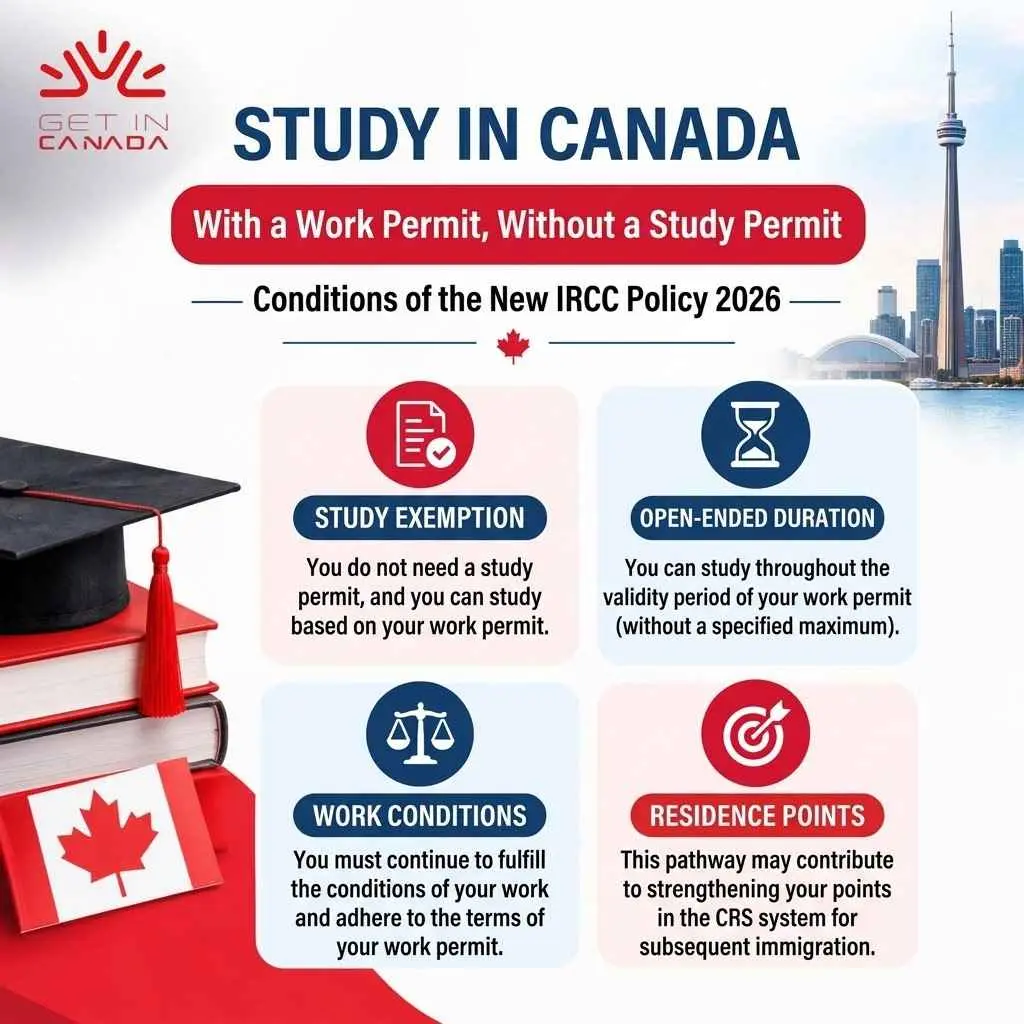
2.3 The Study & Work Pathway: The Smart Investment for Those 35+
For many professionals over the age of 35, studying in Canada remains the strongest and most stable “Plan B.” This path doesn’t just provide an education; it opens doors to financial and legal stability for your entire family from day one.
| Feature | Study Pathway |
| Legal Status | A study permit for the applicant and an Open Work Permit for the spouse. |
| Child Support | Right to Free Public Education for children in Canadian schools. |
| Path to PR | Post-Graduation Work Permit (PGWP) leads to PR via the Canadian Experience Class (CEC). |
Book Your Consultation Session →
3. Immigration Costs: The Budget Required to Secure Your Future
Immigration is a major investment project, and like any successful venture, it requires precise and transparent financial planning. Viewing these costs as an “insurance premium” for a secure future makes it easier to handle the numbers as a tool for progress rather than a barrier.
In 2026, government fees have been adjusted to keep pace with inflation. It is essential that your budget is up-to-date to avoid rejection due to a lack of legally required liquidity.
3.1 Government Fees and Proof of Funds (POF)
It is important to understand that the funds required by Canada are not just fees; they are proof that you have the liquidity to settle without relying on government assistance. These funds remain in your bank account and belong to you for use upon arrival.
| Cost Item | Estimated per Individual (CAD) | Estimated for Family of 4 (CAD) |
| Processing Fees (IRCC) | 950 CAD | 3,500 CAD |
| Right of Permanent Residence (RPRF) | 600 CAD | 1,200 CAD |
| Proof of Funds (POF) | ~14,700 CAD | ~27,000 CAD |
| Language Tests & Documentation | ~600 CAD | ~1,200 CAD |
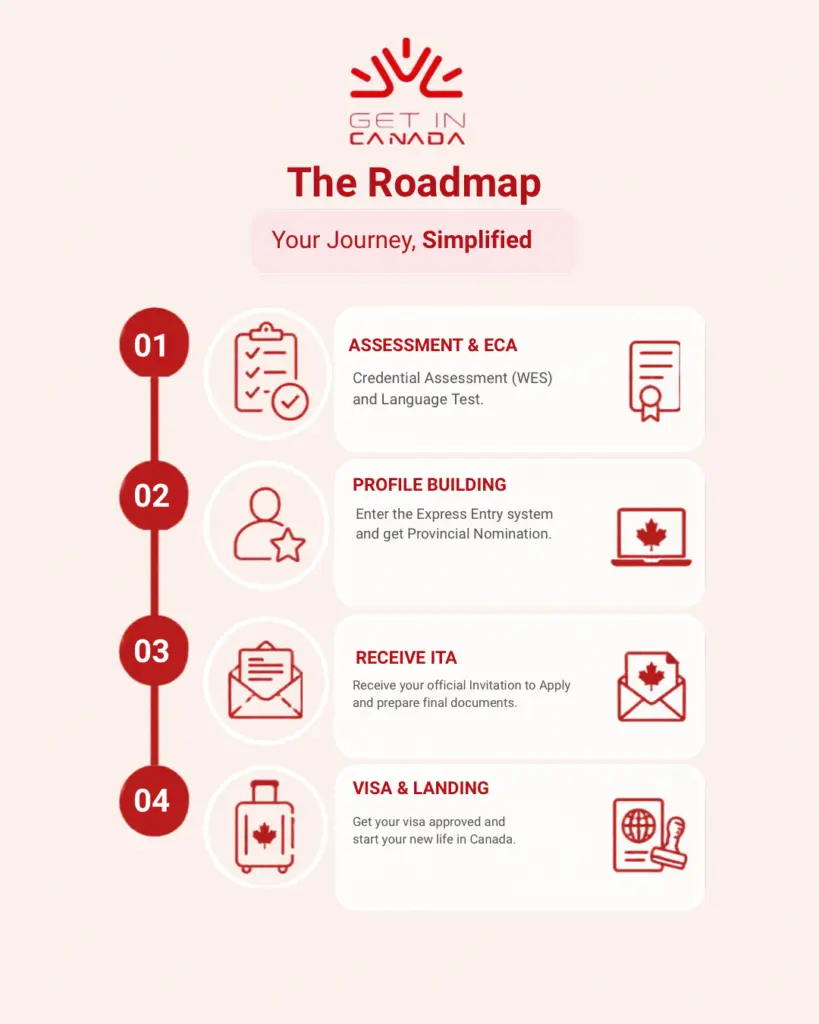
4. Steps to Canada: The Roadmap from Saudi Arabia to Landing
Arriving in Canada is not a random journey; it is a finely tuned “pathway system” that requires precise execution of each stage. Following the correct sequence is what protects you from wasting time or letting important documents expire before submission.
From Riyadh, Jeddah, or Khobar, your journey begins with simple procedural steps that culminate in the final issuance of your visa. Here is the correct timeline for 2026:
4.1 Preparation and Legal Documentation Phase
The journey always begins with paperwork; a strong document is your first advocate before an immigration officer. In this stage, we focus on converting your Saudi academic and professional history into internationally recognized credentials.
- Credential Evaluation: Sending degrees to WES for Canadian equivalency.
- Language Testing: Intensive training and achieving target scores in IELTS.
- Experience Portfolio: Obtaining experience letters from Saudi employers and auditing job duties to meet Canadian standards.
Book Your Consultation Session →
4.2 Digital Application and Post-ITA Phase
Once your papers are ready, you enter the exciting stage of joining the global “Pool.” This requires patience and precision to catch the first invitation that fits your profile and profession.
After receiving your Invitation to Apply (ITA), you have only 60 days to upload all documents, including your medical exam (available in Saudi Arabia) and police clearances via the Absher platform. This stage is critical, as any error can lead to a rejection and the loss of the opportunity.
Your Future Doesn’t Wait for the Storm to Pass
In a world tossed by waves of economic shifts and global crises, staying in the “waiting zone” is the greatest risk to your family’s stability. Immigrating to Canada from Saudi Arabia is not just a change of location; it is building a fortress for your children’s future.
Make 2026 the year of your “Great Transformation.” Start preparing your file today and secure your place in a nation that values your skills and offers the safety you deserve, especially before the fee increase scheduled for April 30, 2026.