Express Entry Vs Studying in Canada: Your Roadmap to Security in 2026
Given the rapidly changing geopolitical dynamics in the region, many residents in the Gulf are now prioritizing a “Plan B” to secure a stable future for their families. Choosing between Express Entry and the Study Pathway is no longer just an academic or professional choice, but a strategic decision aimed at building long-term security in a stable environment.
Book Your Consultation Session →
1. Defining the Pathways: Choosing Your Legal Gateway to Canada
Understanding the legal essence of each pathway is the cornerstone of a successful immigration file that ensures clear rights for you and your family from the very beginning. In 2026, Immigration, Refugees and Citizenship Canada (IRCC) has become more precise in processing files, requiring full awareness of the differences between Permanent Resident and Temporary Resident status.
1.1 Express Entry: The Direct Permanent Residency Gateway
This system is classified as the premier federal immigration pathway, granting the applicant “Permanent Resident” (PR) status upon arrival without the need for transitional stages. It is a competitive, points-based system (CRS) designed to select applicants with the highest levels of professional and linguistic competence.
- Legal Status: You receive full citizenship rights (except voting) the moment your passport is stamped at the airport.
- Family Stability: You are permitted to bring your spouse and children as permanent residents from day one.
- Professional Flexibility: You have total freedom to work for any employer in any Canadian province without restrictions.
1.2 The Study Permit Pathway: The Educational and Professional Bridge
The study pathway represents the most flexible option for families seeking quick entry into Canada to obtain a recognized Canadian credential that opens future doors. While it does not grant PR immediately, it represents an investment in “Canadian Experience,” which is the strongest legal tool for converting your status to permanent residency later.
- Legal Status: You enter Canada as a temporary resident (International Student) under a valid study permit.
- Work Privileges: You are entitled to work a specific number of hours per week, while your partner usually receives an Open Work Permit.
- Pathway Development: It provides significant bonus points in the immigration system after graduation thanks to local “Canadian Experience.
Read also:
- How to Get Canadian PR with a Two-Year College Degree
- The 8 Most Strategic Cities for Newcomers to Canada 2026
- Government Instructions Leave the Door Open for PGP Canada to Return in 2026
- Express Entry CEC Draw Sees Lower Cut-Off Score
2. Cost of Immigrating to Canada: A 2026 Budget Analysis
Proper financial planning requires a careful balance between the administrative fees of the federal pathway and the educational investment of the study route, especially with rising global living costs. Determining the Cost of Immigrating to Canada in advance allows families in the Gulf to distribute their savings wisely to ensure long-term financial stability.
2.1 Budget Requirements for Express Entry
The direct costs of this pathway are relatively economical as they focus on government fees, medical exams, and credential assessments without the need for tuition. The real financial challenge lies in providing the “Proof of Funds” (Settlement Funds) required by the government to ensure you can support your family initially.
- Government Fees: Approximately $1,525 CAD per adult (including processing and Right of Permanent Residence fees).
- Proof of Funds: Liquid capital of approximately $15,263 CAD for a single person (increases with family size).
- Preparatory Expenses: Includes costs for IELTS exams and ECA reports (like WES) in your current country of residence.
2.2 Budget Requirements for the Study Pathway
This pathway requires a larger initial financial investment, as annual tuition fees are added to living costs and permit applications. However, it is distinguished by your ability to work while studying, which contributes to covering a large portion of your family’s daily living expenses and easing the financial burden.
- Tuition Fees: Ranges between $15,000 to $22,000 CAD annually for most colleges.
- Proof of Funds: You must prove the ability to pay the first year’s tuition plus $20,635 CAD for living expenses.
- Health Insurance: Additional annual costs ranging from $800 to $1,150 CAD depending on the province.
Book Your Consultation Session →
3. The Speed Factor: Who Guarantees a Faster Arrival to Safety?
In times of regional uncertainty, the speed of leaving the region and arriving in a stable environment becomes the top priority for most families residing in the Gulf. The pace of arrival varies between the two pathways based on the complexity of administrative procedures at IRCC and the readiness of your personal file for execution.
3.1 The Express Entry Timeline
This pathway relies on periodic draws; even if you have high points and receive an Invitation to Apply (ITA), the final processing takes time. It is a “long-distance wait” pathway where you remain in your current location until the final visa is issued, which takes 6 to 12 months on average.
- Point Draws: You may wait several months for draws to reach your current point level.
- Federal Processing: Security and criminal background checks take longer before permanent residency is granted.
- Pre-planning: This pathway does not provide an “urgent exit” but requires calm, long-term planning.
3.2 The Study Pathway Timeline
The study pathway is characterized by high execution speed, where you can obtain academic acceptance, a student visa, and actual arrival in Canada in record time. It is the “urgent choice” that ensures your family is in Canada starting a new life while permanent residency is arranged from within the country later.
- Academic Acceptance: Can be obtained within a few weeks from Designated Learning Institutions (DLI).
- Visa Processing: Student visas are often processed faster (especially through streams like the Student Direct Stream).
- Immediate Arrival: You can start your studies, work, and secure your family’s housing within 3 to 5 months from now.
4. Decision Criteria: Which Path Suits Your Profile?
There is no one-size-fits-all answer; a smart decision depends on analyzing your strengths and weaknesses within the Express Entry and Study in Canada frameworks. You must balance age, language level, and available budget to determine the path that ensures the highest success rate for sustainable stability in 2026.
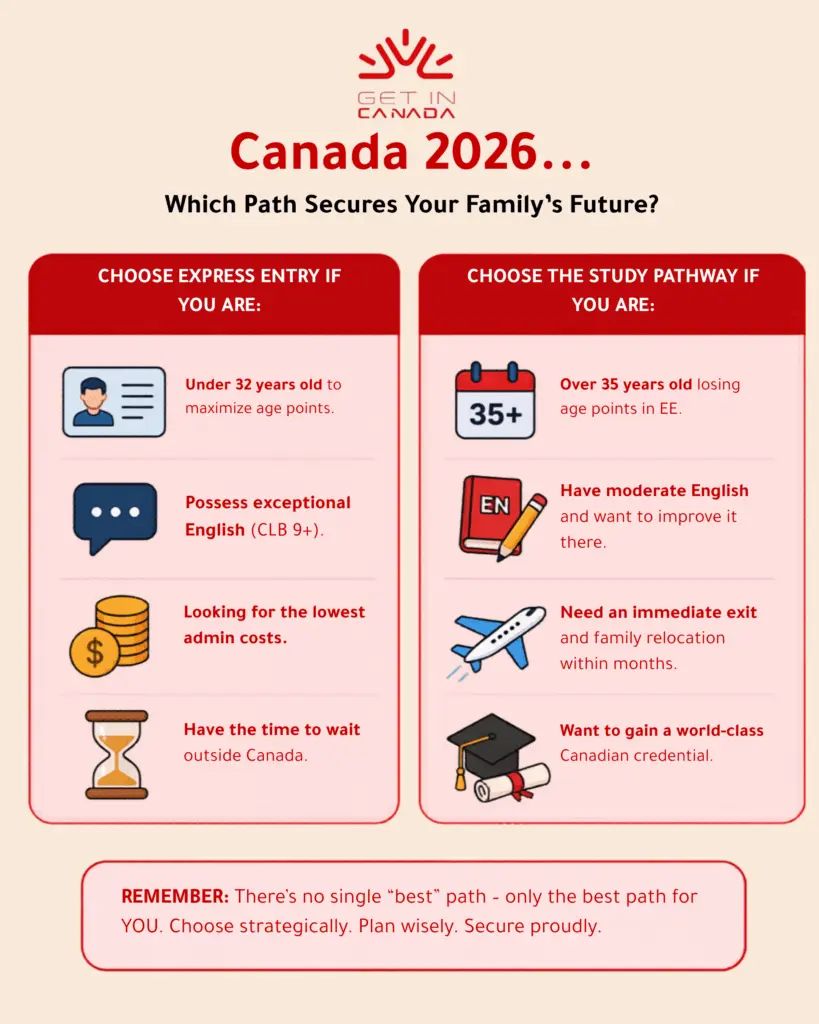
4.1 Who Should Choose Express Entry?
This pathway is the “Golden Choice” for those with competitive profiles who do not mind waiting a little longer outside Canada in exchange for immediate PR.
- Age: If you are under 32 years old (to maximize age points).
- Language: If you possess an exceptional IELTS score (equivalent to CLB 9 or higher).
- Budget: If your budget is focused on settlement and living rather than academic tuition.
4.2 Who Should Choose the Study Pathway?
Studying is the “Lifeline” for those who have lost points due to age or those who wish to enter Canada quickly and secure their families immediately.
- Age: If you are over 35 years old (where Express Entry starts deducting age points).
- Language: If your language level is moderate and you wish to improve it within the Canadian environment.
- Family Security: If your goal is to relocate your family from the region within a few months and start a stable life.
Book Your Consultation Session →
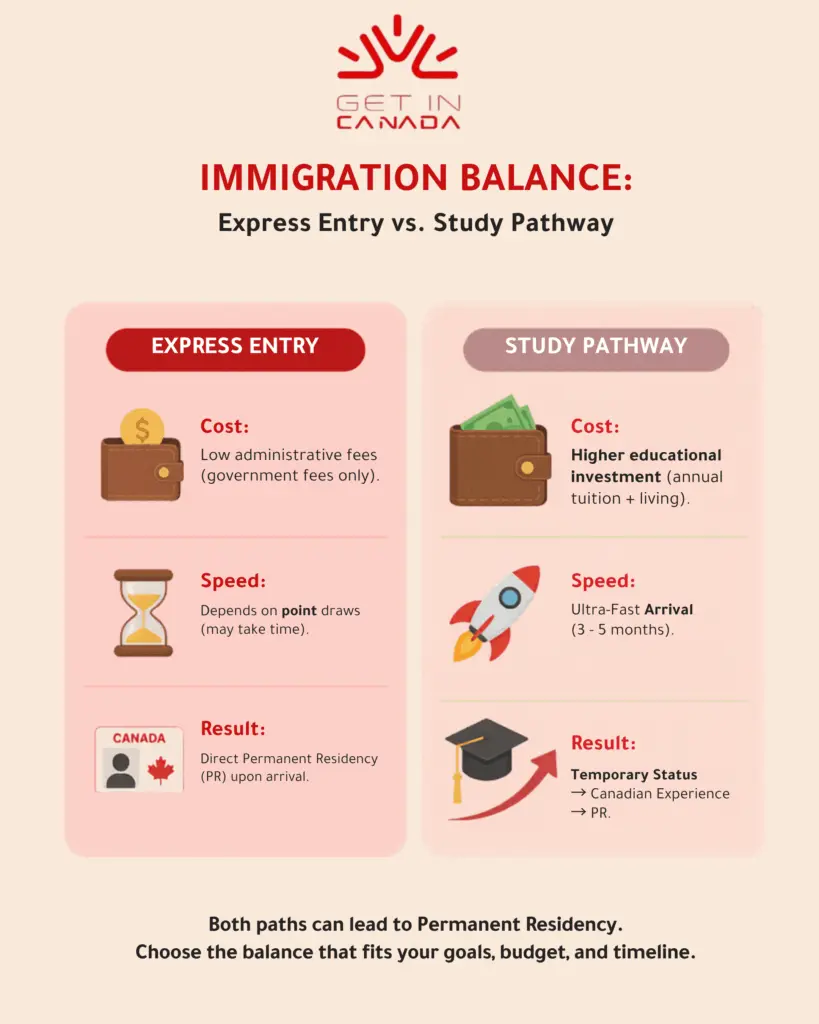
5. Summary of Differences for 2026
The table below illustrates the core differences to help you make the final decision based on the current Difference between Express Entry and Study status.
| Criteria | Express Entry System | Study Pathway in Canada |
| Legal Status | Permanent Resident (PR) on arrival | Temporary Resident (Student) |
| Cost of Immigrating to Canada | Lower administrative fees | Educational investment (Annual tuition) |
| Speed of Arrival | Depends on draws (Medium) | Very Fast (3-5 months) |
| Language Requirements | Very high for competition | Moderate (Varies by University/College) |
| Family Stability | Guaranteed and comprehensive from Day 1 | Gradual (Study then work then PR) |
Get In Canada Consultation for 2026
In light of international variables, making a mistake in choosing your immigration pathway could mean depleting your savings or wasting years of your life waiting without results. At Get In Canada, we offer you a comprehensive 15-minute strategic review of your file to determine the safest and fastest path to secure your family’s future in Canada.
- Consultation Price: $35 USD.
- Objective: A clear roadmap (Study vs. Express Entry) based on 2026 data and regional reality.