When Should You Start Your Immigration Plan to Canada? The Strategic 2026 Guide

Making the monumental decision to relocate and settle in a major global superpower is a life-changing step that requires a meticulous and well-studied analysis of all legal and chronological variables surrounding your profile. Recognizing the perfect timing to take action is the absolute cornerstone of a successful transition. Crafting a proactive and early Immigration Plan marks the defining line between capturing a golden, lifelong settlement opportunity and facing the sudden complexities of strict new legislative shifts that could potentially freeze your academic and professional ambitions.
Book Your Consultation Session →
1. Critical Timing and the Impact of Strict 2026 Legislative Updates
Navigating Canadian federal procedures demands long-term endurance and complete documentation readiness at least a full year before entering the official selection pool. Recent federal policy overhauls by Immigration, Refugees and Citizenship Canada focused heavily on reducing temporary resident volumes while applying highly meticulous, category-specific selection criteria. Understanding how an early, accurate start guarantees the success of your Immigration Plan for you and your family in this shifting environment is vital.
A- Chronological Milestones and the New 2026 Statutory Caps
- The Temporary Resident Volume Cap: The Canadian government implemented a strict policy cap aimed at slashing the temporary resident population down to just 5 percent of the total population, drastically reducing study and work permit issuances, making procrastination a major risk.
- Mandatory Proactive Preparation: The updated system demands gathering and evaluating academic degrees and skilled work references at least eight months prior to your target launch date to secure limited regional allocations before they close.
- Enhanced Background Screening Phases: Immigration authorities introduced additional electronic screening rounds and biometric verifications, requiring applicants to add two buffer months to their timelines to avoid processing backlogs.
B- The Strategic Value of Early Entry into the Federal Express Entry Pool
- Capitalizing on Category-Based Selection: Having an active profile inside the Express Entry pool grants you immediate access to industry-specific target draws, which open and close abruptly based on real-time market labor shortages.
- Capturing Digital Provincial Nominations: Regional immigration pathways give prime placement to long-standing active profiles when issuing exclusive invitations, instantly awarding candidates 600 bonus points to guarantee immediate selection.
- Managing Document Validity Timelines: Perfect timing ensures utilizing the full legal lifespan of language test results and medical clearances before expiration, shielding you from the financial losses of repeating expensive tests.
2. Severe Risks and Challenges Triggered by Delayed Planning
Many prospective candidates fall into the trap of hesitation and delay, falsely assuming that immigration frameworks remain stagnant and unchanged throughout the year. Waiting without establishing a transparent Immigration Plan exposes your profile to common administrative rejections and a rapid loss of age points due to sudden changes in federal fast-track pathways.
A- Consequences of Structural Overhauls in 2026 Federal Channels
- Reduced Target Admission Numbers: Shifting the global annual newcomer target to a firm ceiling of 380,000 immigrants drives score thresholds to historic, record-breaking levels, eliminating average profiles from selection.
- Direct Labor Market Alignment Mandates: Modernized regulations require proving your skilled background directly addresses a documented provincial labor deficit, meaning delays can completely eliminate your profession from regional demand lists.
- Strict PGWP Rule Adjustments: Implementing higher language benchmarks to qualify for post-graduation open work permits creates a legal barrier for international students who fail to plan their language goals in advance.
B- Aggressive Age Point Depreciation and the Competitive Decline
- Automatic Annual Point Deductions: Main applicants lose 5 to 6 points from their comprehensive score profile the moment they cross their thirtieth birthday, with the deduction rate accelerating every single year thereafter.
- The Language Score Compensation Trap: Achieving near-impossible, perfect scores on language exams becomes a mandatory, stressful requirement to compensate for points lost solely due to delayed decision-making.
- Declining Family Admission Strengths: A primary applicant’s advancing age negatively skews the overall assessment of the profile when attempting to include a spouse and dependent children within the same federal application dossier.
Book Your Consultation Session →
3. Promising 2026 Opportunities and Target Sector Allocations
Despite tighter policies and reduced volumes, Canada continues to open its doors to specialized talents who contribute to driving its economic growth forward. The modern Immigration Plan for 2026 concentrates the vast majority of available seats toward economic categories and skilled trades specifically designated to counter acute structural shortages.
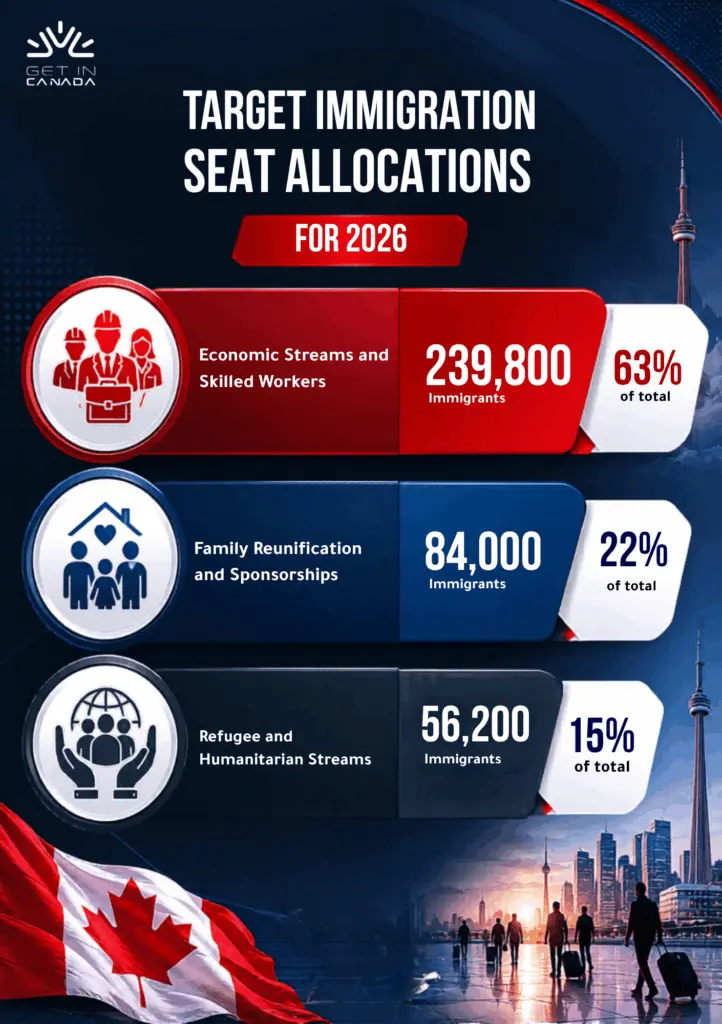
| Target Category in the Updated Blueprint | Annual Intake Volume | Percentage & Strategic Significance to Your Profile |
| Economic Streams & Skilled Workers | 239,800 immigrants | 63 percent representing the prime pathway for professionals and international students |
| Family Reunification & Sponsorships | 84,000 immigrants | 22 percent allocated by the state to guarantee the social stability of settled households |
| Refugee & Humanitarian Streams | 56,200 immigrants | 15 percent maintained by the government to fulfill international treaty obligations |
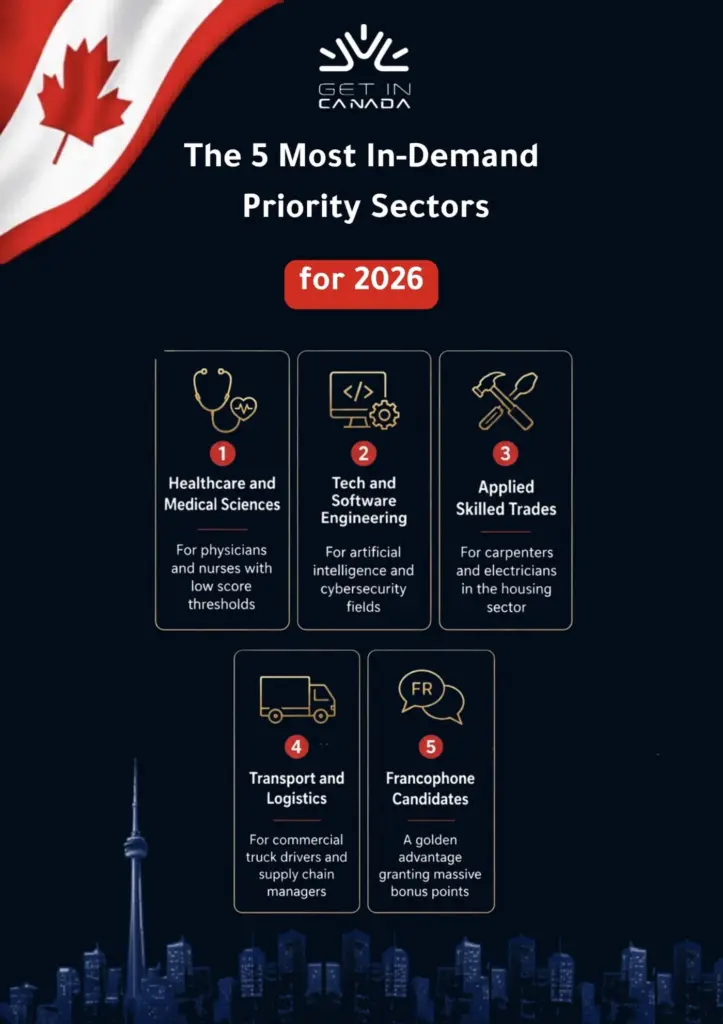
B- The Five Top-Priority Professional Sectors for 2026
- Healthcare and Medical Sciences: Severe, ongoing shortages of physicians and nursing professionals make this the fastest sector for federal approvals with highly accessible point thresholds.
- Technology, Engineering, and Artificial Intelligence: Software engineering, cybersecurity, and advanced data analytics remain at the absolute forefront of federal fast-track selections due to the tech-driven economy.
- Skilled Applied Trades and Construction: Massive, unprecedented demand for carpenters, electricians, and infrastructure designers to solve housing supply shortages across fast-growing Canadian cities.
- Transport and Logistics Operations: Streamlined pathways for heavy-haul commercial drivers and supply chain managers to keep the movement of goods flowing smoothly across provincial borders.
- Francophone Candidates Outside of Quebec: A golden legislative advantage awarding massive bonus points and structural exemptions to any applicant with French proficiency, regardless of their profession.
Book Your Consultation Session →
4. Advanced Financial and Practical Execution: Engineering an Unbeatable File
Succeeding in stepping onto Canadian soil does not rely on coincidence; it is the product of a precise technical equation built upon understanding executive regulations. A successful Immigration Plan requires balancing your language and professional development with fulfilling the updated financial benchmarks mandated by visa offices to secure a smooth entry.
A- Updated Estimated Financial Expenditures for 2026 Processing
- Federal Processing & Right of PR Fees: The mandatory statutory fee stands at 1,365 CAD per adult applicant, payable electronically through the official immigration portal.
- Certified Academic Credential Assessment: Costs range between 250 and 300 CAD depending on the designated evaluation agency, such as WES, covering international document verification.
- The Restructured Proof of Financial Sufficiency Fund: The government requires unencumbered, free liquid assets starting at a minimum baseline of 14,000 CAD for a single applicant, scaling upward based on household size.
B- Tactical Strategies to Secure Your Profile’s Competitive Edge
- Capturing the Absolute Maximum Language Band: Commit to intensive preparation to secure a Canadian Language Benchmark of 9 on your English tests to trigger massive combo points that seal your selection.
- Meticulous Alignment of Professional References: Structure your past employment certificates to map out precisely with the updated National Occupational Classification system and TEER structures.
- Targeting Low-Density Regional Communities: Avoid the hyper-competitive job markets of Toronto and Vancouver, focusing instead on provincial streams in regions like Alberta and Manitoba for flexible criteria.
- Proving Legality and Stability of Funds: Maintain a clean bank statement entirely free of sudden, unexplained large lump-sum deposits for six consecutive months to satisfy the visa officer’s scrutiny.
Conclusion: Making a Smart Decision to Secure Your Sustainable Future
In conclusion, identifying the correct timing to launch your process is the absolute foundation for turning international settlement ambitions into a tangible, successful reality. Consequently, taking proactive steps guarantees your profile top priority in federal and provincial draws optimized for final 2026 settlement. Moreover, avoiding unorganized planning and establishing a transparent roadmap shields your temporal and financial investments from common administrative rejections. Given the rapid pace of legal updates across provincial and federal networks, we at Get In Canada are fully dedicated to providing certified consultation to guide your steps with absolute confidence and professionalism. Therefore, do not hesitate to initiate your critical life decisions today and prepare your official documents with complete readiness without any delay. In the end, establishing a sustainable future is never left to chance; it starts with smart planning and capturing the education and career windows open before you right now.