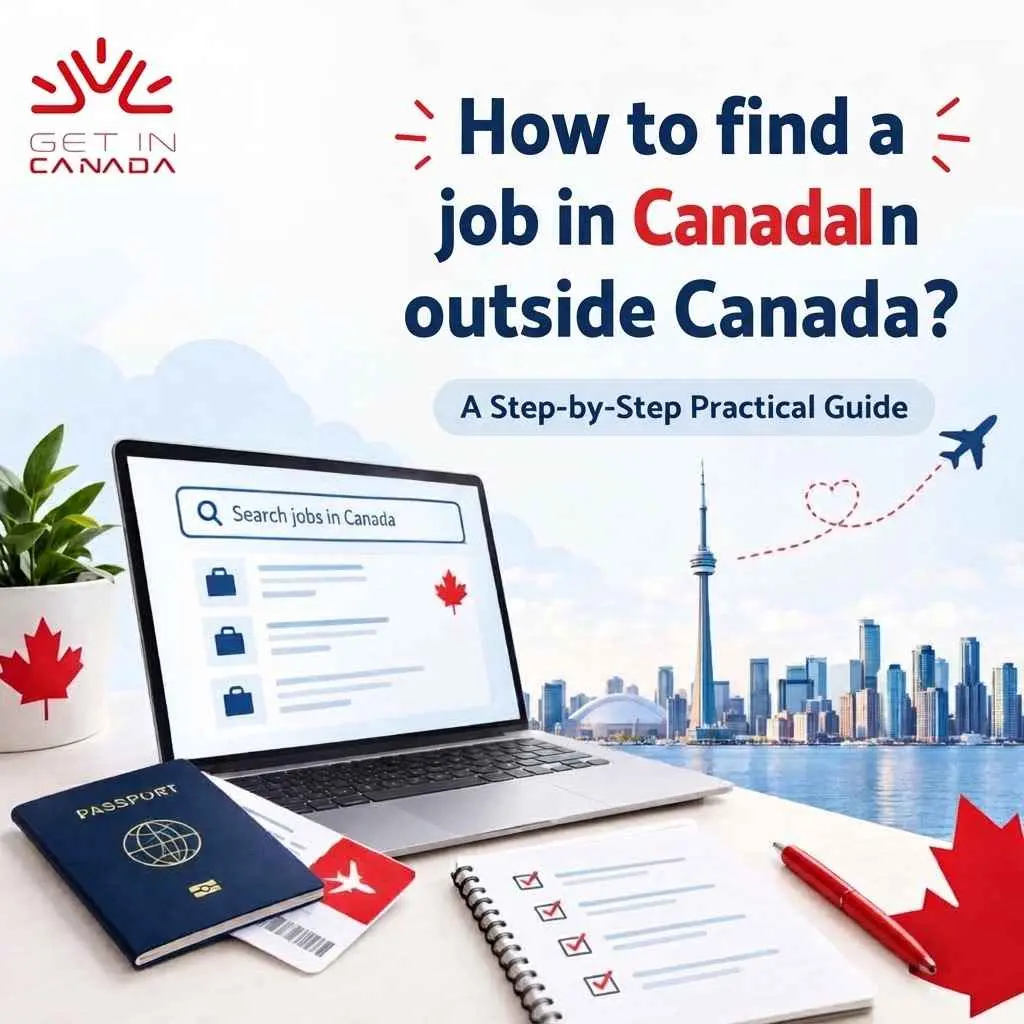
How to Find a Job in Canada From Abroad: A Practical Guide
Landing a job in Canada as a foreign national is entirely possible, but navigating the Canadian labor ecosystem requires an understanding of regulatory compliance, hiring culture, and immigration pathways. Canadian employers operate within strict federal guidelines designed to protect the domestic workforce first. To stand out among thousands of international applicants, you need an actionable strategy tailored to how Canadian recruiters actually hire, interview, and sponsor foreign talent.
1. Can You Get a Job From Abroad?
Canadian immigration law explicitly permits employers to hire foreign nationals, but it is not a direct, barrier-free process. Before an enterprise can extend an offer to someone outside the country, it must demonstrate to federal authorities that no qualified Canadian citizen or permanent resident is available to fill the opening.
Because of this requirement, cold applying across random industries rarely yields results. Your real competitive edge lies in targeting high-demand sectors facing chronic talent deficits, where Canadian companies are already registered and legally cleared to source international candidates.
- Priority Industries: Demand remains concentrated in STEM, healthcare, specialized technical trades, precision manufacturing, and transport logistics.
- Domestic First Policy: Employers must fulfill rigorous advertising standards domestically before turning to overseas talent pools.
- The Reality Check: Success depends on hard skill alignment, verified credentials, and fluency in English or French rather than broad volume applications.
Book Your Consultation Session →
2. The Complete Path to a Work Permit
Securing authorization to work in Canada follows a rigid, linear sequence that bridges corporate recruitment and federal immigration processing. Skipping steps or misunderstanding where employer responsibilities end and candidate duties begin is the primary reason overseas applications fail.
Each phase serves as a prerequisite for the next, requiring documented proof of qualifications, legal clearances, and bilateral compliance between the hiring company and Immigration, Refugees and Citizenship Canada (IRCC).
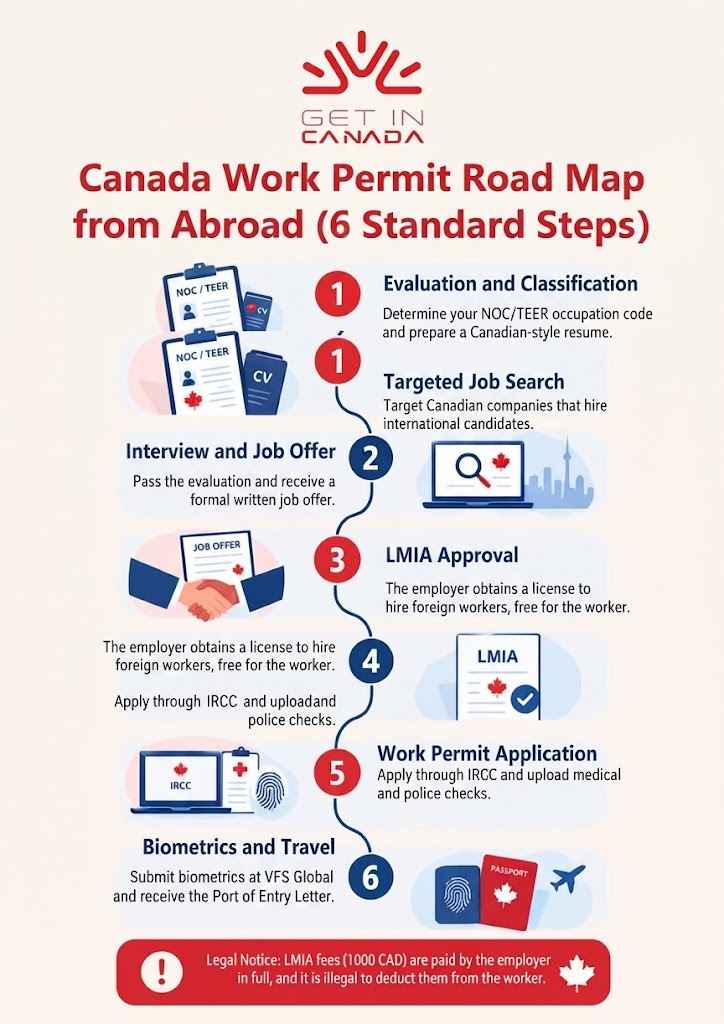
- Stage 1: Profile & Classification: Map your professional background to Canada’s National Occupational Classification (NOC) and draft a Canadian-standard resume.
- Stage 2: Targeted Outreach: Apply strictly through channels and job boards open to international candidates needing visa sponsorship.
- Stage 3: Corporate Screening: Complete remote competency-based interviews and secure a formal, written Job Offer.
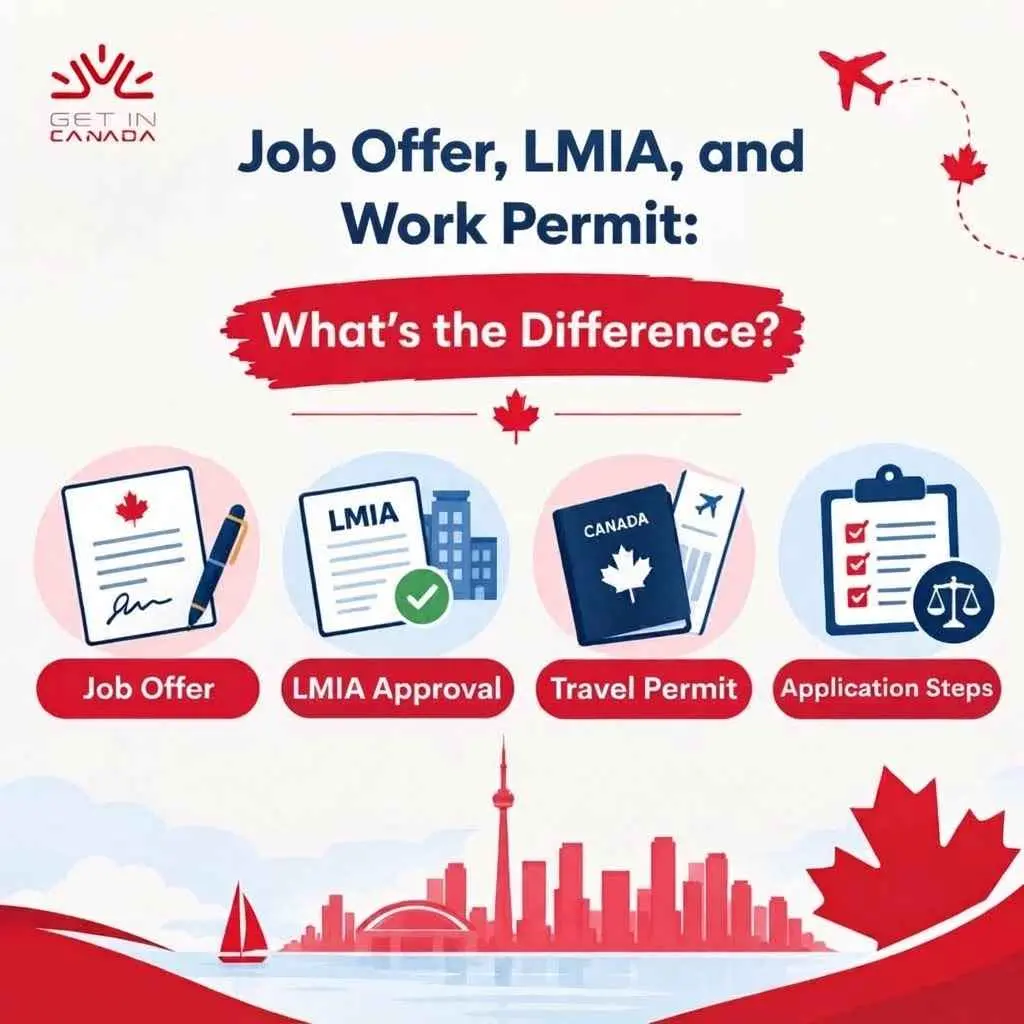
- Stage 4: Labor Market Approval: The employer secures a positive Labour Market Impact Assessment (LMIA) or establishes an LMIA exemption.
- Stage 5: Work Permit Application: Submit your individual work permit file, complete medical exams, and register biometrics through IRCC.
- Stage 6: Port of Entry Issuance: Receive your Letter of Introduction and collect your official work permit upon arrival in Canada.
3. Check Your Eligibility and Occupation
Before investing time in job applications, evaluate how your career history translates into Canada’s labor taxonomy. Canadian hiring managers evaluate candidates against standardized benchmarks that define the required education, duties, and licensing for every role in the economy.
If your daily responsibilities do not match the specific National Occupational Classification (NOC) code, or if you lack recognized credentials for regulated professions, employers will automatically filter out your profile.
- Map Your NOC TEER Category: Identify your 5-digit NOC code to confirm your occupational tier and determine whether your profession falls under regulated or non-regulated classifications.
- Official Language Benchmarks: Professional working proficiency in English (IELTS General/CELPIP) or French (TEF/TCF) is non-negotiable for technical interviews and visa issuance.
- Educational Credential Assessment (ECA): While primarily required for permanent residency, having your degrees pre-assessed by an organization like WES signals immediate credibility to Canadian recruiters.
- Verifiable Employment Records: Ensure every role on your resume is backed by signed reference letters detailing your title, job duties, and weekly hours.
4. Find Employers Recruiting International Candidates
Most domestic job postings are restricted to candidates who already hold Canadian work authorization. Submitting applications to standard job boards without filtering for sponsorship eligibility results in automated applicant tracking system (ATS) rejections.
To secure an interview, you must focus exclusively on platforms, provincial talent drives, and corporate listings that explicitly state an intention to support work permits or LMIA applications.
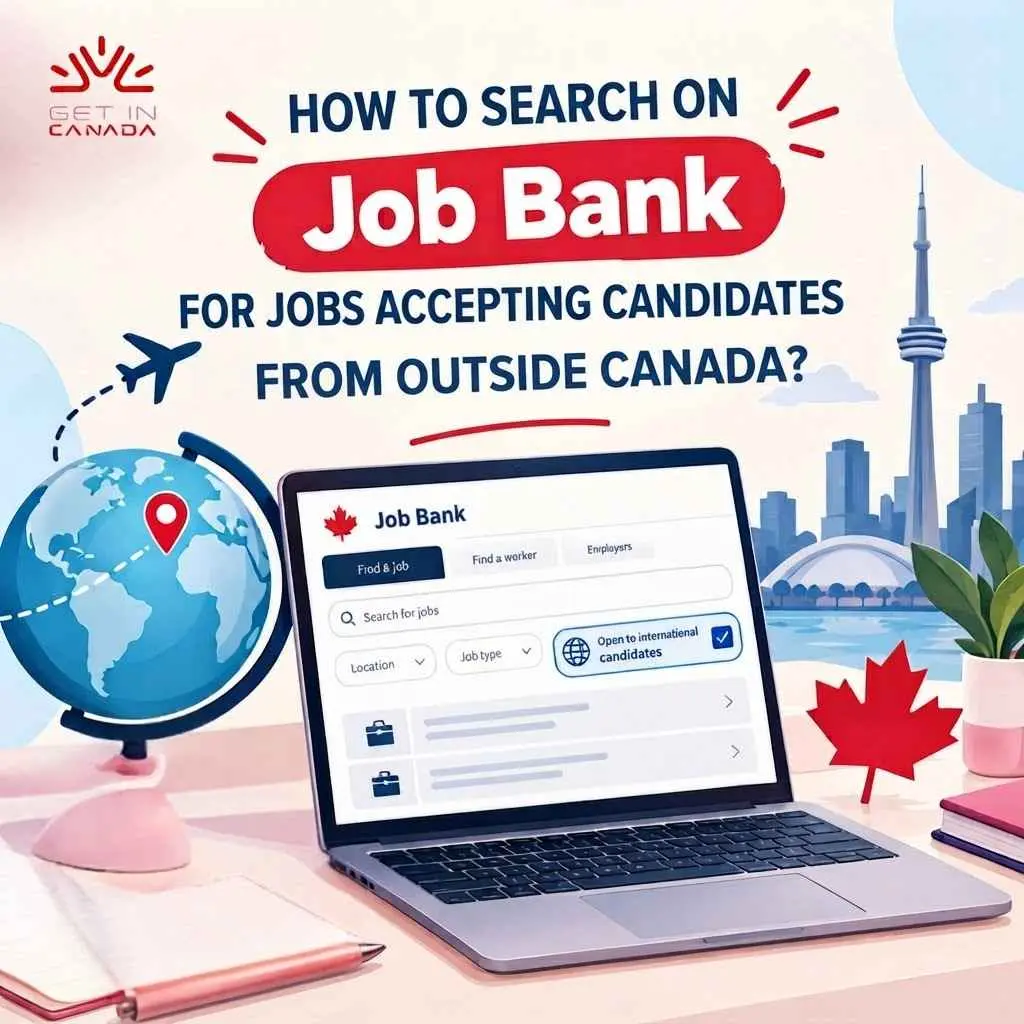
- Job Bank for Foreign Candidates: Filter postings on the official government Canada Job Bank using the “Candidates outside Canada” toggle to see verified, open-access listings.
- Targeted LinkedIn Sourcing: Search for technical recruiters using key phrases such as “Visa Sponsorship Available,” “LMIA Supported,” or “Global Talent Stream.”
- Provincial International Recruitment Events: Monitor international virtual job fairs organized by provinces like New Brunswick, Saskatchewan, and Quebec designed specifically to hire overseas workers.
- Global Talent Stream (GTS) Employers: Target designated innovative tech firms that benefit from expedited two-week LMIA and work permit processing.
Book Your Consultation Session →
Also read about:
Canada Opens Work Permits and Status Extensions for Palestinians
What’s Next for Canada’s EMPP?
What Must Applicants for Immigration to Canada Do Before These Deadlines?
5. Tailor Your Application
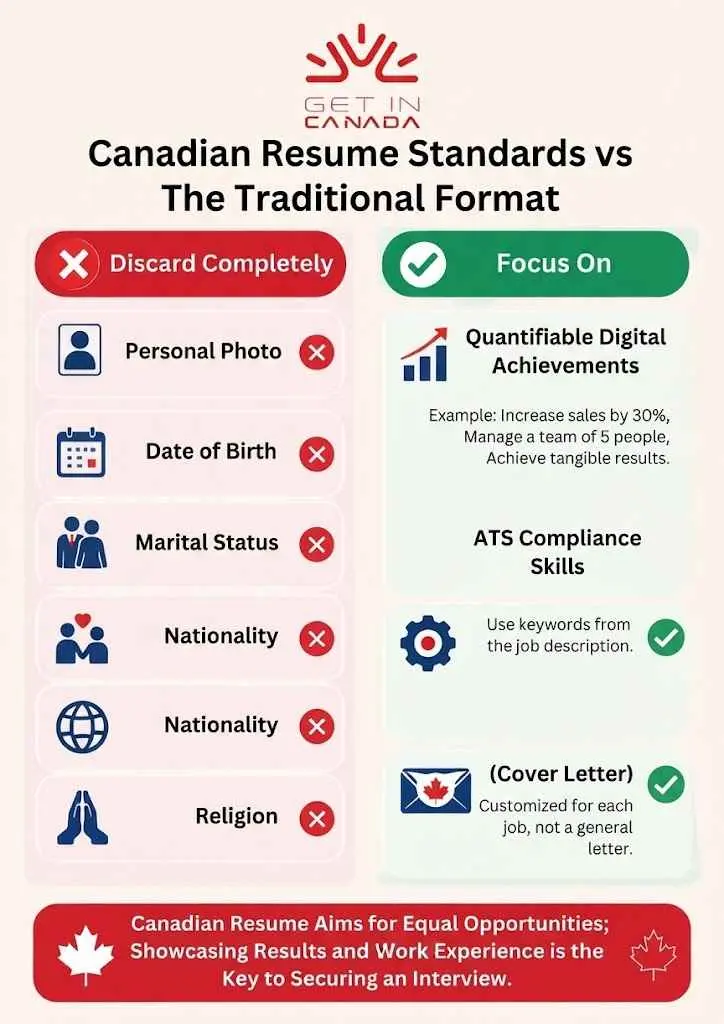
Canadian recruitment norms differ significantly from international CV conventions. Submitting a multi-page, biographical CV complete with personal details will get your application discarded immediately by human resources departments bound by Canadian human rights and anti-discrimination laws.
Your application must strictly adhere to the Canadian resume format: clean, achievement-driven, concise, and optimized for Applicant Tracking Systems (ATS).
- Eliminate Personal Demographics: Remove your photograph, date of birth, marital status, nationality, and gender. These details violate Canadian anti-bias hiring protocols.
- Frame Achievements With Metrics: Replace passive lists of duties with measurable business outcomes (e.g., “Reduced deployment downtime by 34%” instead of “Responsible for system maintenance”).
- Targeted Cover Letters: Write a focused, one-page value proposition explaining why the employer’s specific operational challenges match your overseas skill set.
- ATS Optimization: Match your resume’s skill headers and summary bullet points directly with the technical keywords used in the job description.
6. Job Offer and LMIA
A verbal agreement or informal email from a Canadian manager does not constitute legal authorization to relocate. To initiate the immigration pipeline, you need a formalized employment contract backed by an approved Labour Market Impact Assessment (LMIA) issued by Employment and Social Development Canada (ESDC).
The LMIA is an extensive audit verifying that hiring an international worker will have a neutral or positive effect on the Canadian labor market.
- Formal Employment Contract: A comprehensive document specifying hours, duties, working conditions, and an hourly wage that matches or exceeds the prevailing regional median for your NOC.
- The Employer’s Responsibility: The employer must submit the LMIA application, pay the $1,000 CAD government processing fee, and provide proof of local recruitment efforts.
- Zero Cost to Candidates: Canadian federal law strictly prohibits employers or third-party recruiters from charging candidates for an LMIA, job offer, or placement.
- LMIA-Exempt Pathways: Check if your role qualifies under International Mobility Program (IMP) codes, intra-company transfers, or bilateral international trade agreements that bypass the LMIA process.
Book Your Consultation Session →
7. Apply for a Work Permit
Once your employer delivers the positive LMIA decision letter and signed employment agreement, the legal focus shifts directly to your individual admissibility. You must submit a closed (employer-specific) work permit application via your IRCC online portal from your country of residence.
Canadian visa officers evaluate your personal background to verify that you are qualified for the specific job and that you meet all national security and public health criteria.
- Digital Application Submission: Assemble your portal file with the LMIA approval letter, formal job offer, valid passport, and proof of occupational qualifications.
- Medical Examinations: Complete an upfront or requested immigration medical exam with an IRCC-approved Panel Physician.
- Police Clearance Certificates: Provide clean criminal background checks from every country where you have lived for six consecutive months or longer since turning 18.
- Biometrics Collection: Book an appointment at your nearest Visa Application Centre (VAC) to submit fingerprints and digital photos.
8. Who Has a Realistic Chance?
Navigating this process successfully requires realistic positioning. Canadian employers typically absorb the administrative overhead and financial costs of foreign hiring only when domestic talent shortages leave them no alternative.
Your probability of securing an offer increases dramatically if your profession falls within sectors designated by provincial and federal governments as critical shortage zones.
- Skilled Trades Professionals: Industrial electricians, heavy equipment mechanics, welders, plumbers, and long-haul commercial drivers.
- Healthcare Practitioners: Specialized registered nurses, family physicians, continuing care assistants, and clinical technicians.
- Engineering & Technology Specialists: DevOps architects, enterprise software engineers, cybersecurity specialists, and data scientists.
- Bilingual Professionals: Candidates with demonstrated high proficiency in both English and French who can work seamlessly across multi-provincial teams.
9. Common Mistakes
Many international job seekers derail their prospects by falling victim to unauthorized schemes or using ineffective application strategies. Navigating the Canadian system requires absolute compliance and vigilance against fraudulent practices.
Avoiding these critical pitfalls protects both your finances and your long-term admissibility to Canada.
- Paying for Job Offers: Purchasing an LMIA or paying a placement fee to an agency is illegal under Canadian federal law and will result in an immediate five-year ban for misrepresentation.
- Mass Generic Submissions: Submitting hundreds of generic, uncustomized resumes through automated software triggers immediate ATS rejections.
- Underestimating Credential Alignment: Applying for regulated roles (such as nursing or civil engineering) without researching the provincial licensing board requirements first.
- Falsifying Experience: Embellishing employment dates or submitting non-verifiable work references will permanently compromise your background check with IRCC.
Book Your Consultation Session →
10. When to Seek Professional Advice
While self-directed applicants routinely manage the process successfully, international recruitment and immigration laws carry significant legal complexities. If your background involves non-traditional credentials, past refusals, or unique corporate structures, professional legal counsel can mitigate costly procedural errors.
If you choose to retain representation, Canadian law mandates working exclusively with authorized practitioners.
- Complex Case Profiles: Strategic counsel is vital if you have prior visa refusals, extensive international travel histories requiring complex clearances, or corporate transfers.
- Employer Representation: Companies unfamiliar with ESDC audits often require counsel to ensure LMIA advertising and wage compliance.
- Verify Licensing Credentials: Ensure your representative is a registered Regulated Canadian Immigration Consultant (RCIC) in good standing with the College of Immigration and Citizenship Consultants (CICC), or a lawyer licensed by a Canadian provincial bar association.
FAQs
Book Your Consultation Session →
Taking the Next Step
Navigating the Canadian job market from abroad demands a calculated approach: building an ATS-compliant resume, targeting employers actively seeking foreign talent, and securing an LMIA-compliant job offer.
If you want to ensure your profile aligns with Canadian immigration requirements, need an employment contract vetted, or have questions about work permit processing, book a consultation with a licensed Regulated Canadian Immigration Consultant (RCIC). Getting professional guidance early protects your time, safeguards your investment, and keeps your journey to Canada on solid legal ground.