The Complete Guide of Immigration to Canada from the Middle East in 2026
Canada remains one of the most attractive destinations for skilled professionals, families, and international graduates looking for long-term opportunities and permanent residence. For applicants living in the Middle East, however, choosing the right immigration pathway in 2026 requires more than simply meeting general eligibility requirements.
Canada’s immigration system is increasingly focused on labour-market needs, French-language immigration, Canadian work experience, regional immigration, and occupations facing shortages. This guide explains the main ways to immigrate to Canada from the Middle East in 2026, including federal programs, provincial pathways, Quebec, costs, proof of funds, documents, expected timelines, and common mistakes to avoid.
1. Which Pathway Should You Use to Immigrate to Canada in 2026?
The best Canadian immigration pathway depends on your age, education, work experience, language skills, occupation, family situation, and whether you have Canadian work or study experience. There is no single immigration program that is suitable for every applicant from the Middle East.
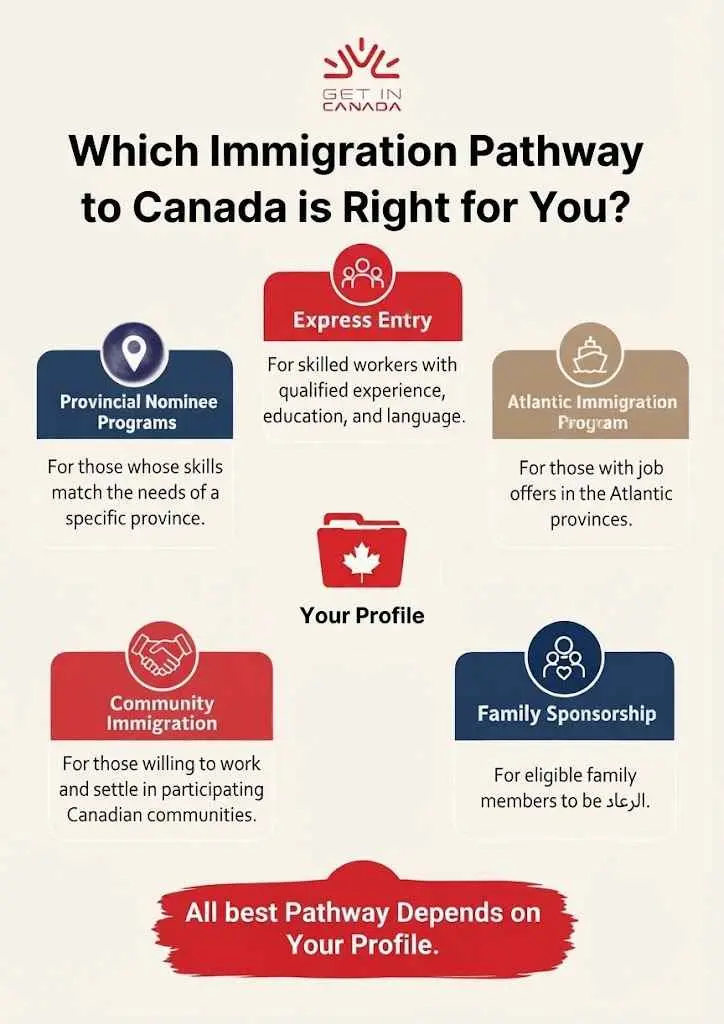
For most skilled applicants living outside Canada, the main pathways to consider are:
- Express Entry, including the Federal Skilled Worker Program, Federal Skilled Trades Program, and Canadian Experience Class.
- Provincial Nominee Programs (PNPs) for applicants whose skills match the needs of a particular province or territory.
- Quebec immigration programs for applicants who intend to settle in Quebec.
- Atlantic Immigration Program, which connects eligible skilled workers with designated employers in Atlantic Canada.
- Community immigration pathways, including the Rural Community Immigration Pilot and Francophone Community Immigration Pilot.
- Family sponsorship, where an eligible Canadian citizen or permanent resident can sponsor certain family members.
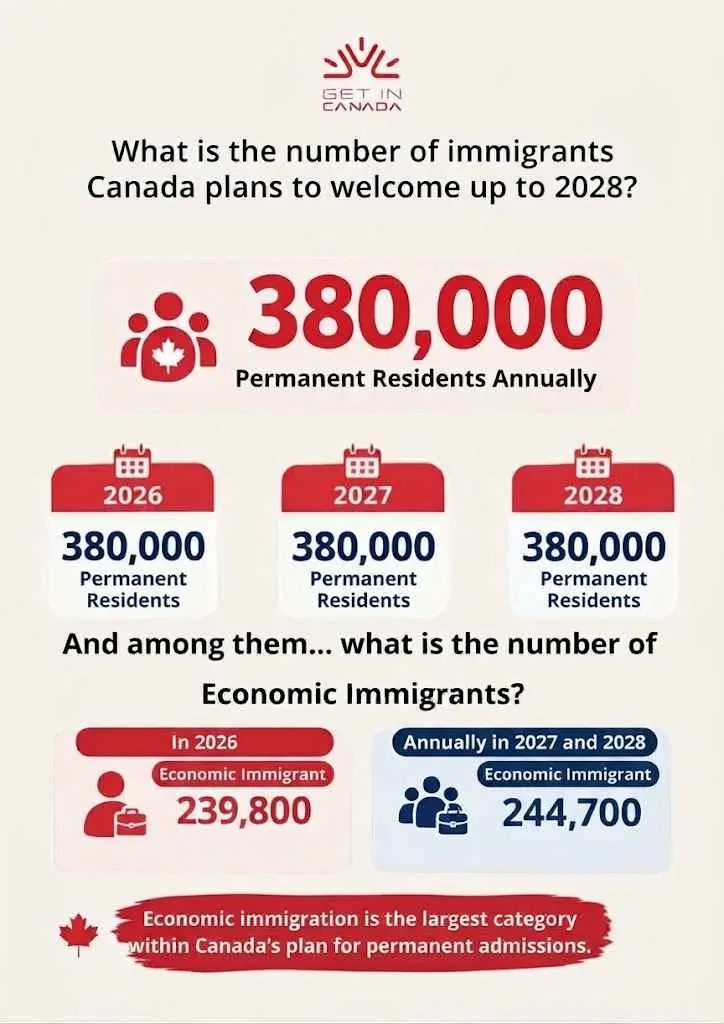
The 2026–2028 Immigration Levels Plan gives a particularly strong role to economic immigration. Canada plans to admit 239,800 economic immigrants in 2026, rising to 244,700 in both 2027 and 2028.
Express Entry
Express Entry is the main federal system for managing applications from skilled workers. It manages three programs:
- Federal Skilled Worker Program
- Federal Skilled Trades Program
- Canadian Experience Class
Applicants who qualify enter the Express Entry pool and receive a Comprehensive Ranking System (CRS) score. Candidates are then ranked against others in the pool and invited to apply through different types of invitation rounds.
For applicants outside Canada, the Federal Skilled Worker Program is often an important starting point because it is specifically designed for skilled workers with foreign work experience.
Provincial Nominee Programs
A Provincial Nominee Program may be particularly useful if your occupation, work experience, language skills, or job offer aligns with the needs of a particular province.
Canada’s PNP operates across provinces and territories, except Quebec and Nunavut. Some PNP streams are connected to Express Entry, while others operate outside the Express Entry system.
Quebec
Quebec has its own immigration selection system under the Canada–Quebec Accord. If Quebec is your intended destination, you should assess Quebec’s immigration requirements separately rather than assuming that the same pathway used for the rest of Canada will apply.
Book Your Consultation Session →
2. What Do the 2026–2028 Immigration Levels Mean for Applicants?
Canada’s 2026–2028 Immigration Levels Plan provides a useful picture of the country’s current immigration priorities. It stabilizes permanent resident admissions at 380,000 per year, while reducing the planned number of new temporary residents compared with previous years.
Canada’s immigration targets
| Category | 2026 | 2027 | 2028 |
|---|---|---|---|
| Permanent residents | 380,000 | 380,000 | 380,000 |
| Economic immigration | 239,800 | 244,700 | 244,700 |
| Family reunification | 84,000 | 81,000 | 81,000 |
| Temporary resident arrivals | 385,000 | 370,000 | 370,000 |
The economic category represents the largest share of planned permanent resident admissions. The plan also targets 9% French-speaking permanent resident admissions outside Quebec in 2026, increasing to 10.5% by 2028.
What is changing in Express Entry in 2026?
Canada is placing significant emphasis on candidates with skills and experience connected to current economic priorities.
The 2026 Express Entry categories include:
- French-language proficiency
- Healthcare and social services
- STEM occupations
- Trade occupations
- Education occupations
- Transport occupations
- Physicians with Canadian work experience
- Researchers with Canadian work experience
- Senior managers with Canadian work experience
- Skilled military recruits
For the renewed occupation-based categories, the required work experience has increased to at least 12 months in an eligible occupation within the previous three years.
3. Which Canadian Immigration Pathway Is Best for You?
Choosing the right pathway should start with your profile, not with a search for the “easiest” immigration program. A pathway that works well for a healthcare professional may be completely unsuitable for an engineer, teacher, skilled tradesperson, or business professional.
Here is a practical starting point:
| Your profile | Pathway worth exploring |
|---|---|
| Skilled worker with foreign experience | Federal Skilled Worker Program |
| Skilled worker with Canadian experience | Canadian Experience Class |
| Eligible skilled tradesperson | Federal Skilled Trades Program |
| Candidate with a provincial job offer or strong provincial connection | Provincial Nominee Program |
| Candidate with strong French | Express Entry French-language category and other French-speaking pathways |
| Worker with an eligible Atlantic job offer | Atlantic Immigration Program |
| Candidate willing to settle in a participating rural or Francophone community | Community immigration pathways |
| Applicant with an eligible family member in Canada | Family sponsorship |
| Applicant intending to settle in Quebec | Quebec immigration pathways |
For applicants living in the Middle East
Applicants from Saudi Arabia, the United Arab Emirates, Qatar, Kuwait, Bahrain, Oman, Jordan, Egypt, and other Middle Eastern countries generally follow the same federal immigration rules as applicants from other countries.
What changes from one applicant to another is the strength and structure of the individual profile.
For example, a 29-year-old professional with a master’s degree, strong English, several years of skilled work experience, and strong French may have very different options from a 42-year-old applicant with the same occupation but weaker language scores.
The key is therefore to evaluate:
- Age
- Education
- Work experience
- English proficiency
- French proficiency
- Occupation
- Marital status
- Canadian experience
- Provincial connections
- Job offer
- Available settlement funds
Book Your Consultation Session →
4. What Are the Main Requirements to Immigrate to Canada?
Canadian immigration requirements vary by program, but economic immigration applications commonly assess education, language ability, work experience, age, and admissibility.
For Express Entry applicants, the exact requirements depend on the program they qualify for.
Language requirements
Language ability can significantly affect both eligibility and CRS ranking.
Applicants may need an approved English or French language test, depending on their pathway. Strong results can improve eligibility and ranking, while French proficiency can also open additional opportunities through Canada’s French-language immigration priorities.
For the French-language Express Entry category, candidates generally need French results equivalent to NCLC 7 or higher in all four abilities and must also meet the requirements of the relevant Express Entry round.
Education
Foreign education may need to be assessed through an Educational Credential Assessment (ECA) when required by the immigration program.
The assessment confirms how a foreign qualification compares with Canadian educational standards and can also be relevant to Express Entry eligibility and CRS points.
Work experience
Your work experience must meet the requirements of the program you are applying through.
It is particularly important to distinguish between:
- Your job title
- Your actual duties
- Your National Occupational Classification (NOC) occupation
- The period and number of hours worked
- Whether the work was paid and authorized
Simply having a job title that sounds similar to an eligible occupation is not enough. Your actual work duties need to align with the applicable occupational requirements.
Age
Age can affect your CRS score. Younger applicants generally receive more CRS points for age, with the highest age score available to candidates aged 20 to 29.
This does not mean older applicants cannot immigrate. It means that they may need to compensate through other factors, such as higher language scores, education, Canadian experience, French proficiency, or a provincial nomination.
Medical and security admissibility
Applicants and accompanying family members may also need to complete medical examinations and provide police certificates or other documentation as required.
5. Can You Immigrate to Canada Without a Job Offer?
Yes. A Canadian job offer is not required for every immigration pathway, this is particularly important for applicants in the Middle East who assume they must first find a Canadian employer before they can start an immigration application.
For example, a valid job offer is not a mandatory requirement for the Federal Skilled Worker Program. Other pathways, however, may specifically require a qualifying job offer or give preference to candidates who have one.
A job offer can still be valuable because it may:
- Support eligibility for certain immigration streams.
- Help with some provincial programs.
- Provide a pathway through employer-driven immigration programs.
- Make certain regional pathways available.
However, applicants should be careful with anyone promising a “guaranteed Canadian job offer” in exchange for a large payment. A job offer should be genuine, verifiable, and connected to a legitimate employer.
Book Your Consultation Session →
6. How Much Does It Cost to Immigrate to Canada?
The cost of immigrating to Canada depends on the program, the number of family members, and the additional services required to prepare the application. Government fees are only one part of the total cost.
Common expenses include:
- Immigration application fees
- Right of Permanent Residence Fee
- Biometrics
- Language testing
- Educational Credential Assessment
- Medical examination
- Police certificates
- Document translation
- Settlement funds, where required
- Travel and initial settlement costs
As of April 30, 2026, IRCC increased several permanent residence fees. For Federal High Skilled, Provincial Nominee, Quebec Skilled Workers, Atlantic Immigration and most economic pilot applications, the principal applicant processing fee is CAD $990. The Right of Permanent Residence Fee for a principal applicant or accompanying spouse/common-law partner is CAD $600.
These are government fees and should not be confused with the amount you may need to demonstrate as settlement funds.
Proof of funds
Some Express Entry applicants must prove that they have enough money to support themselves and their family after arriving in Canada.
The current minimum amounts include:
| Family size | Required funds |
|---|---|
| 1 | CAD $15,263 |
| 2 | CAD $19,001 |
| 3 | CAD $23,360 |
| 4 | CAD $28,362 |
| 5 | CAD $32,168 |
| 6 | CAD $36,280 |
| 7 | CAD $40,392 |
| Each additional person | CAD $4,112 |
These amounts are based on the family size included in the application. Certain applicants, including those applying under the Canadian Experience Class or those with a valid job offer and authorization to work in Canada, may be exempt from the proof-of-funds requirement under IRCC rules.
Book Your Consultation Session →
7. What Documents Do You Need to Immigrate to Canada?
Preparing documents early can make the immigration process significantly easier, especially for applicants who have lived or worked in more than one Middle Eastern country.
The exact document checklist depends on the immigration program, but applicants may need:
- Valid passport
- Birth certificate
- Marriage or divorce documents, where applicable
- Educational certificates and transcripts
- Educational Credential Assessment
- Approved language test results
- Employment reference letters
- Proof of work experience
- Police certificates
- Medical examination results
- Proof of funds, if required
- Provincial nomination certificate, if applicable
- Valid job offer documents, if applicable
- Documents for accompanying family members
- Certified translations where required
Additional consideration for Middle Eastern applicants
If you have worked or lived in several countries, you may need police certificates or supporting documentation from more than one jurisdiction.
It is also important to keep employment information consistent across your:
- CV
- Employment letters
- Immigration forms
- LinkedIn profile, where relevant
- Tax or salary records
- Supporting documentation
Differences in employment dates, job titles, or duties do not automatically mean an application will be refused, but unexplained inconsistencies can lead to additional questions or document requests.
8. How Long Does Canadian Immigration Take?
There is no single processing time for all Canadian immigration applications. The timeline depends on the pathway, application completeness, inventory levels, security checks, and the applicant’s circumstances.
IRCC’s processing-time tool is the best place to check the current estimate for your specific application because these figures can change.
For example, IRCC data published in 2026 showed different expected timelines for Federal Skilled Worker, Canadian Experience Class, and Provincial Nominee applications, illustrating why applicants should not rely on a single “Canada immigration processing time.”
Indicative pathway timeline
The time required before submitting the permanent residence application can vary significantly. For example, an applicant who already has a language test and ECA may be ready to create an Express Entry profile relatively quickly, while another applicant may need several months to prepare the required documents.
A practical immigration timeline may look like this:
Profile assessment → language test → ECA → Express Entry or provincial profile → invitation/nomination → permanent residence application → biometrics and medical examination → IRCC processing → final decision
Once an applicant receives an invitation through Express Entry, they generally have 60 days to submit the permanent residence application.
For this reason, it is better to prepare the major documents before receiving an invitation rather than starting from zero afterward.
Book Your Consultation Session →
9. What Are the Most Common Mistakes That Lead to Refusal?
A strong immigration profile can still encounter problems if the application contains inaccurate, incomplete, or inconsistent information.
Common reasons for Canadian immigration refusal include:
- Providing incomplete or inaccurate information.
- Submitting incorrect or missing documents.
- Failing to meet the program’s eligibility requirements.
- Providing insufficient proof of funds when required.
- Inconsistent information across applications or supporting documents.
- Failing to disclose relevant immigration or criminal history.
- Not meeting medical or admissibility requirements.
- Missing deadlines or failing to follow IRCC instructions.
FAQs
Book Your Consultation Session →
Final Thoughts: Is 2026 a Good Time to Immigrate to Canada?
Immigrating to Canada in 2026 remains a realistic opportunity for candidates who meet the requirements and choose the right pathway. With programs such as Express Entry, Provincial Nominee Programs, family sponsorship, and other immigration streams, there are several options depending on your background and goals.
The key is not simply choosing Canada, but choosing the right immigration pathway for your profile. Start by assessing your eligibility, understanding the requirements, and preparing your application carefully to improve your chances of success.